What Does Career Pathway Mean? Explained in Easy Terms
Employment
Bonica
March 18, 2025
Does thinking about your career make you confused about what to do? You’re not alone! Lots of people have trouble figuring out their careers when terms like career pathways are used without a clear explanation.
A career pathway is the path you follow to achieve your professional goals. It’s about creating a plan that helps you grow and learn over time. Think of it as your career’s GPS that shows you the way with twists and turns.
Having a clear career pathway gives you direction. It helps you make decisions and stay focused even when challenges come along.
A clear path forward gives you confidence and helps you discover opportunities you might have missed.
Career paths are different depending on your industry and your own situation. Keep in mind that career paths are becoming less and less linear. Professionals switch industries or even start their own businesses these days.
Your career pathway is a reflection of your skills and passions. It’s something you shape and reshape as you grow.
Table of Contents
Key Takeaways
- A career pathway is your personalized map to professional growth! It combines skills and experience to help you achieve success.
- A universal approach is not applicable in this context! Career pathways change depending on your interests and circumstances.
- Research and goal-setting are essential steps to building a career pathway.
- Flexibility is key! Learning from setbacks and staying open to new opportunities are crucial for career satisfaction.
- Your career pathway is unique to you! Take the first step and trust that every effort brings you closer to your goals.
What is a Career Pathway?

A job is a specific role you take on to earn a living. It’s focused on immediate tasks. A career is the broader story. It’s the collection of experiences and achievements that define your work over time. A career pathway is the strategy that connects these elements.
It’s the path you create to move from where you are now to where you want to be.
A worker in a retail job sees it as just a way to pay the bills. One using that job to build customer service skills is already starting to think about their career pathway.
Most career pathways include a few key components. Skills are the abilities you develop through training and experience. They can be technical or soft skills. Certifications or training programs also play a role in career pathways.
Hands-on experience helps you apply your skills and build a track record.
Networking is another component. Building relationships with mentors and peers opens doors to new opportunities as well.
A career pathway evolves as your interests change. You find a new passion in one industry and then switch to a completely different career. That’s the beauty of a career pathway.
Types of Career Pathways

Everyone’s career is unique as it’s shaped by their life circumstances. Different career pathways have emerged over time.
Linear Career Pathway
The linear career pathway is the type of career most people imagine when they think of a typical career. It’s straightforward! It’s a gradual progression in a single field.
One starts as an intern and moves up to an entry-level position. Gradually earns promotions to senior roles and eventually retires as a top executive. This pathway is common in education and corporate environments where hierarchy exists.
One of the biggest advantages of a linear pathway is its predictability. You know what steps to take and what skills to develop.
Non-Linear Pathway

It is all about flexibility and exploration. This type of pathway involves switching industries or even career fields entirely.
One starts in marketing and transitions to project management. Gradually they move into a leadership role in a completely different sector.
They’re ideal for people who enjoy learning new skills and adapting to different environments.
It feels uncertain at times, but it often leads to a richer career. It’s also a good choice for people who find new passions or want to change careers after working in a different field.
Portfolio Pathway
This one is perfect for those who don’t want to be tied down to a single job. People with portfolio careers combine multiple part-time jobs and freelance gigs.
One works as a graphic designer and teaches art classes on the weekends but they sell their own artwork online as well.
This pathway is popular among professionals who love autonomy. This lets you earn money in different ways and explore various interests. It requires strong time management skills and the ability to handle many different tasks.
Entrepreneurial Career Pathway

This path offers endless possibilities if you have a big vision and want to be your own boss.
This pathway involves creating a product or service that fills a gap in the market. Entrepreneurs handle many different tasks.
The entrepreneurial pathway requires a willingness to take risks. But the rewards are immense! It’s ideal for people who are passionate about turning their ideas into reality.
The Hybrid Pathway
This approach combines traditional and modern career paths. It allows individuals to mix their passions with their professions. Someone can have a full-time tech job and pursue photography on the side.
The hybrid pathway allows you to enjoy the stability of a traditional career while going for your entrepreneurial interests on the side. It’s attractive to millennials and Gen Z as they look for purpose in their careers.
The hybrid pathways give you the chance to test new ideas without giving up your main source of income. It’s also a great way to build a diverse skill set. You need careful planning to avoid burnout.
Steps to Build Your Career Pathway

Building a career pathway requires a strong starting point and the flexibility to adjust as you go.
See Where You Stand
You need to know where you’re starting from. Take stock of your current education and experience. Are there any gaps in your knowledge?
Your starting point includes your degree and internships along with any part-time jobs you’ve held. Those who have been in their careers longer have years of experience and a network of professional contacts.
Understanding your starting point helps you set goals and take the steps you need to move forward. It’s also a great opportunity to celebrate how far you’ve already come.
Set Achievable Goals

It’s time to decide where you want to go. Goals give you a way to measure your progress.
Start by thinking about your short-term goals. These smaller steps will help you keep moving forward. A short-term goal for someone interested in a career in data analysis is only completing a certification in Python.
Consider your long-term goals afterward. Where do you want to be in five or ten years? These goals help you feel more purposeful.
It’s okay to adjust your goals or even change them entirely as you gain experience. You should have a plan that keeps you moving forward.
Learn Necessary Skills
You should acquire the skills you need to achieve them. Online courses and on-the-job training help a lot.
Learning about social media advertising and analytics tools is needed If you’re aiming for a career in digital marketing. You won’t be successful without these skills.
Don’t be afraid to invest in your education and skill development. These investments pay off in the form of better job opportunities and higher salaries.
Learning new skills is easier than ever with all the online resources.
Gain Relevant Experience

Nothing beats hands-on experience. You should always look for opportunities like internships and volunteer work.
These experiences help you build your resume and give you a chance to test different roles.
Want to do event planning? Try organizing a local fundraiser or interning with a wedding planner.
It is still valuable even if the experience isn’t exactly what you wanted. Every role teaches you something new.
Network
Start by connecting with people in your desired field through industry events. You can use tools like Uniqode Digital Business Card to easily share your contact details during these events.
Don’t be afraid to reach out to people you admire and ask for advice. Many professionals are happy to share their experiences.
Find a mentor who gives you ongoing support and encouragement as you build your career.
Offer to help others when you can and stay in touch with your contacts over time.
Adapt as Needed
Your career pathway is likely to include unexpected twists and turns. That’s why flexibility is so important. Be open to new opportunities and willing to learn.
You will find a new passion and face a change in your personal life or even shifts in your industry. View them all as opportunities to grow instead of obstacles.
A Quora Rundown
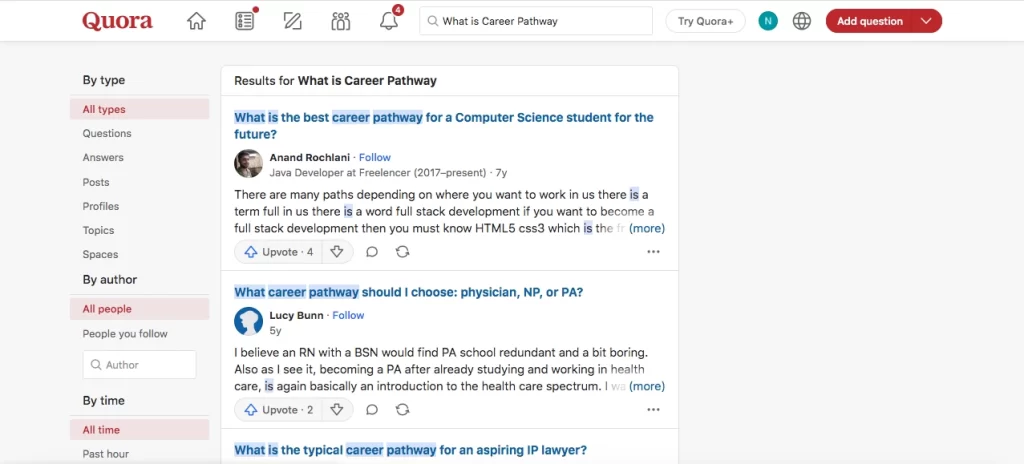
It helps to hear from people who have gone through it. Quora users have many personal stories and expert advice on choosing and growing in a career.
The Role of Background and Resources
Milind Hasabnis discusses the impact of family background and financial stability.
He explains choosing a career path is challenging for those from less privileged backgrounds due to limited resources.
“If your father and mother are not educated, then choosing a career path is very difficult,” he writes. “Financial support is required, and discussing with educated people around you can help.”
People from financially stable families have the luxury of exploring their interests more freely. As Milind puts it, “If you’re from an educated family, it depends on your interests.”
Changing Career Paths

Jordan Harbinger is the host of The Jordan Harbinger Show. He has a really interesting take on how work is changing these days.
He argues that changing career paths is becoming necessary. “There’s a shift in Western work culture going on right now,” he explains. “We can either be prepared to make a pivot on our own terms or be surprised when one is forced upon us by circumstances beyond our control.”
Jordan stresses the importance of adaptability. He encourages people to always keep learning and trying new things. “If you’re constantly in a mindset of learning and experimenting,” he says, “the pivot points aren’t so jarring.”
Self-Discovery and Mentorship
Shiva Sen is a former career advice seeker. She discusses the impact of self-awareness and mentorship. “Mostly, confusion about career paths happens due to a lack of awareness and knowledge about what is best for you,” he writes.
Pre-Med to Professional Writer
Sebastian Robinson’s story shows the unpredictability of career pathways.
Sebastian’s dream of becoming a doctor was derailed by his struggles with chemistry.
He switched to philosophy and finally found his calling as a professional writer.
The Midlife Career Change

Kostas Tsicoulias is a life coach. He offers a powerful reminder that it’s never too late to change your career path. “You can change your career path any time you wish,” he writes. “Doing something you love for a living is the only thing that makes sense.”
Kostas encourages others to prioritize happiness over financial security. He believes that finding your true calling is worth the effort.
The Freedom to Change
Dipankar Mukherjee is a journalist. He shares his own experience of changing career paths multiple times. “I wanted to be a physics professor but later opted to be in media and now work as a journalist, happily,” he writes.
Dipankar’s story shows how career choices evolve. His advice? “Do what you like, and even if you make mistakes, you still have lots of time to improve them.”
Burnout and the Search for Fulfillment
Edward Zuckerberg’s story shows burnout is another reason for changing career paths.
Edward found himself completely burnt out on programming after earning a degree in computer science. He spent years searching for other roles in tech before finding his passion for technical writing.
The Challenge of Choosing a Career Path

Nicolas Piwowarow agrees with how difficult it is to choose a career path. “It is hard because it’s a very personal question that no one can answer for you.”
He suggests a systematic way to plan your career. He believes in thinking about yourself and assessing your own skills before anything.
Conclusion
Your career pathway is about creating a fulfilling professional life that fits your skills and passions.
We’ve explored what career pathways are and why they matter. You should stay motivated on your own unique path.
Knowing your career pathway gives you clarity and direction. It helps you focus even when challenges arise. Having a plan in place makes all the difference.
Your career is dynamic and evolves over time.
Hire the best candidates
with Wetest.
Create pre-employment assessments in minutes to screen candidates, save time, and hire the best talent.
Try for free