
How to Write Self-Appraisal Comments: Employee Examples for Performance Reviews
Uncategorized
Bonica
August 8, 2025
Self-appraisal is basically your shot to say how you see your own work performance. It’s a huge part of most performance reviews, where you’re going to look at what you nailed, what was tough, and how you grew.
And get this, research says almost 90% of HR bosses think regular feedback makes employees way more engaged. So yeah, these evaluations are pretty important for your career, no joke. A lot of people struggle with writing these, though.
What do you even put in there? How do you sound pro without sounding like you’re just bragging? Some people downplay what they did, while others are scared of sounding too full of themselves.
This article is going to help you write some strong self-appraisal comments. You’ll get proven ways to do it, see actual examples, and even get templates you can use. We’ll cover different kinds of jobs and situations.
Table of Contents
Understanding Self-Appraisal: The Foundation of Effective Performance Reviews

Gain clarity on what self-appraisal entails and why it’s vital for your growth.
What is Self-Appraisal?
Self-appraisal is when you look at your own work performance over a certain period. It’s different from your manager’s evaluation because, well, it’s your perspective. This whole thing is usually part of those 360-degree feedback systems.
Those are the ones that get input from everywhere – you, your boss, your teammates, and sometimes even customers.
Benefits of Well-Written Self-Appraisal Comments
So, writing a really strong self-appraisal can help you move up in your career. It makes it easier for your manager to get what you’ve been contributing. These evaluations also make communication way better between you and your boss.
They pretty much lay the groundwork for some real, meaningful talks about your work. Plus, self-appraisals boost your self-awareness. When you write about how you’ve been doing, it helps you see what you’re good at and where you could get better.
They can even give you some leverage when you’re talking about salary. If you write down your achievements, it’s way easier to make a case for a raise or a promotion.
And finally, they help create better performance improvement plans. Your input makes sure those development goals match what you want for your career.
Common Self-Appraisal Formats
With rating scale assessments, you’re basically giving yourself a number or a term on different skills or behaviors, like maybe from 1 to 5, or saying ‘exceeds expectations.’ Then there are narrative-style evaluations, which are all about writing out descriptions of how you did. These give you way more room to explain your achievements and the tough stuff.
Goal-based reviews are where you measure how well you hit specific targets. They usually have both numerical goals and more descriptive goals.
Competency-based frameworks evaluate you against certain skills or behaviors that are important for your job, like leadership, talking to people, or technical skills.
And finally, behavioral assessment models focus on how you act in different work situations. They look at your approach to teamwork, solving problems, and making decisions.
Self-Appraisal Best Practices and Writing Principles

Learn proven techniques to structure and articulate your achievements confidently.
The STAR Method Framework
The STAR method helps you structure your examples clearly. STAR stands for Situation, Task, Action, and Result.
Start by describing the Situation you faced. Then explain the specific Task you needed to complete. Next, detail the Actions you took. Finally, share the Results you achieved.
For example: “When our client complained about slow response times (Situation), I needed to improve our customer service process (Task). I created a new tracking system and trained the team (Action). This reduced response time by 40% and improved client satisfaction scores (Result).”
Quantifying Your Impact
Using numbers just makes your achievements sound way more real and impressive. So, throw in specific metrics whenever you can. Different departments keep track of different things, right?
Sales teams might really focus on revenue or how many people they convert. Marketing teams, though, they’re probably tracking engagement or how many leads they’re generating.
And look, if you don’t have exact numbers, just describe your impact in terms of quality. Explain how your work affected your team, your department, or even your customers.
Just always be honest about your measurements. Don’t exaggerate stuff or make up stats.
Professional Tone and Language
You should find that sweet spot in your writing – be confident but also humble, you know? You want to show off your achievements without sounding unpleasant.
Use action words that show you took initiative, like ‘developed,’ ‘implemented,’ ‘led,’ and ‘improved’ – those show you were actively involved. And pick words that fit your industry and job.
Technical roles might need more specific, fancy language than, say, a general office job. Just avoid common mistakes like being too shy about your accomplishments or using super vague language. Be specific about what you did.
Evidence-Based Self-Assessment
You should back up what you’re saying with actual proof, like bringing up specific projects, emails, or even feedback someone gave you.
And if you can, throw in stuff from your coworkers or clients; positive words from them make your self-assessment stronger. Oh, and seriously, just keep records all year long to make this whole thing easier. Don’t just rely on your memory when it’s evaluation time, trust me.
A Quora Rundown
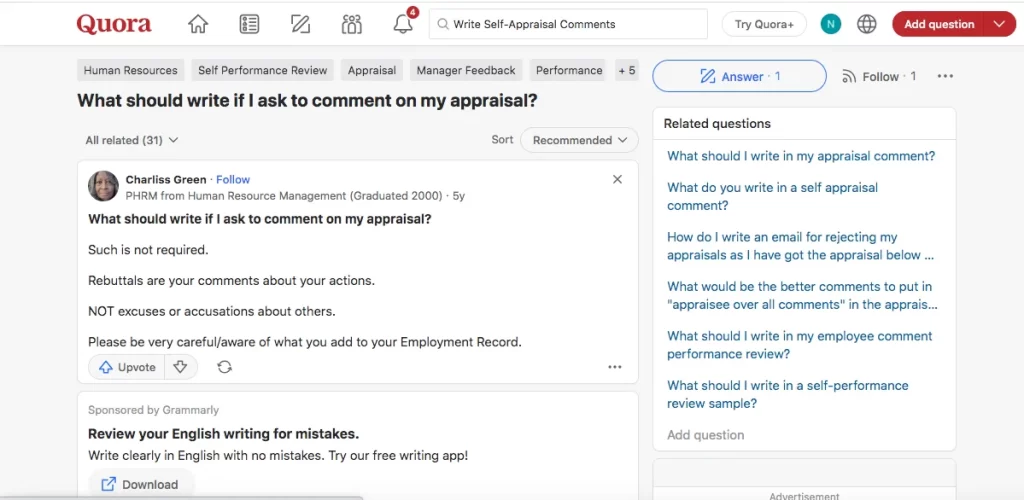
What you’ll find here is a summary of advice from Quora users, with each point quoted directly and then explored in more depth.
AI‑Assisted Drafting
Robert Zenhausern:
“List all the things you accomplished, those you failed, and those you plan, etc. Those are YOUR thoughts on job performance. Now give them to AI, who will organize your thoughts in the best way. Then go over the draft and adjust it, and ask AI to criticize it from an employers’ perspective.”
Robert Zenhausern’s recommendation shows a modern twist on self-appraisal, using artificial intelligence as a first-pass editor. By feeding unfiltered bullet points into an AI model, you can quickly generate a structured narrative. This surfaces phrasing and organization that you might overlook.
Zenhausern advises treating the AI output as a draft. Finally, asking the same tool to critique from an employer’s viewpoint offers a sanity check! Does your appraisal strike the right balance between confidence and humility?
Behavioral Metrics
Coach Jim Clark:
“Prior to assessment, specify up to 7 somewhat measurable, observable, and controllable ‘behavioral indicators’ of performance that you can track on a quarterly basis. \[…] Pin those measures to some kind of ‘unit measure’ that is directly related to either fixing mistakes or increasing success. \[…] Do not include assessment of others in your self-evaluation. Nor do you want to include measures that are directly tied to cost containment or revenue generation since those factors are largely beyond your immediate control.”
Coach Jim Clark’s advice reframes self-appraisal as a scientific experiment in self‑improvement. Rather than waiting until year‑end to tally results, he urges you to identify a handful of specific behaviors and quantify them each quarter.
Performance Journaling
Roger Austin:
“The best way to write a self-appraisal is to keep a performance diary or journal of your accomplishments during the year. \[…] If you wait until the end to gather up what you have done, you will not remember your accomplishments nor will you remember everything that was assigned to you.”
Roger Austin’s performance diary concept serves as a chronicle of your professional life in real time. When the appraisal deadline arrives, you’ll have a rich narrative to draw from, avoiding the frantic end‑of‑year scramble.
Narrative Structure and SMART Goals

Hannah Moore:
“Like any good story, it should have a beginning, a middle and an end. \[…] The middle, what didn’t go so well? \[…] The end, what would you do better next time? \[…] Another way to title it is to make it a S.M.A.R.T target. Specific. Measurable. Achievable. Realistic. Time bound.”
Hannah Moore advocates for a storytelling approach. In the “beginning,” you celebrate your highest-impact achievements, setting the stage with context and data. The “middle” acknowledges setbacks framed not as failures but as learning moments. Finally, the “end” outlines SMART goals for the next cycle.
Active Self‑Promotion
Vishnu Sajeevan:
“Always market yourself. \[…] Ensure that your manager is aware about all the work you are doing, you are not doing a free service. \[…] Save all the appreciation mails you are getting from client as well as internally. \[…] Take ownership of all the activities you do.”
In Vishnu Sajeevan’s view, self-appraisal begins long before you sit down to write. It’s an ongoing exercise in proactive visibility. By regularly sharing brief “success snapshots” with your manager, you ensure your contributions are always top of mind. Sajeevan discusses the importance of archiving every piece of positive feedback.
Realistic Appraisal Practice
Dave Denton:
“Bullet point it to whatever standard is being used. \[…] In reality you will always be working for a group of bosses who don’t understand performance evaluation and don’t care. Life is unfair. It’s not racial bias, it’s the Dilbert principle. A lot of key contributors are ignored and a lot of superficial types who play office politics get on.”
Dave Denton offers a dose of workplace realism. Align your self-appraisal format exactly with your organization’s template, whether that means bullet points, checkboxes, or narrative fields. Denton also warns that office politics and managerial blind spots can render objective achievements invisible.
Self-Appraisal Templates and Frameworks

Access practical templates to streamline and personalize your self-evaluation.
Goal-Based Evaluation Template
First off, list out all your goals from when this review period started. For each one, discuss what you achieved and give some specific examples.
Then, rate yourself on each of those goals using whatever scale your company uses, and explain why you gave yourself that rating.
Lastly, set some new goals for the next period, making sure they fit in with what your team and the whole company are trying to do.
Competency-Based Assessment Template
You should evaluate yourself against those core competencies – things like communication, teamwork, and problem-solving.
And for each one, give some really specific examples that show you’ve got that skill. Instead of just saying you’re a ‘good communicator,’ describe a time when your communication skills changed something.
Also, figure out where you have skill gaps and make a plan to work on them.
360-Degree Self-Assessment Framework
Think about all the feedback you got throughout the year from your managers, your teammates, and even customers, if it makes sense.
Then, compare what you think of your performance with what they said. Look for where everyone agrees, or where you guys see things differently.
And focus on how well you work with others and how effective your relationships are with different people you deal with.
Development-Focused Template
Write down all the learning stuff you did during this review period. That means formal training, any certifications you got, conferences you went to, and even stuff you learned on your own.
Then, explain how you used that new knowledge in your work. Show how learning something new made you better at your job.
And finally, make some specific development goals for the next period, based on what you want for your career and what the company needs.
Project-Based Evaluation Structure
List out the big projects you tackled during this review period. For each one, discuss your role, what you did, and how it all turned out.
Highlight where you worked with different teams or solved problems together. Show how you teamed up with others to get stuff done. And whenever you can, throw in some numbers to show your impact – use metrics that make sense for each project, you know?
Advanced Self-Appraisal Strategies

Elevate your narrative with storytelling, alignment, and future-focused insights.
Storytelling Techniques
Create compelling narratives that engage your reader. Use specific details and examples to bring your achievements to life.
Show growth over time by comparing your current performance to previous periods. Demonstrate continuous improvement and learning.
Connect your individual achievements to broader team or organizational success.
Aligning with Organizational Values
Review your company’s mission and values. Show how your work and behavior support these principles.
Use examples that demonstrate cultural fit and alignment with organizational priorities.
Connect your achievements to strategic business objectives whenever possible.
Future-Focused Self-Assessment
Identify skills you want to develop and explain how they align with your career goals. Show that you’re thinking about long-term growth.
Discuss opportunities you see for yourself and the organization. Demonstrate strategic thinking and initiative.
Handling Difficult Conversations
When addressing performance gaps, be honest but focus on solutions. Explain what you’ve learned and how you’re improving.
Provide context for challenges without making excuses. Take responsibility while explaining relevant circumstances.
Present specific plans for addressing areas of improvement.
Common Self-Appraisal Mistakes and How to Avoid Them
Learn to sidestep pitfalls that can undermine the impact of your self-assessment.
Vague or Generic Statements
Weak: “I’m a hard worker who gets along well with others.”
Strong: “I completed 95% of my projects ahead of schedule while maintaining strong relationships with 3 key client accounts.”
Always include specific examples and measurable outcomes when possible.
Over-Promotion or Underselling
Find the right balance between confidence and humility. Don’t exaggerate your achievements, but don’t minimize them either.
Be honest about your contributions while giving credit to team members when appropriate.
Lack of Supporting Evidence
Always back up your claims with concrete examples. Keep documentation throughout the year to support your self-assessment.
Include feedback from others when it strengthens your evaluation.
Misalignment with Role Expectations
Review your job description before writing your self-appraisal. Make sure you address the key responsibilities and expectations.
Focus on achievements that matter most to your manager and organization.
Poor Structure and Organization
Organize your thoughts logically and write clearly. Use headings or sections to make your self-appraisal easy to read.
Proofread carefully to avoid errors that could undermine your professionalism.
Comprehensive Self-Appraisal Examples by Performance Area

See real-world examples that illustrate strong self-assessment across key performance areas.
Job Performance and Achievements
“I completed all assigned projects on time and within budget this quarter. My quality control process reduced errors by 25% compared to last period. I took initiative to streamline our reporting system, saving the team 5 hours per week.”
“I exceeded my annual sales target by 15%, generating $2.3 million in revenue. My innovative approach to client presentations resulted in a 30% higher closing rate than the team average.”
Leadership and Management Skills
“I successfully led a cross-functional team of 8 people through our software migration project. We completed the transition 2 weeks ahead of schedule with zero downtime. Team feedback indicated 95% satisfaction with my leadership approach.”
“I mentored 3 junior staff members this year. Two received promotions, and all showed measurable improvement in their performance reviews. I developed a structured onboarding program now used company-wide.”
Communication and Collaboration
“I improved our department’s relationship with the IT team by establishing weekly check-ins. This reduced project delays by 40% and increased cross-team satisfaction scores.”
“My presentation to the executive team resulted in approval for our $500,000 expansion project. I also led monthly all-hands meetings that increased employee engagement survey scores by 20%.”
Professional Development and Learning
“I completed 40 hours of professional development training this year, including project management certification. I immediately applied these skills to improve our workflow efficiency by 30%.”
“I learned Python programming on my own time and automated 3 manual processes. This saved our department 15 hours per week and reduced data entry errors significantly.”
Customer Service and Relationship Building
“I maintained a 98% customer satisfaction rating while handling 50+ cases per week. My proactive communication approach reduced escalation rates by 35%.”
“I built relationships with 12 new key accounts, resulting in $800,000 in additional revenue. Client retention in my portfolio increased to 95%, above the company average of 87%.”
Self-Appraisal Examples by Job Function and Industry
Explore tailored examples for different roles and industries to spark your own ideas.
Sales and Business Development

“I exceeded my annual quota by 22%, bringing in $1.8 million in new business. I developed relationships with 5 major clients who now represent 30% of our regional revenue. My territory grew by 40% through strategic prospecting and referral programs.”
“I improved our sales pipeline by implementing a new CRM tracking system. This increased lead conversion rates by 18% and reduced sales cycle time from 90 to 65 days.”
Marketing and Communications
“My email marketing campaigns achieved a 28% open rate, significantly above the industry average of 20%. I launched our social media presence, growing followers by 300% and increasing website traffic by 45%.”
“I managed our annual conference for 500 attendees, coming in 10% under budget while achieving 95% satisfaction ratings. The event generated 150 qualified leads for our sales team.”
Operations and Project Management
“I led the implementation of our new inventory system, reducing stock discrepancies by 60% and improving order fulfillment speed by 25%. The project finished 2 weeks early and $15,000 under budget.”
“I streamlined our vendor approval process, reducing approval time from 30 to 10 days. This improvement helped us secure better pricing on 3 major contracts, saving the company $75,000 annually.”
Human Resources and Administrative

“I redesigned our interview process, reducing time-to-hire by 35% while improving new hire retention rates to 92%. I also developed an employee handbook that increased policy compliance across all departments.”
“I implemented a new benefits enrollment system that reduced processing time by 50% and eliminated paperwork errors. Employee satisfaction with HR services increased by 25% in our annual survey.”
Technical and IT Roles
“I optimized our database queries, improving system response time by 40%. I also identified and fixed security vulnerabilities that could have affected 10,000+ user accounts.”
“I automated our backup procedures, reducing manual work by 20 hours per week and improving data recovery reliability to 99.9%. I also trained 5 team members on the new system.”
Finance and Accounting
“I improved our month-end closing process, reducing completion time from 10 to 6 business days. My analysis identified $250,000 in cost savings opportunities that management approved for implementation.”
“I led our annual audit preparation, resulting in zero findings for the second consecutive year. I also developed new financial reports that improved budget tracking accuracy by 30%.”
Healthcare and Service Industries
“I maintained a 96% patient satisfaction score while managing a 15% increase in caseload. I developed a new patient education program that reduced readmission rates by 20%.”
“I implemented safety protocols that reduced workplace incidents by 45%. I also trained 25 staff members on the new procedures, achieving 100% compliance certification.”
Addressing Different Performance Scenarios

Discover how to frame achievements and challenges across varied review contexts.
Exceeding Expectations
When you’ve performed exceptionally well, provide specific examples with measurable results. Focus on how your achievements benefited the team or organization.
“I not only met my project deadlines but delivered 3 weeks early, allowing the marketing team to launch their campaign ahead of schedule. This early launch contributed to a 20% increase in quarterly sales.”
Show leadership during challenging situations. Describe how you helped others or took on additional responsibilities.
Meeting Expectations Consistently
Steady, reliable performance is valuable. Highlight your consistency and dependability.
“I maintained 100% attendance this year and consistently met all project deadlines. My reliable performance allowed team members to depend on me for critical tasks.”
Emphasize continuous improvement efforts and professional growth. Show that meeting expectations doesn’t mean standing still.
Areas for Improvement
Address challenges honestly but constructively. Explain what you learned and what you’re doing differently.
“I initially struggled with time management on the Johnson project, which caused a 1-week delay. I’ve since implemented a new scheduling system and completed my last 4 projects on time.”
Focus on your development plan and future goals. Show that you’re committed to growth.
New Role or Recent Hire Situations
Highlight your learning agility and quick wins. Show how you’ve adapted to your new environment.
“Despite being new to the team, I quickly learned our systems and processes. Within 3 months, I was contributing at full capacity and had already identified 2 process improvements.”
Career Transition and Role Changes
Demonstrate how your previous experience adds value in your new role. Show transferable skills and fresh perspectives.
“My background in customer service helped me better understand user needs in my new product development role. This insight led to 3 feature improvements that increased user satisfaction by 15%.”
Preparing for Your Self-Appraisal: A Step-by-Step Guide

Follow a structured process to collect evidence and draft compelling comments.
Pre-Writing Preparation
Gather all relevant documentation, including emails, project reports, and feedback you received. Review your job description and goals from the beginning of the period.
Collect input from colleagues and customers. Ask for specific examples of your contributions.
Organize your achievements chronologically or by category to identify patterns and growth.
Writing Process
Start with a rough draft focusing on content over perfection. Include all relevant examples and achievements.
Review and revise your draft multiple times. Look for opportunities to add specific details and quantify your impact.
Ask a trusted colleague to review your self-appraisal for clarity and completeness.
Timing and Submission
Start preparing several weeks before your deadline. Don’t wait until the last minute.
Submit your self-appraisal on time and follow up with your manager to confirm receipt.
Be prepared to discuss your self-assessment during your performance review meeting.
Conclusion
Writing effective self-appraisal comments requires preparation, honesty, and strategic thinking. Focus on specific achievements with measurable results whenever possible.
Use the STAR method to structure your examples clearly. Balance confidence with humility, and always support your claims with evidence.
Remember that self-appraisals are opportunities for career development. Use them to showcase your value while identifying areas for growth.
The templates and examples in this article are starting points. Adapt them to fit your specific role, industry, and company culture.
Approach self-appraisals as ongoing career development tools rather than one-time tasks. Keep records throughout the year to make the process easier and more comprehensive.
Regular self-reflection and honest assessment will help you grow professionally and achieve your career goals.
FAQS
Get quick answers to common questions that will refine your self-appraisal approach.
How long should my self-appraisal comments be?
Self-appraisal length varies by company format, but typically 200-500 words total. Focus on 2-4 sentences per section, prioritizing quality and specific examples over quantity. Check your organization’s guidelines for specific requirements.
What if I can’t think of significant achievements to highlight?
Focus on consistent performance, process improvements, collaboration efforts, and skill development. Consider customer feedback, peer recognition, problem-solving instances, and learning initiatives. Even small wins and steady reliability are valuable contributions.
Should I mention areas where I didn’t meet expectations?
Yes, address challenges constructively by acknowledging gaps, explaining contributing factors, and demonstrating lessons learned. Show accountability and present concrete improvement plans, turning weaknesses into development opportunities.
How do I quantify achievements in non-sales roles?
Use relevant metrics like time saved, cost reductions, efficiency gains, customer satisfaction scores, project completion rates, or quality improvements. When numbers aren’t available, describe scope, impact, and stakeholder feedback qualitatively.
Can I use the same self-appraisal comments for different review periods?
No, each evaluation should reflect the specific period’s unique achievements and growth. While frameworks and templates can be reused, content must be period-specific to demonstrate ongoing development and fresh contributions.
How do I write self-appraisals for remote work situations?
Emphasize communication skills, self-management, virtual collaboration effectiveness, and results delivery. Highlight adaptability, technology adoption, productivity maintenance, virtual leadership, and remote team building contributions.
What’s the difference between self-appraisal and performance review?
Self-appraisal is your own assessment of performance, while a performance review includes a manager’s evaluation and discussion. Self-appraisal serves as input for the broader performance review process and career development conversations.
How do I handle negative feedback in my self-evaluation?
Address concerns proactively with accountability, context, and improvement plans. Show self-awareness, a learning mindset, and concrete steps taken to address issues. Frame challenges as growth opportunities and development areas.
Should I include feedback from others in my self-appraisal?
Yes, incorporating peer feedback, customer testimonials, and stakeholder input strengthens your self-assessment credibility. Use specific quotes or examples that validate your self-perception and demonstrate 360-degree awareness.
How often should I update my self-appraisal documentation?
Maintain ongoing records throughout the year, documenting achievements, feedback, and development activities as they occur. This makes annual or periodic self-appraisals more comprehensive and accurate while reducing last-minute preparation stress.
Hire the best candidates
with Wetest.
Create pre-employment assessments in minutes to screen candidates, save time, and hire the best talent.
Try for free