
What Is a Restricted Holiday? Meaning, Rules, and Examples
Human resources
Bonica
June 10, 2025
Do restricted holidays leave you puzzled? You’re not alone! These holidays have unique rules that create confusion.
This guide offers the solution: a complete breakdown of restricted holidays—their definition, purpose, rules, and practical workplace examples.
Get the answers you need to plan your time off confidently and understand your benefits better.
Table of Contents
Understanding Restricted Holidays in the Workplace

Restricted holidays are a confusing leave category. The solution to this confusion is understanding they’re not forced days off, but rather an option for employees to observe personal, religious, or cultural events, unlike mandatory business shutdowns.
What Defines a Restricted Holiday vs. Regular Holiday
Understanding your leave options starts with knowing the difference between restricted and regular holidays. Regular (or gazetted) holidays are mandatory days off for everyone, like national celebrations.
But restricted holidays offer flexibility: they’re pre-approved days you can choose to take for personal, religious, or cultural reasons. The key is, you decide to use your own annual quota for them, unlike the universal observance of regular holidays.
The primary characteristics of restricted holidays include:
– Optional observance rather than mandatory
– Limited number available per year (typically 2-3)
– Requirement for prior application and approval
– No automatic paid leave unless specifically requested
– Culturally or religiously significant days
How do companies help you plan personal time? They usually mark restricted holidays distinctly from regular ones on their annual calendar, making it easier for employees to plan accordingly.
The Historical Background of Restricted Holiday Policies
Restricted holiday policies first came about because India needed a way to respect its incredibly diverse cultures and religions. This idea really took shape after independence, when the government saw they had to balance keeping workplaces productive with honoring India’s many different identities.
Back in the 1950s, the Indian government made the restricted holiday system official. This was their solution to having so many holidays in a country with countless religions and regional celebrations. Instead of making every single religious festival a mandatory day off (which would hit productivity hard!), the restricted holiday system offered a smart compromise.
This approach allowed:
– Recognition of various religious and cultural celebrations
– Maintenance of workplace productivity
– Respect for India’s diverse traditions
– Flexibility for employees to observe their important occasions
Over time, this system has been adopted and customized by private organizations and multinational companies operating in India, making it a standard feature of the Indian workplace.
Why Companies Implement Restricted Holiday Systems
Organizations implement restricted holiday systems for several practical reasons that benefit both the company and its employees:
Want to see how companies balance operations with employee happiness? Look no further than restricted holidays. These aren’t your typical office-shutdown days; instead, they’re optional, letting businesses keep going while still honoring personal, religious, or cultural observances.
This smart approach demonstrates genuine cultural sensitivity, respects diverse employee needs, and empowers better resource management for staffing. The result? Higher employee satisfaction and better work-life balance, all without compromising business goals. For nations like India, where holidays are plentiful, it’s a truly practical compromise that serves all.
Key Rules Governing Restricted Holidays

Understanding the rules around restricted holidays helps employees navigate these benefits effectively. Organizations typically establish clear policies to ensure fair implementation while maintaining operational efficiency.
How to Apply for Time Off on Restricted Holidays
The application process for restricted holidays follows a structured approach in most organizations:
1. Check eligibility: Verify that the holiday you want to take is listed in your company’s restricted holiday calendar for the year.
2. Submit a formal request: Most companies require employees to submit requests through their HR management system, email, or designated form.
3. Provide justification: While not always required, briefly mentioning the reason (religious observance, cultural event) can help prioritize your request.
4. Wait for approval: Your request will typically be reviewed by your immediate supervisor or the HR department based on:
– Business requirements on that day
– Number of other team members already approved for leave
– Your leave history and quota remaining
5. Receive confirmation: Once approved, you’ll receive official confirmation that can be referenced if needed.
Many companies have moved to digital systems where employees can view the restricted holiday calendar, check their remaining quota, and submit requests—all through an employee portal or HR app.
Notice Period Requirements for Restricted Holiday Requests
Timing matters significantly when requesting restricted holidays. Most organizations implement the following notice period requirements:
– Standard notice period: 1-2 weeks prior notice is typically expected for restricted holiday requests.
– Peak business periods: During high-activity periods, companies may require 3-4 weeks’ advance notice.
– Emergency exceptions: Some policies allow for shorter notice in genuine emergencies, though these are evaluated case-by-case.
– First-come, first-served basis: When multiple employees request the same restricted holiday, priority often goes to those who applied first.
– Department-specific rules: Teams with critical functions may have stricter notice requirements to ensure coverage.
The notice period serves practical purposes: it allows managers to arrange workflow coverage, redistribute responsibilities, and ensure critical operations aren’t compromised when employees are absent.
Pay and Compensation Rules for Working on Restricted Days
Compensation policies for restricted holidays vary between organizations but typically follow these general guidelines:
1. Standard compensation: If you choose not to take a restricted holiday, you receive your normal salary with no additional compensation (unlike gazetted holidays).
2. Taking the holiday: When you take an approved restricted holiday, it’s treated as paid leave deducted from your annual restricted holiday quota.
3. Working on a requested day: If you’ve requested a restricted holiday but are asked to work due to business needs:
– Some companies offer a compensatory day off
– Others provide additional payment (though this is less common)
– The specific policy should be outlined in your employment contract
4. Overtime considerations: Employees who work extended hours on restricted holidays may qualify for overtime as per standard company policy.
5. Contract employees: For contractors or temporary workers, restricted holiday policies may differ significantly from those for permanent employees.
Understanding these compensation rules helps employees make informed decisions about which restricted holidays to request and how to plan their annual leave effectively.
6 Common Examples of Restricted Holidays in India

India’s diverse culture is why many festivals and observances are restricted holidays. They truly reflect the country’s rich traditions and religious practices.
Religious Observances Typically Listed as Restricted Holidays
Religious festivals form the bulk of restricted holidays in India, spanning various faiths:
1. Hindu observances:
– Maha Shivaratri: Dedicated to Lord Shiva, typically falling in February/March
– Raksha Bandhan: Celebrating the bond between brothers and sisters
– Janmashtami: Marking Lord Krishna’s birth
– Karwa Chauth: Observed primarily by married women
2. Muslim observances:
– Muharram: The Islamic New Year
– Milad-un-Nabi: Celebrating Prophet Muhammad’s birthday
– Shab-e-Barat: Night of fortune and forgiveness
3. Christian observances:
– Good Friday (sometimes a gazetted holiday)
– Easter Monday
– Christmas Eve
4. Sikh observances:
– Guru Nanak Jayanti (sometimes a gazetted holiday)
– Guru Gobind Singh Jayanti
– Baisakhi (in some regions)
5. Buddhist observances:
– Buddha Purnima (sometimes a gazetted holiday)
– Vesak
6. Jain observances:
– Mahavir Jayanti
– Paryushana
Organizations typically select from these observances based on their employee demographics and regional considerations when creating their annual restricted holiday calendar.
Regional Festivals That Qualify as Restricted Days
Beyond pan-Indian religious observances, many regional festivals also appear as restricted holidays:
– Onam: Kerala’s harvest festival celebrated with boat races and elaborate flower arrangements
– Bihu: Assam’s agricultural festival marking seasonal transitions
– Pongal: Tamil Nadu’s four-day harvest festival
– Ganesh Chaturthi: Particularly important in Maharashtra and southern states
– Chhath Puja: Significant in Bihar, Jharkhand, and eastern UP
– Gudi Padwa/Ugadi: New Year celebrations in Maharashtra and Andhra Pradesh/Telangana
These regional festivals reflect India’s cultural diversity and allow employees to observe traditions specific to their cultural heritage, even when working far from their home regions.
How Different States Handle Festival-Based Restricted Holidays
The implementation of restricted holidays varies significantly across Indian states due to regional cultural priorities:
– West Bengal: Places greater emphasis on Durga Puja-related holidays, with some organizations offering extended breaks
– Maharashtra: Prioritizes Ganesh Chaturthi and Gudi Padwa in their restricted holiday calendar
– Kerala: Includes Onam and Vishu as important restricted or sometimes gazetted holidays
– Gujarat: Features Navratri and Uttarayan prominently in restricted holiday lists
– Tamil Nadu: Emphasizes Pongal and Tamil New Year (Puthandu)
Many multinational companies and organizations with pan-India presence customize their restricted holiday calendars by region, acknowledging local cultural significance. Some companies even offer “floating holidays” that can be used for regional festivals not on the standard restricted holiday list.
This regional customization demonstrates how the restricted holiday system adapts to India’s cultural diversity while maintaining workplace productivity.
Restricted Holidays vs. Optional Holidays: Understanding Differences

Although often used interchangeably, restricted holidays and optional holidays have distinct characteristics and implementations that affect how employees can use them.
Comparing Leave Policies and Eligibility Requirements
Restricted holidays and optional holidays differ in several fundamental ways:
Restricted Holidays:
– Pre-determined by the organization annually
– Limited to specific culturally or religiously significant days
– Typically capped at 2-3 days per year
– Must be taken on the actual day of observance
– Require prior approval based on organizational needs
Optional Holidays:
– Also known as “floating holidays” in some organizations
– Can usually be taken on any working day
– Often have a higher annual quota (3-5 days)
– Not tied to specific calendar dates or observances
– May have more flexible approval processes
Eligibility for these holidays also varies:
– Restricted holidays are typically available to all permanent employees
– Optional holidays might have probation period requirements
– Contract workers generally have different entitlements
– Some organizations pro-rate these holidays for employees joining mid-year
Understanding these distinctions helps employees strategically plan their annual leave to maximize their time off while meeting personal and cultural needs.
How Organizations Track and Manage Different Holiday Types
Companies employ various systems to administer different holiday categories effectively:
1. Digital tracking systems: Most organizations use HR software that distinguishes between:
– Gazetted/regular holidays (automatic time off)
– Restricted holidays (requiring application)
– Optional/floating holidays (employee-selected)
– Regular paid leave (vacation time)
2. Approval workflows: The approval process typically involves:
– First-level manager review
– Team capacity checks
– Automatic tracking against annual quotas
– Integration with payroll systems
3. Calendar management: Companies publish annual calendars specifying:
– Mandatory holidays when offices are closed
– Available restricted holidays employees can request
– Blackout periods when holiday requests might be limited
4. Documentation requirements: Some organizations require supporting documentation for religious observances, particularly during busy periods.
These management systems ensure transparency and fairness while helping organizations maintain operational continuity throughout the year.
Benefits and Limitations of Each Holiday Category
Both holiday types offer advantages and restrictions that employees should consider when planning their time off:
Restricted Holiday Benefits:
– Recognition of specific cultural and religious observances
– Ability to observe important personal traditions
– Protection of cultural diversity in the workplace
Restricted Holiday Limitations:
– Must be taken on specific calendar dates
– Limited annual quota
– Subject to approval based on business needs
– Cannot be carried forward to the next year
Optional Holiday Benefits:
– Greater flexibility in timing
– Not tied to specific observances
– Can sometimes be combined with weekend or other holidays
– May have less stringent approval requirements
Optional Holiday Limitations:
– May not align with specific cultural events
– Still subject to workload and staffing considerations
– Usually expire at year-end
– Sometimes have blackout periods during peak business times
Understanding these tradeoffs helps employees make strategic decisions about which type of holiday to use for different situations throughout the year.
Managing Your Annual Restricted Holiday Quota

Strategic planning of your restricted holiday quota ensures you can observe important personal occasions while meeting professional responsibilities.
Tips for Planning Your Restricted Holiday Usage
Effective management of your restricted holiday allocation requires thoughtful planning:
1. Review the annual calendar early: As soon as your company publishes the year’s restricted holiday list, identify the days that matter most to you personally or culturally.
2. Prioritize based on significance: Since most companies limit restricted holidays to 2-3 per year, rank your preferred days based on personal importance.
3. Consider combining with weekends: Strategically request restricted holidays that fall near weekends to maximize your time off without using additional leave.
4. Plan around peak work periods: Avoid requesting restricted holidays during known busy periods or project deadlines when approval may be difficult.
5. Submit requests early: Being among the first to request a particular restricted holiday increases your chances of approval before team capacity is reached.
6. Have backup options: Identify alternative dates in case your first choices aren’t approved due to business needs.
7. Check regional office policies: If your company has multiple locations, be aware that restricted holiday policies may vary by region.
This proactive approach helps ensure you can observe your most important days while maintaining positive relationships with management and colleagues.
How to Balance Personal Needs with Professional Obligations
Finding equilibrium between cultural observances and work responsibilities requires communication and compromise:
1. Transparent communication: Discuss important cultural dates with your manager early in the year rather than waiting until the last minute.
2. Propose solutions: When requesting time off during busy periods, suggest how your work can be covered or completed in advance.
3. Offer flexibility: Consider working remotely for part of the day if complete absence isn’t necessary for your observance.
4. Share the significance: Briefly explaining why a particular day matters to you personally can help managers understand its importance.
5. Distribute requests throughout the year: If possible, spread your restricted holiday requests rather than concentrating them in one period.
6. Consider partial days: For some observances, a half-day off might be sufficient and easier to accommodate.
This balanced approach demonstrates professionalism while honoring your cultural needs, making it more likely your requests will be approved.
Best Practices for Restricted Holiday Communication
Clear communication about restricted holidays builds understanding and prevents misunderstandings:
1. Document in writing: Always submit restricted holiday requests through official channels (email, HR system) even after verbal discussions.
2. Provide adequate notice: Follow company policy for advance notice—typically at least two weeks.
3. Set clear expectations: Specify exactly when you’ll be unavailable and when you’ll return.
4. Brief team members: Inform colleagues who might be affected by your absence and arrange coverage for critical tasks.
5. Set up appropriate out-of-office notifications: Include emergency contact information if necessary.
6. Follow up after approval: A brief confirmation ensures everyone is on the same page about your upcoming absence.
7. Express gratitude: Acknowledge the accommodation of your request, recognizing that it often requires adjustments from others.
These communication practices ensure your time off is respected while maintaining professional relationships and workflow continuity.
Legal Framework and Employee Rights

Understanding the legal basis for restricted holidays helps employees navigate their entitlements and protections under employment law.
What the Law Says About Restricted Holiday Entitlements
The legal framework surrounding restricted holidays in India establishes baseline requirements while allowing organizational flexibility:
1. Statutory foundation: The Negotiable Instruments Act, 1881 (as amended) establishes the framework for national and public holidays, while restricted holidays fall under company policy rather than strict legal mandate.
2. Minimum holiday requirements: The Factories Act and Shops and Establishments Acts (which vary by state) mandate a minimum number of holidays annually, but don’t specifically address restricted holidays.
3. Non-discrimination provisions: The Constitution of India and workplace equality laws protect employees’ right to observe religious practices, which indirectly supports the restricted holiday concept.
4. Employment contract governance: Most restricted holiday entitlements are defined in employment contracts and company policies rather than legislation.
5. State variations: Different states may have additional provisions regarding cultural or regional observances.
While the specific number and nature of restricted holidays aren’t typically mandated by law, the practice is widely recognized as part of standard employment benefits in India, particularly in the formal sector.
Can Employers Deny Restricted Holiday Requests?
Employers do have the legal right to deny restricted holiday requests under certain circumstances:
1. Business necessity: Companies can deny requests when operational requirements demand full staffing.
2. Advance notice requirements: Requests made without sufficient notice according to company policy can be legally denied.
3. Documentation standards: If company policy requires justification for certain restricted holidays, failure to provide this can be grounds for denial.
4. Pattern of denial: However, consistently denying restricted holidays to specific employees while approving others could potentially constitute discrimination if based on protected characteristics.
5. Reasonable accommodation: Employers are generally expected to make reasonable efforts to accommodate genuine religious observances when possible.
The key legal concept is “reasonable accommodation”—employers should attempt to grant restricted holiday requests unless doing so would cause undue hardship to business operations. What constitutes “reasonable” varies by industry, company size, and specific circumstances.
5 Important Rights You Should Know About
Employees should be aware of these key rights regarding restricted holidays:
1. Right to non-discrimination: Employers cannot deny restricted holiday requests based on an employee’s religion, caste, gender, or other protected characteristics.
2. Right to information: Employees are entitled to clear information about the company’s restricted holiday policy, including application procedures and quotas.
3. Right to reasonable religious accommodation: Companies should make reasonable efforts to accommodate genuine religious observances, though this is balanced against business needs.
4. Right to consistent policy application: Restricted holiday policies should be applied consistently across all eligible employees.
5. Right to privacy: Employees generally don’t need to provide detailed explanations about their religious practices when requesting restricted holidays for established observances.
Understanding these rights helps employees advocate for themselves when necessary while maintaining reasonable expectations about when and how restricted holidays can be taken.
Restricted Holidays Across Different Industries

The implementation of restricted holiday policies varies significantly across different sectors, reflecting the diverse operational needs and work cultures.
How Corporate Sectors Handle Restricted Holidays
The corporate sector typically takes a structured approach to restricted holidays:
1. Technology and IT services:
– Generally offer 2-3 restricted holidays annually
– Often provide digital systems for requesting and tracking leave
– May allow work-from-home options instead of complete days off
– Typically accommodate diverse religious observances due to multinational workforces
2. Banking and financial services:
– Follow stricter calendars with pre-designated restricted holidays
– Often require longer notice periods due to transaction processing needs
– May have blackout periods during financial year-end or quarterly closing
– Typically follow RBI (Reserve Bank of India) holiday guidelines as a baseline
3. Pharmaceutical and healthcare:
– Implement rotating schedules to ensure continuous operations
– Often require department-specific approval for critical roles
– May offer premium pay for working on requested restricted holidays
– Balance patient care needs with employee religious observances
4. Consulting and professional services:
– Align restricted holiday approvals with client project timelines
– Often have more flexible policies during non-peak periods
– May accommodate remote work instead of complete time off
– Sometimes allow transferable restricted holidays if client obligations prevent taking specific dates
The corporate approach generally emphasizes flexibility while maintaining operational continuity, with digital systems streamlining the request and approval process.
Public vs. Private Sector Approaches to Holiday Policies
The public and private sectors differ notably in their handling of restricted holidays:
Public Sector Approach:
– Follows government-issued holiday lists with standardized restricted holidays
– Typically offers more gazetted holidays but fewer restricted holiday options
– Has more formalized application procedures with standard forms
– Often applies uniform policies across departments
– Usually follows strict adherence to published annual calendars
– May observe additional days based on state government declarations
Private Sector Approach:
– Creates customized restricted holiday lists based on employee demographics
– Generally provides fewer gazetted holidays but more restricted holiday options
– Often implements more flexible policies with negotiable arrangements
– May vary policies between departments based on operational requirements
– Frequently reviews and updates policies to remain competitive for talent
– Sometimes offers “floating holidays” as alternatives to fixed restricted holidays
These different approaches reflect the fundamental operational distinctions between public institutions focused on standardization and private organizations prioritizing flexibility and competitiveness.
Industry-Specific Variations Worth Knowing About
Certain industries have developed unique approaches to restricted holidays based on their specific operational requirements:
1. Manufacturing and production:
– Often implements shift-based restricted holiday policies
– May offer compensatory days instead of specific calendar dates
– Sometimes provides premium pay for working during major festivals
– Typically requires longer notice periods due to production scheduling
2. Retail and hospitality:
– Usually restricts holiday approvals during peak seasons (holidays, festivals)
– Often implements rotating time-off schedules during major shopping events
– May offer restricted holiday benefits only after probation periods
– Sometimes provides alternate benefits for working during major festivals
3. Education sector:
– Aligns restricted holidays with academic calendars
– Generally offers more comprehensive holiday schedules during term breaks
– Often follows regional or state-specific observances
– May have different policies for teaching vs. administrative staff
4. Media and entertainment:
– Frequently implements “blackout periods” during major events or productions
– Often offers compensatory time rather than specific calendar dates
– May have project-based restricted holiday policies
– Sometimes provides industry-specific observances (like National Press Day)
Understanding these industry-specific variations helps employees set realistic expectations and plan their restricted holiday usage effectively based on their particular work environment.
A Quora Rundown
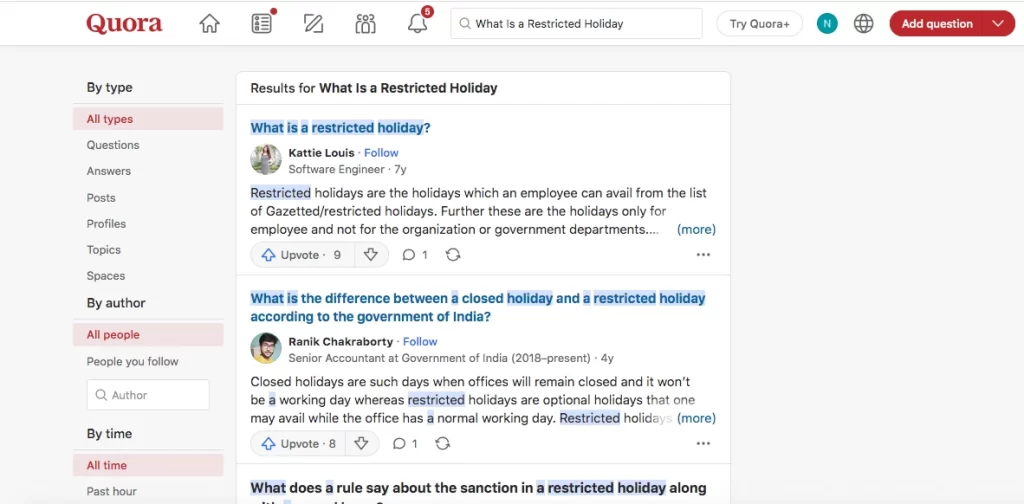
Below are Quora posts, highlighting fresh perspectives on restricted holidays beyond the formal rules.
Variations in Availability and Usage
Suresh Mittal points out selective flexibility,
“Restricted holidays are one of the holidays from the list which you can take. But you are not free to take all of them from the restricted holiday list.”
Amit Kumar adds context on employer practices,
“Not every company in India allows restricted holidays to their employees. Employers who consider such holidays offer a total of two holidays every year.”
Government Employees’ Perspective
Ranik Chakraborty, a Senior Accountant with the Government of India, describes the central government framework,
“In a calendar year a central government employee can avail two (02) Restricted Holiday (RH) leave out of several listed RH dates.”
He contrasts “closed holidays” (mandatory office closures) with optional RHs, reinforcing that RHs are strictly elective even within government settings.
Asimendrakumar Dhirendrakumar Dechaudhari, formerly with BSNL, offers numeric clarity,
“In India there are too many festivals which vary from state to state and community to community. So, there is a list \[of] restricted holidays which covers most festivals of the country, out of which we can avail any two holidays in a year with prior permission. These are paid holidays.”
Personal Anecdotes and Real-World Scenarios

Palanki Suryanarayana, a retired professor, shares historical anecdotes from Madhya Pradesh,
“My Telugu wife used to take leave for Onam when she had a Punjabi boss… Apart from two days holidays for Diwali there was an additional day called South Indian Diwali which enabled my family to celebrate the festival both at Chennai and Bhopal.”
He also recalls that “When it became clear that governance is not possible if the offices are shut down for most part of the year, the holidays were divided into general, sectional, and restricted holidays.”
Additionally, Suryanarayana recounts a campus incident,
“When our students won two matches on Thursday, a holiday was declared for Friday. The President insisted on two holidays for two victories and the Institute was closed from Friday to Monday…”
Clarifications on Eligibility and Limits
Kattie Louis, a software engineer, emphasizes the organizational boundary,
“Restricted holidays are the holidays which an employee can avail from the list of Gazetted/restricted holidays. Further, these are holidays only for the employee and not for the organization or government departments.”
Sethuraman Ramanujam, an ex-serviceman in Military Engineering Services, addresses travel logistics,
“Yes, an employee can leave for outstation if he can return for duty on completion of RH. He needs to inform leave sanctioning authorities if he is leaving out of station and provide contact address.”
Conclusion
Restricted holidays represent an important balance between workplace productivity and personal cultural observances. By understanding how these holidays work, you can effectively plan your time off while respecting organizational needs.
Remember that communication is key—request your restricted holidays early, be flexible when possible, and clearly explain their significance when necessary. With thoughtful planning, you can observe important personal occasions while maintaining your professional responsibilities.
Whether you’re celebrating a religious festival, regional tradition, or family occasion, the restricted holiday system provides the flexibility to honor what matters most to you while contributing to a diverse and inclusive workplace.
Hire the best candidates
with Wetest.
Create pre-employment assessments in minutes to screen candidates, save time, and hire the best talent.
Try for free