
Pay for Performance: How It Works and Why It Matters
Human resources
Bonica
May 23, 2025
Want to boost productivity and retain top talent? Pay for performance might be your answer.
This compensation strategy ties employee earnings directly to their results, creating a win-win that drives business success while rewarding your highest performers.
But implementing it effectively requires careful planning. Get it wrong, and you could face decreased morale, unhealthy competition, or even incentivize the wrong behaviors.
In this guide, I’ll show you exactly how performance-based pay works, why it matters, and how to implement it successfully in your organization – regardless of your industry.
Table of Contents
Understanding the Fundamentals of Pay for Performance

Pay for performance isn’t just another HR buzzword – it’s transforming how companies compensate employees across industries. But what exactly does it mean in today’s workplace?
What Is Pay for Performance in Today’s Workplace?
Pay for performance (P4P) is a compensation strategy that links a portion of employee earnings directly to measurable performance outcomes. Unlike traditional fixed salary models, P4P creates a direct connection between results and rewards.
The concept is simple: excel at your job, and your paycheck reflects it.
Modern P4P models have evolved significantly from the basic commission structures of the past. Companies have effective systems in place to measure the performance of individuals, teams, and the company in various ways. As a result, most companies now employ a compensation system that is performance-based.
According to a recent PayScale survey, a significant 74% of organizations in the UK now utilize some form of variable pay that is directly linked to employee performance.
What’s making this change is the discovery by companies that the use of P4P motivates employees to align with the company’s goals.
5 Core Elements of Effective Performance-Based Compensation
For a pay-for-performance system to succeed, these five elements must be present:
1. Clear, measurable objectives: Employees need to understand exactly what success looks like. These objectives should be specific, measurable, achievable, relevant, and time-bound (SMART).
2. Transparent evaluation criteria: The metrics used to assess performance must be objective and transparent. Employees should understand how their performance is being measured and have access to their progress data.
3. Meaningful rewards: The incentives must be significant enough to motivate the desired behaviors. Financial rewards typically range from 5-20% of base compensation for most roles, with higher percentages for sales and executive positions.
4. Regular feedback loops: Effective P4P systems include frequent performance conversations, not just annual reviews. Many successful programs incorporate monthly or quarterly check-ins.
5. Equitable application: The system must be perceived as fair across different roles, departments, and employee demographics. This requires careful design and ongoing monitoring.
When these elements work together, employees clearly understand how their efforts connect to their compensation. This creates powerful motivation for high performance.
How P4P Differs from Traditional Salary Models
Traditional salary structures and P4P represent fundamentally different compensation philosophies:
Traditional salary models operate on an entitlement principle – compensation based primarily on factors like tenure, credentials, and job title. Annual increases typically follow standard percentages across the board, with minimal differentiation between top and average performers.
Pay for performance, by contrast, operates on an achievement principle. While it usually includes a base salary component, a significant portion of compensation varies based on results. This creates natural differentiation between high and low performers.
The differences extend to organizational culture as well. Traditional models tend to emphasize stability and internal equity, while P4P cultures typically value meritocracy and results-orientation.
Consider this comparison:
In a traditional model, two employees with identical roles and similar tenure might receive nearly identical compensation despite vast differences in their contributions. In a P4P environment, the high performer might earn 15-30% more than their average-performing peer.
This differentiation sends a powerful message about what the organization truly values.
The Business Case for Performance-Based Compensation

Why are so many organizations transitioning to performance-based pay? The business benefits extend far beyond simply motivating employees.
7 Compelling Benefits for Organizations Implementing P4P
Organizations implementing well-designed performance pay systems typically experience these advantages:
1. Improved productivity: When rewards directly connect to output, productivity naturally increases. A Deloitte study found that organizations with performance-based rewards see 10-30% higher productivity levels than those without.
2. Enhanced talent attraction: Environments that recognize and reward contributions attract top talent.. P4P helps companies stand out in competitive talent markets.
3. Reduced turnover of high performers: When your best employees see a clear connection between their exceptional work and their compensation, they’re less likely to look elsewhere. Companies with strong P4P models report 20% lower turnover among top talent.
4. Increased accountability: Clear performance expectations and consequences (both positive and negative) create a culture of accountability at all levels.
5. Better alignment with business goals: P4P naturally focuses employee effort on the metrics that matter most to organizational success.
6. More efficient compensation spending: Rather than spreading raises evenly, P4P concentrates compensation dollars on those driving the most value.
7. Continuous performance improvement: The ongoing feedback and measurement inherent in P4P systems create natural cycles of improvement and skill development.
These benefits compound over time as performance-oriented behaviors become embedded in company culture.
Financial Impacts and ROI of Performance-Based Pay Systems
The financial case for P4P is compelling when implemented effectively:
A comprehensive study by WorldatWork found that companies with well-designed variable pay programs generated 8-12% higher revenue per employee than those without such programs.
The ROI manifests in several ways:
Direct productivity gains: When employees are incentivized based on output, production naturally increases. Manufacturing companies implementing P4P typically see output improvements of 15-25% within the first year.
Reduced compensation waste: Traditional models often overpay underperformers while underpaying top talent. P4P corrects this imbalance, ensuring compensation dollars generate maximum return.
Decreased turnover costs: With top performers more likely to stay, companies save on the substantial costs of recruitment, onboarding, and lost productivity. Given that replacing a knowledge worker typically costs 150-200% of their annual salary, these savings are significant.
Improved customer outcomes: When employees are rewarded for customer satisfaction metrics, service quality improves, leading to higher retention rates and increased customer lifetime value.
The most dramatic ROI typically comes from sales roles, where properly designed commission structures can drive revenue increases of 20-40% for the same headcount cost.
Case Studies of Companies Succeeding with Performance Pay
These real-world examples demonstrate P4P success across different industries:
Technology: Microsoft’s Performance-Based Culture Transformation
When Satya Nadella became CEO in 2014, he implemented a fundamental shift in Microsoft’s compensation structure. The company moved from a stack-ranking system to a performance model. They started rewarding collaboration alongside individual achievement.
The results were dramatic! Microsoft’s market cap has increased by over $1.5 trillion, employee satisfaction scores improved by 27%, and voluntary turnover decreased significantly.
Manufacturing: Lincoln Electric’s Century of Performance Pay
Lincoln Electric, a welding equipment manufacturer, has maintained one of the longest-running and most successful P4P systems in business history. Their piece-rate system combined with profit-sharing has created extraordinary productivity levels – Lincoln’s workers produce nearly twice the output of competitors’ employees.
The company has avoided layoffs for over 70 years while maintaining profit margins well above industry averages.
Healthcare: Banner Health’s Quality Incentives
Banner Health implemented a P4P system tied directly to patient outcomes and satisfaction metrics. Physicians and care teams receive quarterly bonuses based on clinical quality measures, patient experience scores, and efficiency metrics.
Within three years of implementation, Banner saw a 22% reduction in hospital-acquired conditions, a 15% improvement in patient satisfaction scores, and over $40 million in reduced costs from improved care efficiency.
These examples represent diverse applications of the P4P principle, each tailored to industry-specific goals and challenges.
Effective Pay for Performance Strategy Design

A successful P4P strategy begins with thoughtful design that reflects your organization’s unique culture and objectives.
Setting Clear and Measurable Performance Metrics
The foundation of any effective P4P system is clear, measurable performance metrics. These metrics must satisfy several criteria:
Alignment with strategic goals: The organization’s broader goals should be directly reflected in each metric. If customer retention is a strategic priority, for example, customer satisfaction scores should feature prominently in customer service compensation plans.
Objectivity: Metrics must be measurable through objective data rather than subjective opinions. This creates trust in the system and reduces perception of favoritism.
Controllability: Employees should have significant influence over the metrics by which they’re measured. Rewarding people for factors outside their control creates frustration rather than employee motivation.
Comprehensibility: Metrics must be simple enough that employees can easily understand them and track their own progress.
Balance: The most effective systems measure both results (what was achieved) and behaviors (how it was achieved).
Start with no more than 3-5 key metrics per role to maintain focus. Common examples include:
Sales roles: Revenue attainment, gross margin, new customer acquisition
Customer service: Customer satisfaction scores, first-call resolution, average handle time Technical positions: Project completion, quality metrics, innovation measures
Leadership roles: Team performance, employee engagement scores, strategic initiative completion
Regularly review these metrics to ensure they continue driving the right behaviors as business conditions change.
Balancing Individual vs. Team-Based Performance Incentives
Most successful P4P systems incorporate both individual and team-based incentives, carefully balanced to drive collaboration while recognizing personal achievement.
Individual incentives create direct accountability and recognize standout performers. These strategies are most effective for roles where individual tasks are clearly defined. Sales or individual contributor roles are among the best examples.
Team-based incentives improve collaboration and reduce unhealthy competition. The greatest achievements require coordinated effort. They’re particularly important in environments requiring cross-functional cooperation.
The ideal balance varies by organization and role:
Entry-level roles often benefit from a heavier emphasis on individual metrics (70-80%) with smaller team components (20-30%) to help employees see the direct impact of their efforts.
Mid-level positions work best with a more balanced approach. Perhaps 50-60% individual metrics along with 40-50% team or departmental goals.
Leadership roles should have a greater proportion tied to team or organizational success (60-70%) with a smaller individual component (30-40%) to emphasize their responsibility for collective outcomes.
Companies like Google have found success with a “50/30/20” model: 50% based on individual performance, 30% on team performance, and 20% on company-wide results. This creates multi-level alignment while maintaining personal accountability.
How to Structure Performance Bonuses and Incentives
The structure of your incentives impacts their effectiveness. Consider these design principles:
Frequency matters: Annual bonuses create a single moment of recognition but may not drive consistent behavior throughout the year. Many organizations are shifting toward quarterly or even monthly incentive payouts to maintain ongoing motivation.
Threshold, target and stretch goals: Effective incentive structures typically include:
- Threshold levels (minimum performance to receive any bonus, typically 80-85% of target)
- Target levels (expected performance, receiving 100% of target bonus)
- Stretch goals (exceptional performance, receiving 120-150% of target bonus)
This creates motivation at all performance levels.
Bonus calculation approaches: Common methods include:
1. Multiplier models: Base bonus multiplied by a performance factor (e.g., 0.8x for threshold performance, 1.0x for target, 1.2x for stretch)
2. Linear percentage models: Bonus percentage increases incrementally with each performance improvement (e.g., 1% additional bonus for each 1% above target)
3. Tiered achievement models: Specific bonus amounts tied to achievement levels ( For example, $2,000 for meeting Level 1 metrics, $5,000 for Level 2, etc.)
The right calculation approach depends on your industry, role types, and organizational culture.
Communication is crucial: However you structure your incentives, clear communication about how they work is essential. Employees should be able to calculate their own potential earnings based on their performance.
Implementing Pay for Performance Across Different Industries

P4P principles apply across sectors, but effective implementation requires industry-specific adaptation.
Performance Pay Models in Sales and Revenue-Generating Roles
Sales roles represent the most traditional and straightforward application of performance-based pay, with several proven models:
Commission-only: Entire compensation based on sales results, typically used for independent representatives or highly transactional sales. While offering maximum incentive, these plans can create cash flow challenges for salespeople and may encourage overly aggressive tactics.
Base-plus-commission: A moderate base salary (typically 50-70% of target earnings) combined with commission on sales. This balanced approach provides stability while maintaining strong performance incentives.
Tiered commission rates: Commission percentages that increase as salespeople reach higher achievement levels. For example, 3% commission up to quota, 5% for sales 100-120% of quota, and 7% beyond. This structure creates powerful motivation for high achievers.
Balanced scorecard approaches: Commission based on multiple factors beyond just revenue – including profit margin, customer satisfaction, and new product sales. Leading companies like IBM have shifted to this model to drive balanced business outcomes.
Regardless of structure, successful sales compensation plans share these characteristics:
- Clear connection between effort and reward
- Timely payment (monthly or quarterly)
- Transparent calculation methods
- Appropriate caps or accelerators
- Regular review to ensure alignment with market strategy
The most effective plans are reviewed and adjusted annually to reflect changing market conditions and company priorities.
Adapting Pay for Performance in Technical and Creative Fields
Technical and creative roles present unique P4P challenges. Unlike sales, outcomes are often less directly measurable and may occur over longer timeframes. Successful approaches include:
Project completion bonuses: Financial rewards tied to successful delivery of projects, considering factors like timeliness, budget adherence, and quality metrics. Companies like Microsoft reward development teams based on both timely delivery and post-release quality measurements.
Innovation incentives: Rewards for patents filed, new product ideas implemented, or process improvements. IBM’s long-running patent incentive program pays inventors for each patent filed and additional bonuses when patents are granted.
Customer impact metrics: Bonuses based on user adoption, customer satisfaction, or problem resolution rates. Atlassian ties technical team bonuses to customer satisfaction scores and product reliability metrics.
Skill acquisition incentives: Financial rewards for obtaining certifications or demonstrating mastery of new technologies. Cloud services provider Rackspace offers substantial bonuses for employees who earn advanced technical certifications.
For creative roles specifically, effective metrics often include:
- Campaign effectiveness metrics
- Audience engagement measurements
- Award recognition
- Portfolio quality assessments
The key is finding metrics that capture value creation without constraining the creativity and innovation these roles require.
Public Sector Applications
Contrary to popular belief, performance-based pay can work effectively in public sector and non-profit settings. While budget constraints and mission-focused cultures create unique challenges, several models have proven successful:
Goal-based bonus programs: The U.S. Department of Veterans Affairs implemented a goal-based bonus program that rewards employees for meeting specific targets in patient care quality, timeliness, and veteran satisfaction. The program contributed to a 19% improvement in appointment wait times.
Skill-based pay increases: Many government agencies have implemented systems where employees earn permanent pay increases for developing and demonstrating specific job-related skills and competencies.
Group incentive funds: Some public agencies create pooled incentive funds that reward entire departments for achieving efficiency goals or service improvements. The savings generated by the improvements fund the bonuses, creating budget neutrality.
Recognition-based awards: Non-profits like Teach For America supplement modest salaries with recognition programs that include both monetary and non-monetary rewards for exceptional educators.
The Federal Employee Viewpoint Survey has consistently found that performance-based rewards significantly increase engagement and retention among government workers when implemented with clear criteria and transparent processes.
Overcoming Common Challenges in Performance-Based Pay

Even well-designed P4P systems face implementation challenges. Proactively addressing these issues is essential for success.
Addressing Fairness Concerns in Performance Evaluation
Perceived unfairness can quickly undermine a P4P system. Common fairness concerns and their solutions include:
Subjectivity in evaluations: Employees often worry that subjective assessments will determine their compensation.
Solution: Use multiple evaluators, clearly defined rubrics, and include objective data whenever possible. Companies like Deloitte have moved to a system where managers answer specific questions about employee performance rather than assigning subjective ratings.
Unequal opportunity: Some roles or departments may have inherent advantages in achieving bonus metrics.
Solution: Normalize performance expectations across different contexts and ensure metrics reflect factors within employee control. Technology company Asana adjusts performance targets based on team-specific factors to ensure equitable opportunity.
Bias in evaluation: Research consistently shows that unconscious bias can affect performance ratings.
Solution: Implement bias training for evaluators, use structured evaluation processes, and regularly analyze rating patterns for demographic disparities. Google conducts regular calibration sessions where managers compare evaluations to identify and correct potential bias patterns.
Transparency gaps: When employees don’t understand how decisions are made, they assume the worst.
Solution: Document and communicate evaluation criteria, provide evaluation rubrics in advance, and offer detailed explanations for decisions. Buffer takes transparency to an extreme, publishing all salary and bonus information internally.
Regular fairness audits – examining performance ratings and rewards for patterns that might indicate systemic issues – are essential for maintaining trust in the system.
6 Ways to Prevent Unintended Consequences of Incentive Pay
Even well-intended incentive systems can drive problematic behaviors if not carefully designed. Prevent these issues with these strategies:
1. Balance competing metrics: When one metric is incentivized in isolation, other important aspects of performance may suffer. Always include counterbalancing metrics – productivity balanced with quality, sales volume with customer satisfaction.
2. Incorporate qualitative assessment: Not everything that matters can be measured numerically. Include manager assessment of behaviors and methods alongside quantitative results.
3. Set appropriate measurement periods: Metrics measured too frequently can drive short-term thinking at the expense of long-term value. Match measurement periods to natural business cycles.
4. Include team components: Pure individual incentives can harm collaboration. Including team-based components encourages cooperation toward shared goals.
5. Establish ethical boundaries: Make clear that how results are achieved matters as much as the results themselves. Wells Fargo’s incentive scandal demonstrates the dangers of rewarding outcomes without ethical guardrails.
6. Regularly review for gaming behaviors: Monitor for patterns that suggest employees are optimizing for metrics rather than actual business value. Be willing to adjust metrics that drive counterproductive behaviors.
Pharmaceutical company GSK shifted from individual sales targets to team-based measures incorporating appropriate prescribing patterns specifically to avoid incentivizing aggressive sales tactics that had created industry-wide issues.
Technology Solutions for Tracking Performance Metrics
Modern performance pay systems rely heavily on technology for tracking, analyzing, and communicating performance data. Key technological enablers include:
Performance dashboards: Real-time visibility into performance metrics helps employees track their progress and make adjustments. Leading tools like Tableau and Power BI allow organizations to create customized dashboards showing individual and team performance against targets.
Automated data collection: Manual tracking creates administrative burden and potential for error. Integration between operational systems and performance tracking reduces both issues. Customer service platform Zendesk, for example, automatically captures resolution times, satisfaction scores, and other key metrics used in service team compensation.
Analytics capabilities: Advanced analytics helps identify patterns and relationships between activities and outcomes. Companies like Workday offer sophisticated analytics that help organizations understand which behaviors most strongly predict performance success.
Calibration tools: Technology can help identify and correct potential bias in performance evaluations. Tools like Culture Amp include features that flag unusual rating patterns that might indicate bias.
These technologies reduce administrative burden while increasing transparency and trust in the P4P system.
The Employee Experience

Understanding the psychological dimensions of P4P is essential for maximizing its motivational benefits.
Psychological Impact of Performance-Based Compensation
Performance-based pay affects employee psychology in complex ways:
Extrinsic vs. intrinsic motivation: While financial incentives create extrinsic motivation (working for the reward), the most powerful performance comes when they reinforce intrinsic motivation (enjoying the work itself). Well-designed P4P systems recognize and reward activities that employees already find meaningful.
Risk and reward sensitivity: Research from behavioral economics shows that people differ significantly in how they respond to variable compensation. Some employees are energized by the opportunity for higher rewards, while others experience anxiety about potential earnings volatility.
Fairness perception: According to equity theory, employees constantly compare their inputs (effort) and outputs (rewards) against those of peers. When perceived inequity exists, motivation suffers dramatically. The perception of fairness matters more than the absolute reward value.
Psychological safety: For P4P to drive innovation and problem-solving, employees must feel safe taking calculated risks. When compensation variability creates fear, employees default to safe behaviors rather than potentially higher-value approaches.
Leading organizations like Microsoft have evolved their performance systems to incorporate these psychological insights, creating models that balance accountability with psychological safety and combine extrinsic rewards with intrinsic motivators.
How Performance Pay Influences Employee Engagement
The relationship between P4P and engagement depends largely on implementation quality:
Clarity and purpose: Well-implemented performance pay creates clarity about what matters to the organization. This clarity can significantly boost engagement by helping employees understand how their work contributes to larger goals.
Recognition effect: Beyond the financial impact, performance-based rewards serve as formal recognition of contribution. This recognition component often drives engagement more than the monetary value itself.
Fairness perception: When employees believe the performance system fairly rewards contribution, engagement typically increases. Conversely, perceived unfairness in how performance is evaluated or rewarded is among the fastest ways to destroy engagement.
Autonomy support: P4P systems work best for engagement when they specify outcomes while leaving methods flexible. This supports employees’ need for autonomy – a key driver of engagement according to self-determination theory.
A Gallup study found that organizations combining clear performance expectations with recognition for achievement saw engagement scores 14 percentage points higher than those using traditional compensation approaches.
Building a Culture That Supports Performance Recognition
Performance pay works best within a broader recognition culture. Key elements include:
Leadership modeling: When executives and managers publicly recognize performance and accept accountability for their own results, it normalizes performance discussions throughout the organization.
Regular feedback: Annual or semi-annual performance conversations are insufficient. High-performance cultures incorporate weekly or monthly discussions about progress and results.
Multiple recognition channels: Financial incentives should be one component of a multi-faceted recognition strategy that includes public acknowledgment, development opportunities, and other non-financial recognition.
Celebration of achievement: Creating rituals to celebrate achievement reinforces the performance culture. Salesforce is famous for its achievement celebrations, from ringing gongs for closed deals to quarterly recognition events.
Learning orientation: The most effective performance cultures treat shortfalls as learning opportunities rather than failures. This psychological safety encourages appropriate risk-taking while maintaining accountability.
Technology company Adobe abandoned traditional performance reviews entirely in favor of regular “check-in” conversations focused on feedback and development, while maintaining performance-based compensation determined through these ongoing discussions.
Future Trends in Pay for Performance

The future of performance-based pay is being shaped by technological, workplace, and social changes.
How AI and Analytics Are Reshaping Performance Evaluation
Advanced technologies are transforming how performance is measured and rewarded:
Algorithmic performance assessment: AI systems now analyze multiple data sources to evaluate performance more objectively than traditional manager ratings. JPMorgan Chase uses machine learning algorithms to assess trader performance based on dozens of factors beyond simple profit metrics.
Predictive performance indicators: Rather than measuring only outputs, AI can identify behavioral patterns that predict future performance. Microsoft uses analytics to identify collaboration behaviors that predict team success and incorporates these into performance evaluation.
Real-time feedback systems: Technologies now enable continuous performance feedback rather than periodic reviews. Companies like Reflektive provide platforms for ongoing feedback that influences compensation decisions.
Bias detection and correction: Advanced analytics can identify patterns of bias in performance evaluations and suggest corrections. Gap Inc. uses analytics to compare performance ratings across demographic groups and flag potential bias patterns for review.
While promising, these technologies also raise important questions about transparency, fairness, and the appropriate balance between human and algorithmic judgment in determining compensation.
The Evolution of Performance Metrics in Remote Work
The rapid shift toward remote and hybrid work has necessitated changes in how performance is measured and rewarded:
Output over input: Remote work naturally shifts focus from hours worked (input) to results delivered (output). Companies like GitLab, which has been all-remote since its founding, evaluate performance entirely based on measurable contributions rather than work patterns.
Collaboration quality metrics: With remote work, effective collaboration requires deliberate effort. New metrics measuring collaboration effectiveness – including communication patterns, knowledge sharing, and cross-functional support – are becoming components of performance evaluation.
Asynchronous contribution measurement: As work becomes more asynchronous across time zones, performance systems must adapt to measure contribution that happens outside traditional observation. Documentation quality, knowledge base contributions, and problem-solving support are emerging as valuable metrics.
Well-being and sustainability indicators: Leading companies now recognize that sustainable performance requires attention to employee well-being. Companies like Unilever incorporate wellness metrics into their performance systems to discourage burnout-inducing behaviors.
These evolutions reflect a fundamental shift toward measuring the value created rather than the activity performed – a change accelerated by remote work arrangements.
Emerging Compensation Models Beyond Traditional Bonuses
Innovative organizations are exploring alternatives to conventional bonus structures:
Skills-based compensation: Rather than paying for job titles or performance alone, companies increasingly compensate for specific skill mastery. IBM’s skills-based compensation adjusts pay based on market-value skills employees have demonstrated, separate from their performance ratings.
Spot bonuses and micro-incentives: Instead of annual or quarterly bonuses, some organizations are shifting to immediate rewards for specific achievements. Consulting firm Deloitte uses a points-based recognition system where peers can award points redeemable for rewards.
Choice-based rewards: Recognizing different motivational preferences, some companies allow employees to choose their incentive structure. Aetna allows employees to select from different combinations of base and variable pay based on their risk tolerance and preferences.
Equity participation models: Beyond traditional stock options, companies are creating innovative ways for employees to share in value creation. Brewery New Belgium gives all employees ownership stakes and ties annual bonuses directly to company valuation increases.
Purpose-linked incentives: Organizations increasingly connect bonuses to purpose-related metrics like sustainability goals or social impact. Danone ties executive compensation partially to environmental impact reduction and social responsibility metrics.
These innovations reflect a growing understanding that performance motivation is complex and requires a more nuanced approach than traditional bonus formulas.
A Quora Rundown
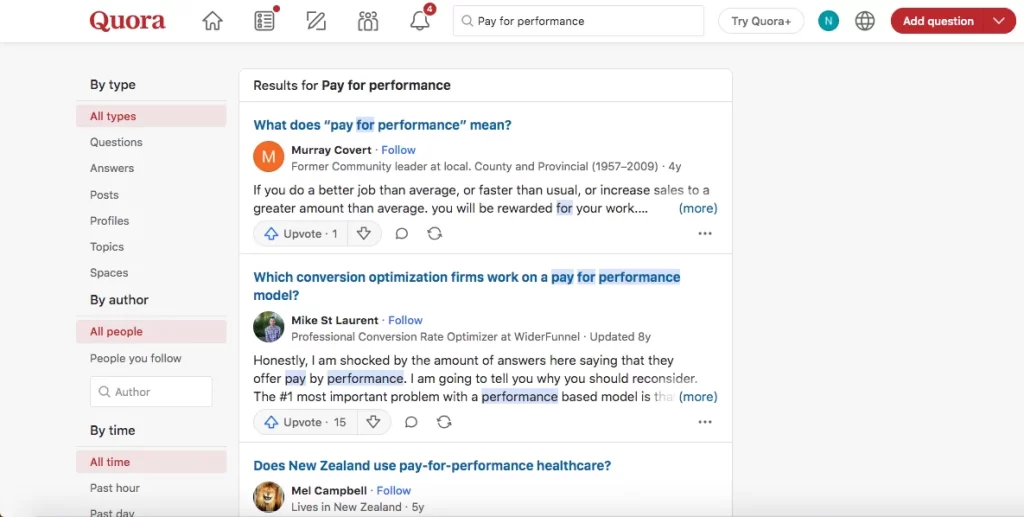
Quora users have offered more viewpoints that add layers to the basic definitions we have been considering.
Perspectives on Performance Pay
Gilbert Mazzeo analyzes the ideological basis,
“Payments based on your performance is an additional incentive to work with enthusiastic efficiency in the capitalist ideal for the mitigation of the most effective division of labor… It’s the complete opposite of survival of the fittest, and the freedom of self-determination to succeed.”
Victoria Duvall offers another perspective by focusing on career growth,
“There is a broader meaning behind this statement as I have heard it used to justify higher pay to some employees. You get hired to do a job… Higher pay means higher performance. So, always seek to add new skills by taking on jobs that require you to challenge yourself.”
Performance pay is intertwined with personal development.
Practical Realities and Trade-Offs
Quora users discuss the tangible relationship between effort and compensation. Denyse de Villiers states,
“One gets paid according to their performance in a working environment. Excellent employee, excellent work performance… Poor performance by an employee who does not enjoy his work – just works to receive his money on payday = Poor pay.”
The system naturally rewards less dedication when employees aren’t passionate.
Michael Cooperman simplifies the concept,
“I believe this means ‘One is paid based upon a measurable standard of performance’; for example, in sales, a salesperson earns a commission based on how many units are sold. The more work done, the more pay.”
Field Observations

Chandrasekaran Avanavadi Sundaram brings historical examples,
“Performance-related pay… is money paid relating to how well one works. Car salesmen or production line workers, for example, may be paid in this way… successfully implemented by Jack Welch in General Electric.”
Jim Watkins provides a balance between the pros and cons,
“Performance pay can work in situations where performance is easy to measure in an objective way, like farm workers or sales people… However, there are many situations where quality is more important than quantity.”
Jack Menendez offers a cautionary note,
“Performance based pay is workable in some situations but I am only addressing the idea for IT, programming, engineers and scientists. There is nothing that can be measured in these jobs that makes any sense to base incentive pay on.”
Career Impact
Scott Biddle considers how performance pay impacts career trajectories,
“Performance-based raises are going to benefit you… My salary has increased over 230% over the past couple of decades. If you believe in yourself and your skills, always opt for performance based plans.”
This strongly motivates those using its advantages to improve their careers.
Conclusion
Pay for performance, when thoughtfully designed and executed, creates a powerful alignment between individual rewards and organizational success. The most successful implementations share common characteristics:
- Clear connection between strategic objectives and performance metrics
- Balanced measurement across individual, team, and organizational levels
- Transparent processes that build trust in the system
- Regular calibration to ensure fairness and adjust for changing business needs
- Support from technology that reduces administrative burden
- Cultural reinforcement through leadership modeling and regular performance conversations
As you design or refine your performance-based compensation strategy, remember that no single approach works for every organization. The most effective systems reflect your specific culture, industry dynamics, and strategic priorities.
While implementing P4P requires significant effort, the potential rewards – increased productivity, stronger talent attraction and retention, and tighter alignment between individual efforts and organizational goals – make it well worth the investment.
Your performance pay system should evolve as your organization grows and changes. Regular review and refinement ensure it continues driving the outcomes that matter most to your success.
Hire the best candidates
with Wetest.
Create pre-employment assessments in minutes to screen candidates, save time, and hire the best talent.
Try for free