Why Is Mandatory Overtime Legal? Unpacking Labor Law Provisions
Employment
Bonica
September 9, 2025
Employees based across the world wonder about the legality of mandatory overtime.
It’s a misunderstood aspect of labor law. You need a comprehensive breakdown of why employers mandate extra hours and the protections afforded to employees.
Employees subject to overtime and managers responsible for scheduling it need to understand these regulations. I’ll provide you with a legal framework that allows mandatory overtime.
Table of Contents
Legal Framework of Mandatory Overtime

The legality of mandatory overtime is structured upon concrete labor laws and regulations that have undergone development over the decades.
The Fair Labor Standards Act (FLSA)
The FLSA stands as the foundation of overtime law in America. Established in 1938, this federal law doesn’t actually limit how many hours an employer can require you to work. Surprising, right?
The FLSA’s actual mandate is that most employees must be paid at a premium rate (one and a half times their regular pay) for any work exceeding 40 hours in a week. This rule intends to discourage excessive overtime through financial implications.
The law intentionally avoids setting maximum work hours, instead creating a compensation structure that makes overtime more expensive for employers. This approach reflects America’s market-oriented labor philosophy, where economic incentives rather than rigid prohibitions drive workplace practices.
State vs. Federal Overtime Regulations Compared
While federal law provides a baseline, state regulations often add additional layers of protection:
– California requires daily overtime pay after 8 hours worked in a single day
– Maine prohibits mandatory overtime for nurses in most circumstances
– Oregon limits manufacturing workers to 13 hours per day
– New York has industry-specific overtime rules for hospitality workers
A straightforward principle governs the interplay of state and federal overtime regulations: the law offering greater benefits to employees takes precedence. Consequently, this results in a varied landscape of rules nationwide, where workers in certain states have considerably stronger safeguards than those provided by federal law.
A Legal Comparison Across Industries
Not all overtime is created equal in the eyes of the law. Different industries operate under vastly different rules:
– Healthcare workers often face specific overtime regulations due to patient safety concerns
– Transportation workers follow hours-of-service regulations instead of traditional overtime rules
– Agricultural workers are exempt from FLSA overtime requirements in many cases
– Executive, administrative, and professional employees may be exempt from overtime pay entirely
These industry-specific definitions create substantial variation in how overtime operates across the economy. A truck driver, nurse, farm worker, and office manager all work under different overtime frameworks—despite being governed by the same base legislation.
5 Key Reasons Why Employers Can Mandate Overtime

Mandatory overtime exists for specific legal and economic reasons that have been reinforced through legislation and court decisions.
Economic Necessity and Business Continuity Provisions
Businesses face unpredictable demands—sudden orders, seasonal rushes, or emergency situations that require immediate staffing. Labor law recognizes this reality by allowing flexible staffing through overtime.
For many businesses, especially those in manufacturing or healthcare, maintaining continuous operations is essential. Mandatory overtime provides the flexibility needed to:
– Cover unexpected absences without disrupting operations
– Meet sudden increases in production demands
– Address emergency situations requiring additional staff
– Manage seasonal fluctuations without hiring temporary workers
The law recognizes that prohibiting mandatory overtime could threaten business viability in certain sectors, particularly those requiring 24/7 operations or facing unpredictable demand.
Historical Development of Overtime Labor Laws
Today’s overtime rules didn’t appear overnight—they evolved through complex historical negotiations between labor, management, and government.
Prior to the FLSA, 12-16 hour workdays were common in many industries with no premium pay requirement. The introduction of overtime pay requirements in 1938 represented a compromise: rather than capping hours (as labor advocates wanted), the law made extended hours more expensive for employers.
This compromise reflected the prevailing philosophy that market mechanisms rather than direct prohibitions should govern working hours. Over time, this approach became deeply embedded in American labor law, creating the foundation for today’s mandatory overtime practices.
At-Will Employment Facilitates Mandatory Overtime
The doctrine of at-will employment—where either employer or employee can terminate the relationship without cause—provides crucial legal support for mandatory overtime.
Under at-will employment, refusing assigned work (including overtime) constitutes grounds for termination in most circumstances. Courts have repeatedly upheld employers’ rights to set working hours as a fundamental management prerogative.
This legal foundation means that unless protected by a specific exemption, contract, or collective bargaining agreement, employees generally must work assigned overtime or risk termination—a powerful mechanism that makes overtime effectively mandatory in practice.
Industry Exemptions That Permit Extended Work Hours
Certain industries receive specific exemptions from standard overtime rules, allowing for extended work hours:
– Healthcare facilities can require extended shifts during emergencies
– Transportation companies operate under separate hours-of-service regulations
– Agricultural businesses are largely exempt from federal overtime requirements
– Seasonal operations like holiday retail can utilize different overtime standards
– Public safety positions often have mandatory overtime provisions during emergencies
These exemptions recognize that standard overtime restrictions would be impractical in certain sectors, particularly those involving public safety, seasonal demand, or continuous operations.
Court Precedents Upholding Mandatory Overtime Practices
The judicial system has consistently reinforced employers’ rights to mandate overtime. Key court decisions have established that:
– Requiring overtime as a condition of employment is generally lawful
– Employers can discipline employees who refuse mandatory overtime
– Only specific statutory exemptions (like disabilities or religious accommodations) limit overtime requirements
– Collective bargaining agreements can establish binding overtime provisions
These precedents create a strong legal foundation for mandatory overtime practices, making successful challenges difficult outside specific exemption categories.
When to Legally Require Extra Hours?

Employers can mandate overtime in most situations, but certain conditions and limitations apply.
Emergency Situations and Essential Service Provisions
During emergencies, overtime rules often expand to ensure essential services remain operational:
– Healthcare facilities can require extended coverage during public health emergencies
– Utility companies can mandate overtime during power outages or natural disasters
– Public safety agencies can extend shifts during emergencies or major incidents
– Transportation services often have emergency provisions for weather events
These provisions recognize that during crises, the public interest in maintaining essential services outweighs restrictions on working hours. Many states have specific emergency provisions that modify standard overtime regulations during declared emergencies.
Contractual Agreements Permitting Overtime
Employment contracts and handbooks frequently contain language specifically authorizing mandatory overtime. These provisions typically include:
– Acknowledgment that overtime may be required as a condition of employment
– Procedures for assigning mandatory overtime when necessary
– Consequences for refusing assigned overtime
– Any limitations or exceptions to overtime requirements
These contractual provisions strengthen employers’ ability to mandate overtime by creating explicit consent at the time of hiring. Courts generally uphold these agreements as binding, provided they don’t violate specific statutory protections.
Notice Requirements for Scheduling Mandatory Overtime
While federal law doesn’t mandate advance notice for overtime, many state regulations and company policies establish notification standards:
– Some states require 24-72 hours notice for schedule changes
– Certain collective bargaining agreements contain notification requirements
– Company policies often establish standard notification procedures
– Some industries have sector-specific notification requirements
These notice requirements don’t typically prevent mandatory overtime but instead create procedural frameworks for how it must be assigned. They represent a compromise between employer flexibility and employee predictability.
Seasonal Industry Considerations in Overtime Law
Seasonal businesses face unique demands that labor law accommodates through specialized overtime provisions:
– Retail operations during holiday seasons
– Agricultural businesses during harvest periods
– Tourism and hospitality during peak travel seasons
– Tax preparation services during tax season
These operations often receive special consideration under overtime laws, reflecting the economic reality that their business models depend on the ability to significantly increase hours during peak periods.
The “Reasonable” Standard in Overtime Enforcement
Courts often apply a “reasonableness” standard when evaluating mandatory overtime disputes. This standard considers:
– The amount of overtime required
– How the overtime was distributed among employees
– Notice provided before mandatory overtime
– The business necessity driving the overtime requirement
– Available alternatives to mandatory overtime
This flexible standard helps courts balance employer needs against potential employee hardship, particularly in cases involving accommodations or special circumstances.
Employee Rights and Protections During Overtime

While mandatory overtime is generally legal, employees still have significant rights regarding how those extra hours are handled.
Fair Compensation: Time-and-a-Half Payment Requirements
The cornerstone of overtime protection remains the premium pay requirement:
– Non-exempt employees must receive at least 1.5 times their regular rate for overtime hours
– This calculation must include most bonuses and incentive payments
– Employers cannot use “comp time” instead of overtime pay in the private sector
– Overtime must be calculated based on actual hours worked, not scheduled hours
This financial requirement creates both protection for workers and a financial incentive for employers to limit overtime. Violations of overtime pay requirements represent one of the most common wage-and-hour complaints and can result in substantial penalties.
7 Ways Workers Can Challenge Illegal Overtime Practices
Employees have several avenues to address problematic overtime requirements:
1. Request accommodations for medical conditions that limit overtime capacity
2. Utilize union grievance procedures when covered by collective bargaining
3. File wage-and-hour complaints for unpaid or improperly calculated overtime
4. Request religious accommodations for conflicts with overtime schedules
5. Document and report safety concerns related to excessive hours
6. Apply for FMLA protection when family obligations conflict with overtime
7. Contact state labor departments regarding violations of state-specific overtime rules
These mechanisms don’t typically challenge the concept of mandatory overtime itself but instead address improper implementation or circumstances where exceptions should apply.
How Unions Negotiate Overtime in Collective Bargaining
Unionized workplaces typically operate under different overtime rules established through collective bargaining:
– Many union contracts require overtime to be offered by seniority before becoming mandatory
– Collective agreements often establish maximum overtime limits
– Union contracts frequently include premium pay rates above the legal minimum
– Work rules may establish rotation systems for distributing overtime equitably
– Grievance procedures provide mechanisms to challenge improper overtime assignments
These negotiated protections demonstrate how collective bargaining can modify the general rules surrounding mandatory overtime, creating additional protections beyond statutory minimums.
Documentation Requirements for Overtime Hours Worked
Proper tracking of overtime hours is legally mandated:
– Employers must maintain accurate records of all hours worked, including overtime
– Employees should document their own hours as a protection against wage theft
– Time records must be maintained for at least two years under federal law
– Disputes about overtime hours typically place the burden on employers when records are inadequate
These documentation requirements create accountability and provide essential evidence for resolving disputes about overtime hours or compensation.
Rest Period Regulations During Extended Shifts
Various regulations address rest periods during extended work hours:
– Some states mandate meal breaks after specific hour thresholds
– Certain industries have mandatory rest periods between shifts
– Department of Transportation regulations include specific rest requirements for drivers
– OSHA considers excessive overtime when evaluating workplace safety
These provisions acknowledge the safety and health implications of extended work hours, creating guardrails to prevent the most extreme overtime practices.
Exceptions: When Mandatory Overtime Becomes Illegal

Despite the general legality of mandatory overtime, several important exceptions exist that limit employer authority.
Medical and Religious Exemptions to Consider
Employees with certain medical conditions or religious beliefs may be entitled to exemptions from mandatory overtime:
– The Americans with Disabilities Act requires reasonable accommodations for qualifying conditions
– Title VII protects workers whose sincere religious beliefs conflict with overtime requirements
– These protections require employers to make reasonable efforts to accommodate limitations
– Employees must generally provide documentation and engage in the interactive process
These exemptions reflect the principle that certain fundamental rights—like religious practice and disability accommodation—can outweigh employer scheduling prerogatives in specific circumstances.
Family and Medical Leave Act (FMLA) Protections
The FMLA provides important limitations on mandatory overtime:
– Employees on FMLA leave cannot be required to work overtime
– FMLA leave cannot be counted against attendance policies, including overtime requirements
– Intermittent FMLA leave can provide protection for regular overtime limitations
– Retaliation for using FMLA instead of working overtime is prohibited
These protections ensure that family and medical needs receive priority over overtime requirements when employees qualify for FMLA protection.
Americans with Disabilities Act Accommodation Requirements
The ADA creates significant overtime exemptions for qualifying employees:
– Limitations on working hours can qualify as reasonable accommodations
– Employers must engage in an interactive process to determine appropriate accommodations
– Only accommodations causing “undue hardship” can be denied
– Medical documentation can establish the need for overtime restrictions
These protections have created some of the strongest limitations on mandatory overtime, particularly in cases where medical evidence clearly establishes that extended hours would exacerbate health conditions.
Retaliation Claims Related to Overtime Refusal
Whistleblower and anti-retaliation provisions provide important protections:
– Employees cannot be punished for complaining about unpaid overtime
– Workers who report safety concerns related to excessive hours are protected
– Retaliation for requesting legally-protected accommodations is prohibited
– Documenting the connection between protected activity and adverse action is crucial
These anti-retaliation provisions ensure that employees can exercise their limited rights regarding overtime without fear of punishment.
State-Specific Protections Beyond Federal Standards
Several states have enacted overtime protections exceeding federal requirements:
– Maine and Oregon restrict mandatory overtime for healthcare workers
– California requires daily overtime and double-time in certain circumstances
– Some states have “one day of rest in seven” laws limiting consecutive workdays
– Certain jurisdictions have implemented predictive scheduling laws affecting overtime
These state-level protections highlight how federal standards represent a floor rather than a ceiling for overtime regulation, with significant regional variation in employee protections.
The Economic Impact of Mandatory Overtime Laws

The current overtime system has far-reaching economic consequences for businesses, workers, and the broader economy.
How Overtime Regulations Affect Business Operations
Overtime rules directly influence key business decisions:
– Staffing levels often reflect the relative cost of overtime versus additional employees
– Scheduling systems are designed to optimize overtime allocation
– Training practices must include overtime policies and requirements
– Compensation structures account for expected overtime patterns
– Recruitment must address overtime expectations to find compatible employees
These operational impacts demonstrate how deeply overtime regulations are embedded in business planning and workforce management.
Employee Wellbeing and Productivity During Extended Hours
Research consistently shows performance impacts from extended hours:
– Productivity typically declines after 8-10 hours of work
– Error rates increase significantly during extended shifts
– Workplace injuries become more common during overtime hours
– Absenteeism rises in environments with excessive mandatory overtime
– Turnover costs increase in positions with unpredictable overtime requirements
These findings highlight the hidden costs of mandatory overtime that may not appear in direct financial calculations but significantly impact organizational performance.
Cost-Benefit Analysis of Overtime vs. New Hiring
Employers face complex calculations when deciding between overtime and additional hiring:
– Overtime typically costs 50% more per hour but avoids additional benefit expenses
– New hiring involves recruitment, training, and benefit costs but provides fresh workers
– Overtime utilizes employees already familiar with operations but risks burnout
– Additional employees increase scheduling flexibility but require management resources
– Market conditions and skill availability significantly influence this calculation
This economic analysis drives many overtime decisions, with employers constantly balancing the immediate cost premium against the fixed costs of expanding headcount.
Industry-Specific Overtime Trends and Statistics
Overtime patterns vary dramatically across the economy:
– Manufacturing typically utilizes planned, systematic overtime
– Healthcare experiences demand-driven, often unpredictable overtime
– Seasonal industries concentrate overtime during peak periods
– Professional services often have “crunch periods” with intensive overtime
– Government and public safety positions frequently use overtime for staffing flexibility
These patterns reflect different economic models, labor market conditions, and operational requirements across sectors.
Global Comparison: US vs. International Overtime Practices
The American approach to overtime differs significantly from international standards:
– European countries typically impose maximum weekly hours (usually 48)
– Many nations require rest periods between shifts and workweeks
– Some countries mandate overtime premiums exceeding time-and-a-half
– Work councils in certain nations must approve overtime requirements
– “Right to disconnect” laws in countries like France limit after-hours work expectations
These international contrasts highlight the distinctive American approach that emphasizes compensation rather than prohibition of extended hours.
Future Trends in Mandatory Overtime Legislation

The regulatory landscape surrounding overtime continues to evolve in response to changing work patterns and societal priorities.
Pending Legislative Changes to Overtime Regulations
Several significant regulatory changes are under consideration:
– Proposals to increase salary thresholds for overtime exemptions
– Industry-specific overtime reforms, particularly in healthcare
– State-level initiatives to limit mandatory overtime in essential services
– Predictive scheduling requirements affecting overtime notification
– Portable benefits proposals addressing gig economy overtime concerns
These potential changes reflect ongoing debate about the appropriate balance between employer flexibility and worker protection in overtime regulation.
How Technology Is Reshaping Overtime Expectations
Digital transformation is fundamentally changing overtime patterns:
– Remote work has blurred the boundaries between regular and overtime hours
– Automated scheduling systems optimize overtime allocation more efficiently
– Digital monitoring creates more accurate overtime tracking
– On-call technologies expand effective availability without physical presence
– Communication platforms create implicit overtime expectations
These technological developments have outpaced regulatory frameworks, creating new challenges in defining and managing overtime in the digital workplace.
Right-to-Disconnect Laws Gaining Momentum Worldwide
A growing international movement addresses after-hours work expectations:
– France pioneered right-to-disconnect legislation in 2017
– Similar laws have emerged in Spain, Italy, and other European countries
– Some U.S. cities are considering limited versions of these protections
– Corporate policies increasingly address after-hours communication expectations
– These protections specifically target “hidden overtime” in digital communications
This trend represents a significant challenge to traditional overtime concepts by focusing on actual work patterns rather than scheduled hours.
Work-Life Balance Considerations in Modern Labor Law
Changing attitudes toward work-life balance are influencing overtime debates:
– Younger workers often prioritize predictable hours over overtime opportunities
– Remote work has created new expectations about schedule flexibility
– Caregiver responsibilities increasingly conflict with mandatory overtime
– Mental health concerns have elevated the importance of reasonable work hours
– Companies increasingly view work-life balance as a recruitment advantage
These shifts in priorities are gradually influencing both legislation and workplace practices regarding mandatory overtime.
Advocacy Efforts to Reform Mandatory Overtime Rules
Various stakeholders are pushing for overtime reform:
– Healthcare worker unions advocate for strict limits on mandatory overtime
– Work-family advocates push for expanded FMLA-style protections
– Industry groups seek flexibility within clearer regulatory frameworks
– Safety advocates highlight fatigue-related risks from excessive overtime
– International labor organizations promote global standards for working hours
These advocacy efforts reflect diverse perspectives on how overtime should function in the modern economy, with stakeholders emphasizing different priorities within the complex overtime landscape.
A Quora Rundown
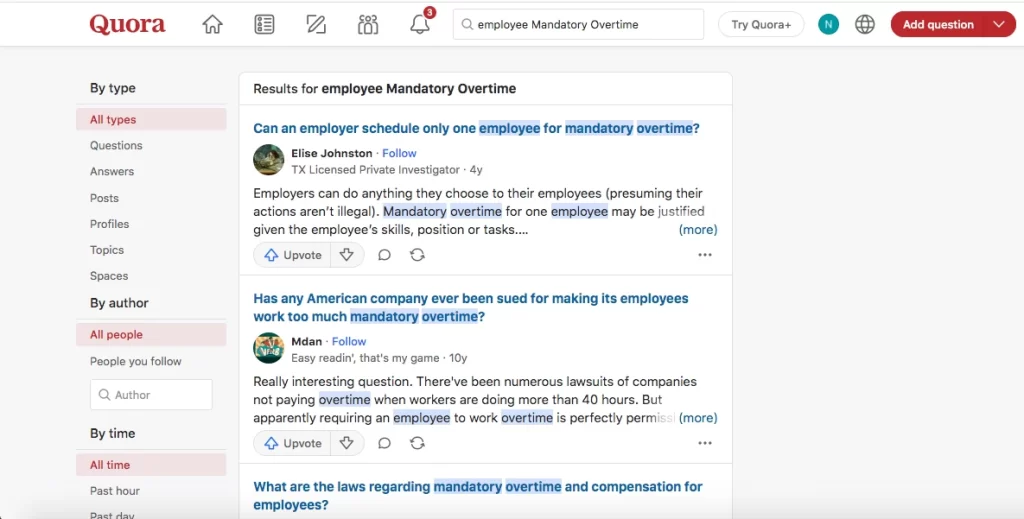
To explore how everyday workers feel about mandatory overtime, we combed through dozens of user discussions on Quora. Here’s a closer look at how real people are experiencing the realities of mandatory overtime.
Modern Indentured Servitude!!
Many users express outrage over what they perceive as the exploitative nature of mandatory overtime. Terry Spalding offers one of the most impassioned takes,
“Mandatory overtime is a f***ed up way the modern work world in America turns working into indentured servitude… It creates feelings of resentment and a loss in employee morale… I think the end goal is to create a perfect slave system.”
Tj Spalding sees the normalization of extended work hours as deliberate,
“Employers realized they maximize more profits intentionally running operations under-staffed, and mandating overtime instead of hiring an adequate amount of people… Full-time basically means 60 hours a week anymore.”
The Toll on Health and Productivity
Some users emphasized the cognitive and physical cost of persistent overtime.
Gomathivinayagam Muthuvinayagam pointed to the long-term inefficiency it produce,
“It reduces productivity. I became inefficient, and started to become lazy… Proper planning is required for a proper work schedule.”
Dipanshu Bhargava argues that the practice of working endless hours cannot be maintained in the long run.
“There is always going to be more work – so say NO! We are not supposed to be all-work machines… Your job is not your life, it is a part of your life. Enjoy both.”
When Overtime Is Necessary
While many respondents criticized the concept of mandatory overtime, others offered supportive perspectives.
Steve Baker defends overtime in some jobs,
“There are some service industries that absolutely MUST have coverage 24/7… If you made [mandatory OT] illegal, you’d be sitting without gas, water or electricity all through Xmas… There are places like steel mills where the foundry can literally never be shut down.”
Carol of the Forest made a similar point,
“What do you do with nursing home residents during a natural disaster… because people don’t want to stay or the law prohibits it? You leave them lying there with no food, no medicine?”
Limited and Compensated Overtime
Some users believe a middle ground is possible. Juan Espinosa suggests,
“Overtime should not be regularly scheduled… but it should definitely be limited and require additional compensation… if the employee exceeds that limit.”
Terry Bowden described how companies like Xerox attempt to balance workload needs with employee rights:
“After volunteers were placed on the schedule… they would then calculate how to fill the remaining slots. That’s when it became mandatory but was usually limited to 4 to 6 hours beyond the regular shift.”
Conclusion
Mandatory overtime remains legal for good reason—it provides essential flexibility for businesses while creating premium compensation opportunities for workers. But this system requires careful navigation by both employers and employees.
For workers, understanding your specific rights and the limited exceptions to mandatory overtime is crucial. For employers, balancing business needs against potential legal issues and productivity impacts requires thoughtful policy development.
As work patterns continue evolving, expect overtime regulations to adapt accordingly—potentially creating new protections while preserving the fundamental structure of America’s time-and-a-half approach to extended hours.
Key Takeaways for Employers and Employees
– Mandatory overtime is generally legal with very specific exceptions
– Premium pay requirements create financial incentives against excessive overtime
– Documentation is essential for both compliance and dispute resolution
– State laws often provide additional protections beyond federal requirements
– Accommodation requirements create the most significant limitations on mandatory overtime
Resources for Understanding Your Overtime Rights
– Department of Labor Wage and Hour Division: www.dol.gov/agencies/whd
– State labor department websites for state-specific regulations
– EEOC guidelines on overtime accommodations: www.eeoc.gov
– Industry associations for sector-specific overtime standards
– Legal aid organizations for assistance with overtime violations
When to Seek Legal Counsel for Overtime Disputes
Consider professional legal assistance when:
– Your overtime pay has been incorrectly calculated or denied
– You’ve been refused legally-required accommodations affecting overtime
– Your employer has retaliated against you for overtime-related complaints
– You’re developing policies that must comply with complex overtime regulations
– You face unusual overtime situations not clearly addressed by standard regulations
Hire the best candidates
with Wetest.
Create pre-employment assessments in minutes to screen candidates, save time, and hire the best talent.
Try for free