Final Paycheck Laws for Terminated Employees: A Quick Guide
Human resources
Bonica
April 4, 2025
What happens with the final paycheck when a job ends? Some laws are designed to protect the rights of both terminated employees and employers.
These laws bring clarity on timelines and legal obligations. Understanding these laws feels overwhelming as they vary from one state to another.
Employees must understand their rights regarding final pay. This ensures they receive all earned compensation without unnecessary delays.
Companies have a legal responsibility to follow the rules about final paychecks. Not doing so leads to costly fines.
The FLSA law governs many aspects of employee compensation. It does not explicitly dictate how final wages should be paid. These specifics are often determined by state laws.
Some states require employers to issue the final paycheck on the same day as termination. Others allow longer periods.
Why is understanding these laws so important? Employees ensure they’re financially stable when they quit and employers avoid lawsuits. They benefit from a clear understanding of their responsibilities.
Final paycheck laws show that companies should be transparent and accountable. They emphasize the importance of a smooth departure process in difficult situations like being fired.
Table of Contents
General Overview of Final Paycheck Laws
Final paycheck laws are a crucial part of employment regulations. They are designed to ensure employees are fairly compensated.
These laws give clear rules about when a company has to pay a fired employee their final wages. Companies must pay final wages on time when someone is fired.
The federal Fair Labor Standards Act governs certain aspects of compensation. It does not regulate the timing or conditions of final paychecks. These details are left to state governments.
California requires employers to give final paychecks immediately when someone is terminated. Texas gives employers up to six days. Understanding these differences is essential to avoid misunderstandings.

Another key part of final paycheck laws is making sure earned benefits are included. Unused vacation days or commissions need to be included in the final paycheck.
Some states allow employers to set their policies regarding unused benefits. They have to follow local laws and make sure it’s clear in the employment agreement.
Employers should also know that there can be serious penalties for not following the final paycheck laws. They include additional wages or even legal action brought by the employee.
These laws provide a vital safety net for employees. They guarantee that workers receive the money they’re owed without any unnecessary delays. Final paycheck compliance proves employer professionalism.
Knowing how federal and state regulations work together is vital for correctly following final paycheck laws.
State-by-State Breakdown

Each state sets its requirements for when and how terminated employees should receive their final wages.
Some states have strict timelines and detailed regulations. Others provide more flexibility or lack specific laws altogether.
We need to simplify this complex landscape! Here’s a general breakdown of final paycheck requirements across various states.
Alabama
- No specific laws! State law doesn’t require employers to give final paychecks within a certain time.
Alaska
- Involuntary termination: Final pay is due within three business days of your last day.
- Voluntary resignation: Final wages are due on the next regular payday which is at least three days after the employer received notice of the employee’s resignation.
Arizona
- Involuntary termination: Your employer has to pay you within seven working days or on your next regular payday.
- Voluntary resignation: Final wages are due by the next regular payday.
Arkansas
- All terminations: Your last paycheck is due on your next scheduled payday.
California
- Involuntary termination: Your employer has to pay you immediately when you’re terminated.
- Voluntary resignation with at least 72 hours notice: Final pay is due on your last day of employment.
- Voluntary resignation without 72 hours’ notice: Final wages are due within 72 hours.
Colorado
- Involuntary termination: Your employer must pay you immediately when you are terminated.
- Voluntary resignation: Final wages are due on the next regular payday.
Connecticut
- Involuntary termination: Payment of final wages must be made by the close of the next business day after termination.
- Voluntary resignation: The employee’s final wages are due on the next regular payday.
Delaware
- All terminations: Your final pay is due on your next scheduled payday.
District of Columbia
- Involuntary termination: Final wages are due within one working day.
- Voluntary resignation: The employee’s final wages are due on the next regular payday or within seven days of termination.
Florida and Georgia
- No specific laws!
Hawaii
- Involuntary termination: Final wages are due immediately after termination or the next working day.
- Voluntary resignation: Final wages are due on the next regular payday or immediately if the employee gives at least one pay period’s notice.
Idaho
- Final wages are due by the next regular payday or within ten days.
Illinois
- Your final pay is due on your next payday.
Indiana and Lowa
- All final wages are due by the next payday.
Kansas
- Involuntary termination: Payment of final wages is due within the next seven days.
- Voluntary resignation: Final wages are due by the next regular payday.
Kentucky
- Payment of final wages is due by the next regular payday or within fourteen days.
Louisiana
- Involuntary termination: Final wages are due within fifteen days or by the next regular payday.
- Voluntary resignation: The employee’s final wages are due on the next regular payday.
Maine
- Final wages are due within a reasonable time after demand, not to exceed two weeks.
Maryland
- You get your last check on your next payday.
Massachusetts
- Involuntary termination: Final wages are due immediately upon termination.
- Voluntary resignation: Final wages are due by the next regular payday or the following Saturday.
Michigan
- The deadline for your final paycheck is your next scheduled payday.
Minnesota
- Involuntary termination: Final wages are due within twenty-four hours of demand.
- Voluntary resignation: Your last check is due on your next payday.
Mississippi
- No specific laws!
Missouri
- Involuntary termination: Final wages are due immediately upon termination.
- Voluntary resignation: Final wages are due by the next payday.
Montana
- Involuntary termination: Your employer has to pay you immediately when you’re terminated.
- Voluntary resignation: Final pay is due on the next payday or within fifteen days.
Nebraska
- Final wages are due by the next payday or within two weeks.
Nevada
- Involuntary termination: Final wages are due immediately after termination.
- Voluntary resignation: Final wages are due by the next regular payday or within seven days.
New Hampshire
- Final wages are due within seventy-two hours.
New Jersey
- Payment of final wages is due by the next regular payday.
Federal rules apply in a state that doesn’t have specific laws about final paychecks. Employers still have to follow their contracts.
Special Considerations

We have to go beyond the basic timeline requirements and touch on critical aspects such as allowable deductions and payment methods.
Accrued Benefits and Deductions
Most of the employees have no clue about the rules of getting paid for accumulated benefits. The answer largely depends on state law and the employer’s written policies.
Unused Vacation Days
Accrued vacation is considered earned compensation and must be paid out in the final paycheck in many states.
States like California and Massachusetts require employers to include unused vacation pay. Texas only mandates this payment if it is explicitly stated in the employee’s contract.
Sick Leave
The treatment of sick leave is typically different from vacation pay.
Employers are not required to pay out unused sick leave in most states unless the policy explicitly allows it.
Other Benefits and Deductions
Bonuses are also included in the final paycheck. It depends on the terms of the employment agreement. The timing of the earned compensation is also important.
Deductions from final paychecks are permissible under certain circumstances.
Common deductions include the cost of unreturned company property and reimbursement for loans. Deductions cannot reduce the employee’s pay below the minimum wage.
Method of Payment

Final paycheck laws also govern how employees must receive their final wages.
Direct Deposit
Employers can use direct deposit for final payments if the employee has previously authorized this method.
Mailed Check
Employers may send the final paycheck via mail as long as it arrives within the required timeframe.
In-Person Delivery
Some states require employers to deliver the final paycheck in person for immediate terminations.
Employees should be notified of how their final paycheck will be delivered.
A Quora Rundown
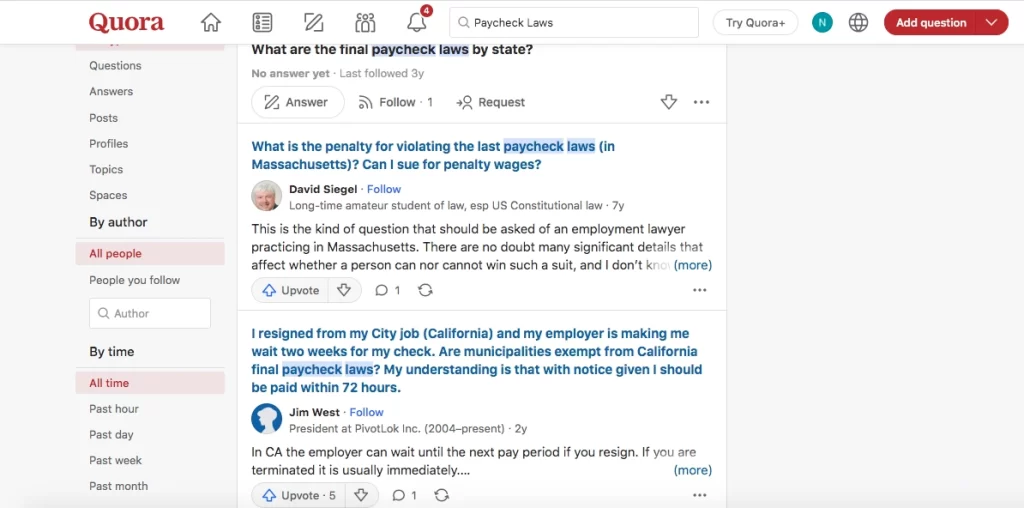
Quora has lots of personal stories and expert advice about what happens when employees are terminated and when they should receive their final paychecks.
Timing of the Final Paycheck
Users on Quora seem to agree that when you get your final paycheck depends on the laws in your state and the reason you left your job.
Sheila Greenlee agrees that employers are legally required to provide the final paycheck on the day of termination in states like California. This means working with a payroll service to quickly calculate how much is owed.
Philip Klossner noted that certain situations like abrupt terminations allow for delays of up to 72 hours when mailing is involved for remote employees or those unable to collect in person.
He also mentioned that the timing of payment depends on the nature of the termination.
Deductions and Withholdings

Avery Kennedy emphasized that employers are not allowed to deduct for unreturned equipment or other company property. She explained that unauthorized deductions must be treated as a civil matter and that withholding pay due for these reasons is illegal.
Kevin Murphy explained that sometimes employees agree to deductions from their pay for missing equipment! This has to be clearly agreed upon beforehand. He also said that employees must be paid their full amount even if there are unresolved disputes.
Steps to Take if Final Paycheck is Delayed
Users shared practical advice for employees who face delays.
Philip Klossner recommended sending a notarized letter to the employer demanding the final paycheck and citing legal deadlines. He believes that traditional mail carries more weight in legal disputes than modern communication methods like emails.
Bill Edelblute is a licensed attorney. He advised turning to the state’s Department of Labor if employers fail to comply. The DOL processes complaints and pursues cases against employers who withhold wages.
Consequences for Employers
Philip Rabe shared a case where an employer in California was penalized with daily fines equivalent to eight hours of the employee’s daily rate for delaying the paycheck.
Bill Edelblute added employers face double damages for willful failure to pay wages while covering the employee’s legal fees.
Tim Krauskopf noted that mishandling terminations creates a toxic work culture. He warned that employees pay close attention to how their peers are treated. This hurts the company’s reputation and makes it harder to attract good employees.
Benefits and Additional Payouts

Philip Klossner pointed out that accrued vacation time is included in the final paycheck and unused sick time payouts depend on company policies.
He also said that the money you contribute to your 401(k) is safe, but the employer’s matching contributions depend on a vesting schedule. Employees should review their benefits to know what they’re entitled to.
Legal Remedies and Real-Life Examples
Avery Kennedy and Bill Edelblute stressed that employees can seek legal representation if employers fail to pay. Edelblute noted that even simple demand letters from attorneys get employers to take action.
Philip Rabe shared his experience of an employer delaying his paycheck. He received compensation for 21 days at his full daily rate.
Conclusion
Understanding when and how to receive your final paycheck is essential for navigating the often complex process of employment termination.
The rules about your final pay depend on your state. Learn the state-specific laws.
Understanding your rights regarding unused benefits and penalties for late payments allows you to take action when necessary.
Being knowledgeable is always crucial for avoiding disagreements.
Hire the best candidates
with Wetest.
Create pre-employment assessments in minutes to screen candidates, save time, and hire the best talent.
Try for free