Job Description vs Job Specification: Complete Guide to Understanding the Key Differences
Business strategy
Bonica
August 19, 2025
Did you know that a huge 73% of companies struggle with making bad hiring decisions? That happens mostly because they don’t have clear job requirements. A lot of businesses get all mixed up and confuse job descriptions with job specifications.
They think those papers are the same thing, but they’re not. A job description tells you what the job involves. It lists things like duties, tasks, and responsibilities. A job specification tells you what kind of person can do that job well.
It lists the skills, education, and experience you need. Both documents are super important for hiring the right people. They also help you keep good employees. When you understand the difference, you can hire better and avoid costly mistakes.
This guide is going to show you exactly how these documents work. You’ll learn when to use each one and why both of them are so important for your success.
Table of Contents
Job Description Deep Dive: Your Roadmap to Role Clarity

Here you’ll learn what a job description is and why it guides both employers and employees.
What is a Job Description? Core Definition and Purpose
A job description is a written document that explains a specific job. It tells you what someone does in that role every day. Think of it as a roadmap for the position.
The main purpose is communication. It helps employers and employees understand the role clearly. It sets expectations from day one. This prevents confusion later.
Job descriptions also have legal importance. They protect companies during hiring and firing decisions. They show that decisions are based on job needs, not personal bias.
Essential Components of Effective Job Descriptions
Every good job description needs certain parts. The job title comes first. It should be clear and specific. Avoid fancy names that confuse people.
The job summary explains the role’s main purpose. Keep it short and direct. Tell readers why this job exists.
Next, list key responsibilities. Use action words like “manages,” “creates,” or “analyzes.” Put the most important tasks first. According to research, 76% of job seekers read entire job descriptions before applying.
Include reporting relationships. Show who the person reports to. Also show who reports to them, if anyone.
Describe working conditions. Tell people where they’ll work. Mention any special requirements, like travel or physical demands.
Add salary range and benefits. People want to know what they’ll earn. Being upfront saves everyone time.
Types of Job Descriptions
Companies use different types of job descriptions. Internal versions focus on performance management. They’re detailed and specific. External versions attract candidates. They’re more marketing-focused.
Generic descriptions work for common roles. Specific descriptions work for unique positions. Choose the right type for your needs.
Some descriptions focus on legal compliance. Others focus on attracting talent. The best ones do both.
Real-World Examples and Analysis
Let’s look at a Marketing Manager position. A good description starts with a clear title. It explains that this person leads marketing efforts.
The responsibilities might include:
- Developing marketing strategies
- Managing advertising campaigns
- Analyzing market trends
- Leading a team of three people
A poor description would be vague. It might say “handles marketing stuff.” This doesn’t help anyone understand the real job.
Different industries need different approaches. Healthcare jobs need detailed compliance information. Tech jobs focus on technical skills. Manufacturing jobs emphasize safety requirements.
Job Specification Mastery: The Blueprint for Perfect Candidate Fit

This part defines job specifications and shows how they pinpoint the ideal candidate profile.
Understanding Job Specifications: Definition and Strategic Value
A job specification lists what a person needs to do a job well. It’s like a shopping list for the perfect candidate. While job descriptions focus on the work, specifications focus on the worker.
These documents help predict job success. They guide your hiring decisions. They also help screen candidates quickly.
Specifications make interviews more focused. You know exactly what to look for. This saves time and improves hiring quality.
Comprehensive Components of Job Specifications
Education requirements come first. List needed degrees or certifications. Be realistic about what’s truly necessary.
Professional experience matters too. Specify years of experience needed. Include specific industry background if required.
Technical skills are crucial today. List software, tools, or equipment knowledge. Be specific about proficiency levels.
Soft skills often determine success. Communication, teamwork, and problem-solving matter. Research shows that 89% of hiring failures result from poor cultural fit, not skill gaps.
Physical requirements apply to some jobs. Include lifting requirements or mobility needs. Make sure these relate to actual job tasks.
Language skills matter in global businesses. Specify required languages and fluency levels.
Must-Have vs Nice-to-Have Classifications
Separate essential requirements from preferred ones. Must-have qualifications are non-negotiable. These are needed for basic job performance.
Nice-to-have qualifications help you choose between candidates. These add value but aren’t essential.
Avoid over-qualification. Don’t ask for more than the job needs. This limits your candidate pool unnecessarily.
Industry-Specific Specification Deep Dive
Healthcare jobs need specific licenses. A Registered Nurse needs state licensing and CPR certification. They also need clinical experience and strong communication skills.
Technology roles require technical expertise. A Full-Stack Developer needs programming languages, database knowledge, and problem-solving abilities.
Finance positions demand analytical skills. A Financial Analyst needs accounting knowledge, Excel expertise, and attention to detail.
Retail management combines people skills with business knowledge. A Store Manager needs leadership experience, sales background, and customer service skills.
Detailed Comparison: Job Description vs Job Specification

You’ll see a side-by-side look at how descriptions and specifications differ in purpose and content.
Comprehensive Difference Matrix
The purpose differs between these documents. Job descriptions explain what needs to be done. Job specifications explain who can do it.
Content focus varies, too. Descriptions focus on tasks and duties. Specifications focus on qualifications and skills.
Target audiences are different. Descriptions help current employees understand their roles. Specifications help recruiters find the right people.
Document structure differs as well. Descriptions are organized by responsibilities. Specifications are organized by requirement types.
Creation Timeline and Usage Patterns
Job descriptions usually come first. You need to understand the role before finding someone to fill it. Specifications follow once you know what the job involves.
During recruitment, both documents work together. Descriptions attract candidates. Specifications screen them.
HR systems use both documents differently. Descriptions help with performance reviews. Specifications help with candidate matching.
Legal and Compliance Considerations
Both documents must follow employment laws. They can’t discriminate based on protected characteristics. Requirements must relate to actual job performance.
The Americans with Disabilities Act affects both documents. You must provide reasonable accommodations. Physical requirements must be essential job functions.
Documentation helps during legal challenges. Clear, job-related requirements protect your decisions.
Practical Application Scenarios
Recruiters use specifications to screen resumes. They look for required qualifications first. Descriptions help them explain the role to candidates.
Managers use descriptions for performance reviews. They compare actual work to expected duties. Specifications help them understand what skills to develop.
Candidates use descriptions to understand the role. They use specifications to see if they qualify. Both documents shape their application decisions.
The Strategic Importance: Why Both Documents Are Essential

This section explains how using both documents together drives better hiring, legal protection, and retention.
Recruitment and Hiring Efficiency
Clear job requirements speed up hiring. Candidates self-select based on specifications. This reduces unqualified applications.
Screening becomes faster with good specifications. You can quickly identify promising candidates. Companies with clear job requirements see 40% faster hiring.
Interview quality improves, too. You know exactly what to ask about. This leads to better hiring decisions.
Legal Protection and Risk Management
Proper documentation protects against lawsuits. Job-related requirements defend hiring decisions. Clear expectations support performance management.
Termination decisions need documentation. Job descriptions show what is expected. Specifications show the qualifications needed.
Equal opportunity compliance requires clear standards. Both documents must be fair and job-related.
Employee Experience and Retention Impact
Clear expectations improve job satisfaction. Employees know what success looks like. This reduces stress and confusion.
Career development becomes clearer, too. People can see what skills they need. This helps with promotion decisions.
Onboarding works better with clear documentation. New employees understand their roles faster. This leads to quicker productivity.
Organizational Benefits
Workforce planning improves with clear job definitions. You can better predict staffing needs. Budget forecasting becomes more accurate.
Employer branding stays consistent. All job postings reflect company values. This attracts the right cultural fits.
Succession planning needs clear role definitions. You can identify skill gaps early. Development programs become more targeted.
A Quora Rundown
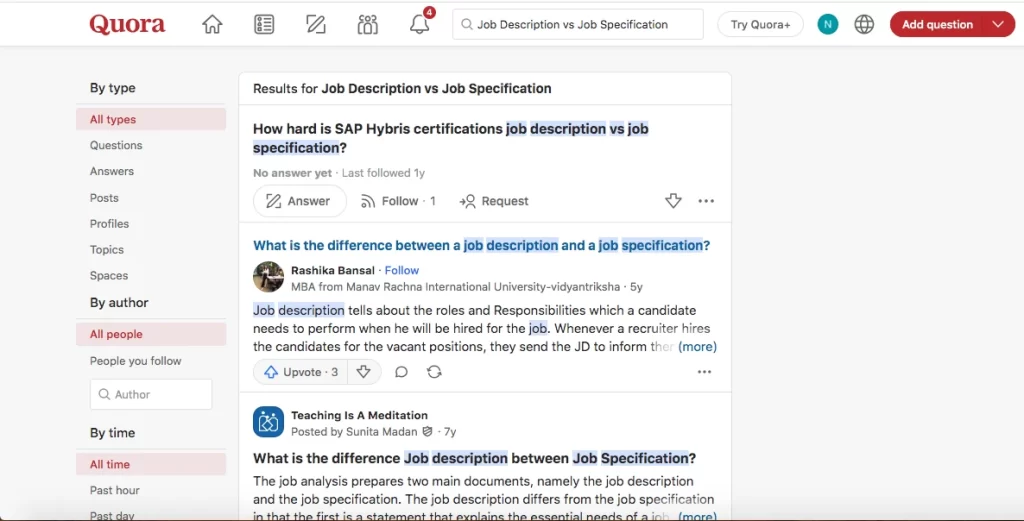
Below is a synthesis of real-world perspectives from Quora users on the difference between a job description and a job specification.
Community Definitions and Core Distinctions
Rashika Bansal:
“Job description tells about the roles and Responsibilities which a candidate needs to perform when he will be hired for the job… And job specification tells about the skills, knowledge and qualities which are required in a specific job like as what should be the educational qualification, skills, etc which are necessary to a job profile.”
Rashika highlights the basic split: “what you do” versus “who you are.” While we’ve already covered duties versus qualifications, her framing as “roles and Responsibilities” versus “skills, knowledge, and qualities” reemphasizes the candidate-centric nature of specifications.
Structured Formats vs. Flexible Profiles
Sadhana
“Common format: Title; duties; roles, environmental conditions; authority and responsibilities… What human traits and experience are required to do the job well? Qualifications, Prior experience, Personality factors, Physical characteristics, Other attributes/qualities.”
Sadhana provides a highly structured template for both documents, stressing that the job description is often broken into identification, summary, duties, and relationships, whereas the job specification becomes a checklist of physical, mental, and social traits.
Executive and Recruiter Perspectives
James Dorsey
“In our executive recruiting firm… A slightly more accurate term might be Position Specification. A PS includes how and where the position fits into the organization… It may also specify the prior industry exposure required, preferred, requested, or considered adequate.”
“A Job Description includes the specific tasks involved in meeting the job requirements… The JD will go into detail about the specific tasks and activities that will be worked on jointly by the roles.”
James introduces “Position Specification” as a strategic layer above specifications, blending organizational context with compensation details. His distinction reminds us that at senior levels, specifications also signal culture fit.
Person Specifications and Role Profiles
Jon Spencer
“A ‘person specification’… focuses on the person required to do that job… It will often distinguish between essential and desirable characteristics—i.e. eligibility criteria, and suitability criteria.”
“Some organizations have ‘role profiles’—which combine elements from both job descriptions and person specifications.”
Jon’s terminology shows that person specifications should explicitly label essential vs. desirable attributes. His mention of role profiles points to hybrid documents that merge duties and candidate traits.
Practical Hiring and Candidate Guidance

Yosef Baskin
“Job specifications list what you need to have (degrees, years of work, skills). Job descriptions list what work you will perform on the job… But if you are the applicant, it doesn’t matter. Applying where you don’t match half the requirements will leave you wondering why they didn’t respond.”
Yosef’s advice shifts perspective to the candidate experience, cautioning job seekers against over-filtering themselves. Specifications can be rigid, but descriptions provide broader insight into day-to-day work.
Common Pitfalls and Maintenance
Cary Silverstein
“It is important to review job descriptions on a regular basis. The components of a job evolve as the business changes… Many job descriptions experience creep over the years and are quickly out of date.”
Cary flags the risk of “job creep”, urging organizations to revisit both documents routinely. This echoes our best practices on scheduled reviews and highlights the dynamic nature of roles.
Job Analysis, Specifications, and Legal Context
Rashika Bansal (again)
“Job analysis… is the systematic analysis of tasks, duties and responsibilities… The important thing is that the analysis of a job is conducted and not of the person.”
Pairing this with John Voloudakis’s note that job descriptions carry little legal weight compared to contracts shows two layers: job analysis as the foundational study, job descriptions as internal guides, and employment contracts as legally binding agreements.
Anecdotal Insights: When Roles Go Awry
Roy Chambers
“I worked in a place where the CEO hired someone to do a job, but there was already someone doing that job… they had to create a whole new division to give that person a job… poorly managed companies often end up with staff with no clear job, resources or position in the company.”
Roy’s story proves the perils of unclear descriptions.
Creation Best Practices and Implementation Guidelines

Learn step-by-step tips for writing, reviewing, and maintaining effective job documents.
Writing Excellence Standards
Use active language in both documents. Start sentences with action verbs. This makes expectations clearer.
Avoid biased language. Focus on job-related requirements only. Remove unnecessary barriers to employment.
Make documents searchable online. Use keywords that candidates search for. This improves job board visibility.
Format for mobile devices. Many people search for jobs on their phones. Short paragraphs and bullet points work better.
Collaboration and Review Processes
Include key stakeholders in creation. Talk to current employees in the role. Get input from managers and team members.
HR should review for compliance. Legal teams should check for discrimination risks. Senior leaders should approve strategic roles.
Create clear approval workflows. Document who reviews what. This ensures nothing gets missed.
Technology Integration
Make documents work with your hiring systems. Most applicant tracking systems need specific formats. Test compatibility before launching.
Optimize for job boards. Different sites have different requirements. Tailor your postings accordingly.
Track performance with analytics. See which descriptions attract better candidates. Update based on results.
Maintenance and Update Protocols
Schedule regular reviews. Annual updates work for most roles. More frequent updates may be needed for fast-changing positions.
Monitor industry trends. New technologies may change requirements. Stay current with market conditions.
Update based on feedback. Listen to hiring managers and employees. Continuous improvement leads to better results.
Advanced Strategies and Modern Trends

Discover how AI, remote work, and DEI initiatives are reshaping job descriptions and specifications.
Digital Transformation Impact
Artificial intelligence is changing job matching. AI can compare candidates to specifications automatically. This speeds up initial candidate screening.
Video job descriptions are becoming popular. They show workplace culture better than text. Consider this for hard-to-fill roles.
Social media integration helps reach more candidates. LinkedIn and other platforms use job description keywords. Optimize your content for these channels.
Remote work changes both documents. Specifications need self-management skills. Descriptions must address virtual collaboration.
Diversity, Equity, and Inclusion Integration
Remove biased language from both documents. Words like “ninja” or “rock star” can exclude people. Use inclusive terminology instead.
Question degree requirements. Many skills can be learned outside college. Focus on abilities rather than credentials when possible.
Consider cultural competency needs. Global teams need cross-cultural skills. Include these in specifications when relevant.
Skills-Based Hiring Evolution
Focus more on what people can do. Portfolio reviews may matter more than degrees. Project-based evaluations show real ability.
Micro-credentials are gaining acceptance. Online certifications may replace traditional requirements. Stay open to new forms of qualification.
Competency-based specifications work better. They focus on outcomes rather than inputs. This can expand your candidate pool.
Common Pitfalls and How to Avoid Them

Identify frequent mistakes in drafting these documents and practical ways to steer clear of them.
Content-Related Mistakes
Avoid writing novels. Long descriptions discourage applicants. Keep both documents focused and readable.
Don’t create impossible wish lists. Requiring everything limits your options. Prioritize what really matters.
Update regularly. Outdated information hurts credibility. Set reminders to review documents periodically.
Include company culture information. Skills matter, but fit matters too. Help candidates understand your workplace.
Process and Implementation Errors
Get input from the right people. Current role holders know the job best. Managers understand performance requirements.
Have a legal review of everything. Employment law is complex. Professional review prevents problems later.
Control document versions carefully. Old versions can cause confusion. Use clear naming and storage systems.
Strategic Misalignment Issues
Make sure documents match reality. Overselling roles leads to quick turnover. Be honest about challenges and opportunities.
Keep salary information current. Outdated ranges waste everyone’s time. Regular market research helps here.
Align with employer branding. All communications should feel consistent. This builds trust with candidates.
Measuring Success and ROI

Explore the key metrics and feedback loops that prove the value of clear job requirements.
Key Performance Indicators
Track time-to-hire improvements. Better documents should speed up the process. Measure before and after changes.
Monitor application quality. Good specifications should attract better candidates. Track interview-to-hire ratios.
Measure new employee performance. People hired with clear expectations should succeed faster. Compare performance ratings.
Check employee retention rates. Clear role understanding should reduce turnover. Track both short-term and long-term retention.
Continuous Improvement Processes
Collect feedback from hiring managers. Ask what’s working and what isn’t. Use this input for improvements.
Survey candidates about their experience. Even rejected candidates can provide valuable insights. Learn from their perspective.
Review performance evaluations. See if job descriptions match actual work. Update documents based on reality.
Conduct regular effectiveness audits. Compare your hiring success to industry benchmarks. Identify areas for improvement.
Conclusion and Future Outlook
Job descriptions and job specifications serve different but equally important purposes. Descriptions focus on the work itself. Specifications focus on the worker needed.
Both documents work together to improve hiring. They set clear expectations and attract the right people. They also protect your organization legally.
The future will bring more changes. Technology will automate some processes. Skills-based hiring will grow. Remote work will create new requirements.
Start improving your documents today. Review what you have now. Update outdated information. Get input from key stakeholders.
Remember that good hiring starts with clear requirements. Invest time in these documents. The payoff in better employees is worth the effort.
Your next great hire is waiting. Give them the clear information they need to find you.
FAQs
Basic Understanding
What’s the fundamental difference between a job description and a job specification?
A job description outlines the duties, responsibilities, and scope of a role, while a job specification details the skills, qualifications, and attributes required to perform it.
Can job descriptions and specifications be combined into one document?
Yes, many organizations merge them into a single document for simplicity, but separating them can help HR teams and candidates focus on different aspects more clearly.
How often should these documents be updated?
Ideally, review and update them annually or whenever a role significantly changes due to business needs, restructuring, or new technologies.
Creation and Management
Who should be involved in creating job descriptions and specifications?
HR professionals, direct supervisors, and sometimes current employees in the role should collaborate to ensure the documents are accurate and aligned with real-world expectations.
What’s the difference between “must-have” and “nice-to-have” qualifications?
“Must-haves” are essential qualifications without which a candidate cannot perform the job, while “nice-to-haves” are desirable but not critical and may offer added value.
How can companies avoid discrimination in job specifications?
Use inclusive language, focus on objective criteria, avoid age or gender-biased terms, and ensure requirements are directly related to job performance.
Legal and Compliance
Are job specifications legally binding requirements?
Not directly, but they can be used as evidence in legal cases related to discrimination, wrongful termination, or disputes over employment qualifications.
How do industry regulations affect job specifications?
Certain industries require job specifications to meet regulatory standards for safety, licensing, or skill certifications, especially in healthcare, aviation, and engineering.
What role do job descriptions play in salary determination?
Job descriptions help benchmark roles against market standards, clarify responsibilities, and support transparent compensation frameworks.
Modern Workplace Considerations
How do remote work arrangements affect job descriptions and specifications?
They now include digital collaboration tools, location flexibility, time zone considerations, and greater emphasis on self-management and communication skills.
What’s the impact of AI and automation on job documentation?
Job descriptions are evolving to reflect new tools, reduced manual tasks, and required adaptability to technological change. Soft skills are gaining increased importance.
How do these documents support diversity, equity, and inclusion efforts?
They guide fair hiring by standardizing criteria, removing biased language, and ensuring roles are accessible to a broader range of candidates.
Performance and Impact
How do these documents impact employee performance reviews?
They serve as benchmarks for evaluating how well an employee meets their responsibilities and whether they align with expectations.
How do job descriptions support internal mobility?
Clear documentation helps identify transferable skills and qualifications across roles, making it easier to promote or laterally move employees.
What are the cost implications of poorly written job documents?
Vague or outdated documents can lead to hiring mismatches, legal risks, low retention, and productivity loss—all of which drive up operational costs.
Hire the best candidates
with Wetest.
Create pre-employment assessments in minutes to screen candidates, save time, and hire the best talent.
Try for free