Group Communication: Different Types and Strategies
Employee relations
Bonica
February 10, 2026
The way groups communicate is a huge deal for how modern companies hire people and work together.
Group communication is what keeps productivity on track. It’s the same for a hiring team trying to agree on a candidate or different departments chasing the same goals.
Knowing how to talk in a group is a necessary skill that managers are always hunting for. It’s just three or more people swapping ideas and feedback to get something done.
This happens in meetings or even in shared Google Docs. Each way of talking changes how clear the message stays and how into the work everyone feels.
Companies that get it right can spot good communicators easily and keep things running smoothly without all the internal drama. That’s exactly why you see good communication on every single job post out there.
Getting good at this levels up your career. You’re going to get noticed and promoted faster if you can speak up clearly in a group. Work is getting more digital, and being adaptable is worth its weight in gold.
Table of Contents
What Is Group Communication?
Group communication is what happens when three or more people get together to swap opinions with a goal in mind.
That goal might be finishing a project or just getting everyone on the same page with company goals. It’s different from just chatting with a friend because it needs some structure. You have to keep a lot of different viewpoints in mind at once.
It’s when people talk as a group instead of just one-on-one. You see this in brainstorming. You have to be extra clear and wait for your turn to speak.
People mix up individual and team communication all the time. Individual talk is like a manager giving you a heads-up. Those are more personal and easier to manage.
Team communication is just the small circle you work with every day who already know their roles. Group communication is bigger and more random. It might involve people from all over.
Everyone sees things differently! If the communication doesn’t work, you end up with biases. It’s way more complex than talking to one person because your message has to make sense to everyone at the same time.
There’s a bigger risk of people getting overwhelmed. Some voices can be drowned out as well. That’s why being good at listening and getting straight to the point is huge at work. Mastering this helps you collaborate better and share your ideas with confidence.
Types of Group Communication
You have to understand how group communication works if you want a team that doesn’t fall apart.
Being clear and moving fast is everything. You have all these different channels to pick from, and you choose based on what the team looks like and how urgent the task is.
You’ll see way fewer misunderstandings if you pick the right way to talk. It helps everyone make smarter decisions together. I have broken down the most common types of group talk you’ll run into.
In‑Person Meetings

In-person meetings are about as traditional as it gets for group communication.
It’s just the team gathering in one physical spot to swap info and make decisions right then and there. You’ll usually see this for starting a new project and those final hiring chats.
The biggest win here is being able to read the room. Picking up on body language and facial expressions tells you a lot about how people are feeling.
Having the whole team in one room for a debrief leads to much better feedback. Take note that they’re difficult for remote teams and can become a waste of time if they aren’t structured well.
You need an agenda and a way to make sure everyone gets a chance to speak for it to be worth it.
Conference and Video Calls
Video calls have changed the game for how groups communicate. They let teams work together live, no matter where they are.
They’re used for updates or quick huddles. Tools like Google Meet are useful for sharing screens and recording meetings. It’s also made hiring way easier since you can connect with stakeholders anywhere. The big win is that it saves time and supports a flexible schedule.
The main win is accessibility. It saves time and supports a flexible schedule. Take note that you will have tech glitches, and the fact that people get tired of staring at screens.
Good virtual communication depends on making sure everyone is participating.
Written Group Communication
Written group communication covers emails and memos as well as shared docs and formal reports. It creates a permanent record that everyone can refer back to whenever they need.
It’s the go-to for scheduling and getting final approvals. The main strength here is that it keeps everyone on the same page with the same information.
It’s great for asynchronous work. People can reply when they have a second.
The downside is that the tone can always be misunderstood without a face. People also just tune out if messages are too long.
You should keep things concise and easy to scan with clear headers and bullet points so nothing gets missed.
Digital Messaging and Collaboration Platforms
Apps like Slack and Asana have completely shifted how workplace groups communicate.
These platforms are great because they combine quick messaging with task management.
It’s way easier to ask a quick question or get feedback without the whole formal email vibe.
Hiring teams use these constantly to handle interview logistics or share quick thoughts on a candidate.
It’s also nice to have everything centralized so info doesn’t get scattered.
Be aware that important stuff can get buried in long threads. The constant notifications can be distracting as well.
Teams need to agree on what stays in the chat and what needs to be formally recorded.
Formal vs. Informal Channels
Workplace group communication falls into either formal or informal categories.
Formal communication is the official side of things. It covers set meetings, documented reports, and structured emails. These are non-negotiable for hiring processes because you need a paper trail for big decisions.
Informal communication is the more casual side. This covers quick messages or spontaneous desk chats. These help people get along and allow the team to resolve small issues on the fly. A quick message to clarify feedback can keep a hiring process moving without waiting for a meeting.
Knowing when to switch between the two is a skill. Formal is for the heavy lifting and long-term plans. Informal is for staying agile.
Great teams find a balance so they’re professional but not bogged down by red tape.
Common Challenges in Group Communication
There are always challenges in how people hear and act on information.
It’s important to understand these obstacles. You need to know how to spot whether a new hire can communicate well when things get confusing in a group.
Dealing with these problems head-on helps cut down on friction and keeps the team’s energy high. It makes the whole hiring process way more effective because you know what communication red flags to look for.
Barriers to Effective Group Communication
Distance is a major hurdle for group communication with remote work. You lose that in-the-moment clarity you get in person.
Time zone gaps and slow response times can stall a project.
Language barriers are another big one in multicultural teams. Different communication styles can cause people to misread each other. This leads to some team members being overlooked.
There’s the issue of perception as well. Everyone interprets messages differently based on their own background.
Make sure everyone truly understands the why behind a message. The team can easily get out of sync.
Role Ambiguity and Team Conflict
Unclear roles are a reason why group communication breaks down.
Messages get sent twice or ignored when people aren’t sure who’s responsible for decisions or follow-ups.
This kind of ambiguity just leads to inefficiency and a lot of annoyed coworkers. Not knowing who has the final say can cause the team to talk in circles. This delays everything and makes the process look bad.
Conflict also pops up when there isn’t enough psychological safety. This is when the loud voices dominate. The quieter people just stop trying.
You need to set expectations and a constructive way to resolve any friction that comes up.
Group Communication Strategies
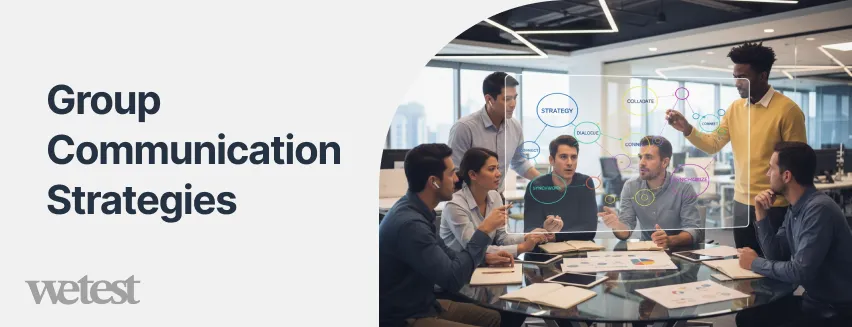
Great group talk doesn’t just happen on its own. It’s all about being intentional. Use deliberate strategies to build trust and keep everyone aligned.
These strategies are for managers who want to level up how they work together.
Establish Clear Goals and Roles
You avoid all that annoying confusion and double-work when everyone knows the goals and who’s doing what.
Using a framework like RACI is a great way to map out who’s making the decisions and who’s just staying in the loop.
This is key during hiring. You need to know exactly who is hunting for talent and who is sending out the offer letters.
New employees feel way more confident when their onboarding tells them exactly how they’ll be measured and who to go to with questions.
Encourage an Open Environment
Transparent talk is how you build psychological safety. This is when people aren’t scared to share ideas or feedback.
This gets everyone talking. Not just the senior or the loudest person in the room. Transparency looks like sharing the right info openly and explaining the why behind decisions.
It helps the whole team stay aligned and keeps things unbiased. You can squash confusion before it gets out of hand when teams are upfront with each other.
Provide Two-Way Feedback
Talking in a group is at its best when it goes both ways. Two-way feedback makes sure that whatever is said isn’t just floating out there. It’s received and acted on.
Active listening is the big skill here. It means you’re asking follow-up questions and making people feel heard.
These feedback loops are essential if a team wants to grow and not just stay stuck. Offices that share feedback are way more agile.
It helps everyone get on the same page. Listening well is just a sign of respect that keeps the group’s vibe positive.
Use Technology Tools Strategically
We’re all leaning on tech for group talk these days. It only works if you’re using the right tool at the right time.
Video calls and instant messaging are great for quick huddles or just getting to know each other. But email and shared docs are the way to go for the deep details or tasks that can wait.
Using the wrong tool is a recipe for a headache. You’re going to lose the why behind your decisions if you’re making big calls in a chat app without documenting them.
A smart strategy is to set some basic rules on which channel to use for what. The important info is always there when people need it.
Hold Regular Check-Ins
Doing quick standups is a great way for a group to stay aligned and spot issues early.
You can share updates and flag any blockers without having to sit through a boring discussion.
They help everyone stay connected and keep the communication moving across the whole team.
Hiring squads benefit a lot from these syncs as well. It’s how you track candidates and make fast calls on who to move forward with.
Apply Written Communication Best Practices
Written communication is still a massive deal for teams with all the video calls we do.
When you write clearly, it helps everyone process the info without having to guess what you’re trying to say.
Stick to clear subject lines, bullet points, and very obvious action items.
Tone matters a lot as well. You want to be professional and inclusive when you’re representing a brand.
Way too long emails confuse people and bog the whole project down. Good writing skills do make the whole team perform better.
A Quora Rundown
This section brings in perspectives from Quora users who have shared thoughts on group communication.
Building Blocks in Group Communication
Quora users emphasized that group communication is about fundamentals done well.
Ram Naresh Jha is an AI researcher. He breaks it down simply by focusing on what keeps a group functional.
“Five Essential Elements of Group Communication: Goals. Members. Interaction. Interdependence. Working.”
Antrika describes herself as someone who wants to inspire.
“Members are the most important to form groups. A group cannot be formed without members.”
When Group Communication Isn’t the Best Option
Some users discussed that group communication is not always ideal.
Sabine Kraus explains why one-on-one communication can sometimes be more effective.
“One-on-one communication fosters deeper connections by enabling focused attention, personalized dialogue, and a safe space for vulnerability.”
The Human Side of Speaking to Large Groups
William Frederick sees group communication as a psychological challenge.
“Some people get ‘spooked out’ when having to address a large group of people… they are putting their self-worth at risk.”
Comprehension Matters More Than Talking
Grayson McKenna challenges a common assumption:
“Communication without comprehension is just noise.”
Respect, Listening, and Shared Standards
Rajat Kamboj is a design engineer. He focuses on everyday behavior.
“One should first be a good listener… do not cut anyone in between… present facts… respect all.”
Timing, Tone, and Emotional Control
Some users are discussing when and how communication happens. Irwin Ashish Coelho points out the importance of timing and emotional awareness.
“If you have something important to say, make it in the morning… attention span keeps dwindling throughout the day.”
Choosing the Right Medium and Audience Awareness
Govindswamy MC considers communication as a series of questions professionals should ask themselves.
“How relevant is the message? How can I structure the message? What medium of communication is more impactful?”
Conclusion
Group communication is the foundation of the modern workplace. It directly affects how teams collaborate and how organizations handle their talent. Strong group communication is a strategic necessity. You’re giving your team a major edge in terms of alignment.
You should be smart about which tools you use. Make sure everyone knows their role from the start.
You need a way to share feedback and evaluate people together. Teams that know exactly who owns what part of the process and keep documented feedback make much better decisions. It’s all about staying aligned so you don’t miss out on great talent.
Your career success is directly tied to how well you handle group dynamics. It’s about whether you can express those ideas clearly when the whole team is watching. Knowing how to adapt when someone has a different communication style from yours makes you look credible.
You’re going to build trust way faster if you can handle conflict constructively.
Just review how your team picks their communication channels and if roles are defined. You’d be surprised how much better documentation or being more intentional in meetings improves your efficiency.
FAQs
What are the main types of group communication?
The main types of group communication include in-person meetings, video or conference calls, written communication, digital messaging platforms, and formal vs informal communication channels.
How can group communication be improved in the workplace?
Group communication improves when teams set clear goals and roles, use the right communication channels, encourage open dialogue, and practice active listening and feedback. Consistency and clarity are key to better collaboration.
Why is group communication important for team success?
Group communication ensures alignment, supports collaboration, reduces misunderstandings, and improves decision-making. Teams that communicate effectively are more successful at achieving shared goals.
What are common barriers to effective group communication?
Remote work distance, language and cultural differences, unclear roles, technology overload, and misinterpretation of messages.
How does group communication affect hiring and interviews?
Group communication impacts how hiring teams align feedback, make decisions, and assess candidates. Recruiters evaluate communication skills in interviews to predict how well candidates will perform in team environments.
Hire the best candidates
with Wetest.
Create pre-employment assessments in minutes to screen candidates, save time, and hire the best talent.
Try for free