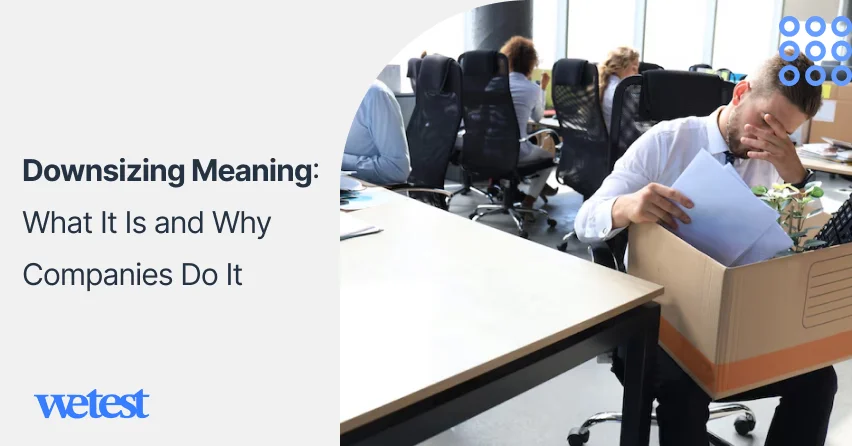
Corporate downsizing is a headline you can’t escape. With major players across industries, including tech giants like Amazon and Meta, cutting hundreds of thousands of jobs in 2023 alone, understanding this trend is vital.
Whether you’re a leader planning changes, an employee focused on job security, or simply tracking economic shifts, grasping downsizing’s fundamentals will empower you.
This guide provides everything you need: a clear definition, the reasons behind it, how it unfolds, and potential alternatives.
Table of Contents
What Is Downsizing? Definition and Core Concepts

Downsizing means a company reduces its number of workers or its work to reach certain goals. It’s a big plan that means getting rid of jobs, closing places, or changing departments to make the company work better with fewer people.
While “downsizing” is the most common term, you’ll often hear other language used to describe similar processes:
– Rightsizing: Framing the reduction as creating the “right” size for current business needs
– Restructuring: Emphasizing organizational changes beyond just headcount reductions
– Layoffs: Focusing specifically on employee terminations
– Reduction in Force (RIF): A formal term often used in corporate communications and legal documents
Unlike routine terminations or performance-based dismissals, downsizing represents a structural change to the organization itself. While individual performance might factor into decisions about who stays and who goes, the primary driver is organizational need rather than employee behavior.
3 Key Types of Downsizing Strategies Companies Implement
Organizations typically pursue downsizing through three main approaches:
1. Workforce Reduction Approaches
– Layoffs and terminations of specific employees or entire departments
– Early retirement incentives to reduce headcount voluntarily
– Buyout offers to encourage voluntary departures
– Attrition strategies that eliminate positions as employees naturally leave
2. Organizational Restructuring Methods
– Flattening hierarchies by removing management layers
– Consolidating departments with overlapping functions
– Closing underperforming locations or facilities
– Centralizing previously dispersed operations
3. Systemic Strategy Changes
– Exiting certain markets or product lines completely
– Outsourcing non-core business functions
– Shifting from in-house to contract-based workforce
– Implementing automation to replace manual processes
Most times, when companies downsize, they use ideas from many different areas. This helps them change the company in a full way.
7 Common Reasons Why Companies Choose to Downsize

Understanding why companies downsize helps contextualize these decisions beyond the headlines. Here are the primary drivers:
Financial Pressures and Cost-Cutting Necessities
Declining profits or worsening economic conditions frequently lead to workforce reduction as the fastest means of cost cutting. Labor accounts for 20-30% of a company’s expenses, making it a primary target during financial distress.
For instance, nearly 40% of companies implemented layoffs in response to the 2020 pandemic’s economic uncertainty, while the 2008 financial crisis saw over 2.6 million jobs eliminated.
Beyond external factors, internal financial pressures such as missed earnings, increasing debt, or investor demands for improved margins can also trigger downsizing. For public companies, workforce reductions often serve to boost short-term stock prices by signaling cost discipline to investors.
Technological Advancements Replacing Human Functions
Digital transformation has dramatically reshaped workforce needs. According to McKinsey, automation could displace 85 million jobs by 2025 while creating 97 million new ones – but these new positions require different skills and are often located in different places.
When companies implement new technologies, they frequently eliminate roles that software or machines can now handle:
– Customer service chatbots replacing call center representatives
– Self-checkout systems reducing retail cashier needs
– Automated manufacturing equipment replacing assembly workers
– AI tools handling tasks previously done by knowledge workers
These technology-driven reductions reflect fundamental changes in how work gets done rather than temporary cost-cutting measures.
Mergers and Acquisitions Creating Redundant Positions
When two companies combine, duplicated roles become an obvious target for elimination. The finance department doesn’t need two controllers. Understanding why downsizing happens includes recognizing redundancies, like a sales team having duplicate regional directors.
Post-merger, the goal is often to capture 10-15% in cost savings, and a significant portion comes from reducing staff. So, while “minimal disruption” is often promised, knowing this context helps you anticipate potential headcount reductions within 12-18 months of a merger.
Common redundancies occur in:
– Corporate headquarters functions (HR, legal, finance)
– Regional management positions
– Back-office operations
– Overlapping production facilities
Strategic Repositioning in Competitive Markets

Markets evolve constantly, requiring companies to adapt their focus. Downsizing often accompanies strategic shifts as organizations reallocate resources from declining areas to growth opportunities.
For example, when IBM transformed from a hardware company to a services and cloud computing provider, it eliminated thousands of positions in traditional hardware divisions while building its consulting capabilities. Similarly, Ford’s shift toward electric vehicles has meant reductions in its traditional internal combustion engine divisions.
These strategic downsizings differ from purely financial cuts because they’re part of an intentional transformation rather than simply reducing expenses.
Operational Efficiency and Productivity Improvements
Sometimes downsizing results from asking a fundamental question: “Could we accomplish the same work with fewer resources?” Process improvements, workflow redesigns, and efficiency initiatives often reveal opportunities to operate with a smaller workforce.
Many companies discover they’ve accumulated organizational inefficiencies over time:
– Approval processes requiring unnecessary steps
– Redundant checking and verification procedures
– Reports that nobody actually uses
– Meetings that could be emails
When operations are streamlined, the natural result is often a reduced need for personnel. While this can be positioned positively as “doing more with less,” the practical outcome typically includes workforce reductions.
The Downsizing Process: How Companies Execute Reductions

Understanding how downsizing unfolds helps demystify what often feels like an opaque process from the outside.
Planning Phase: Assessment and Strategic Decisions
Effective downsizing begins with careful planning, typically involving:
1. Scope definition: Determining reduction targets (usually a percentage of workforce or specific dollar amount of savings)
2. Organizational analysis: Mapping current structure, identifying inefficiencies, and modeling alternative approaches
3. Selection criteria development: Establishing how decisions will be made about which positions or individuals to eliminate
4. Legal review: Ensuring compliance with employment laws, union agreements, and anti-discrimination protections
5. Timeline creation: Planning announcement timing, implementation phases, and transition periods
The planning phase often involves a small, confidential team to prevent premature information leaks that could damage morale or trigger unwanted departures.
Implementation: Methods for Reducing Workforce Size
Companies typically choose between voluntary and involuntary approaches:
Voluntary reduction methods include:
– Early retirement packages with enhanced benefits
– Voluntary separation programs with financial incentives
– Internal transfer opportunities to other divisions
– Reduced hours or job-sharing arrangements
Involuntary approaches include:
– Direct layoffs based on position elimination
– Performance-based selections when reducing within a department
– “Last in, first out” seniority-based decisions
– Closure of entire facilities or business units
Most organizations offer severance packages that typically include:
– Continued salary for a defined period (often 1-2 weeks per year of service)
– Extended health benefits coverage
– Outplacement services for job search assistance
– References and other transition support
Post-Downsizing: Managing Organizational Changes Effectively
The work doesn’t end when departing employees leave. Successful downsizing requires intentional management of the aftermath:
1. Clear communication about how remaining work will be distributed
2. Rebuilding trust through transparency about future plans
3. Acknowledging emotional impact on remaining employees
4. Recalibrating expectations for what can be accomplished with reduced resources
5. Reinforcing company vision to maintain direction amid disruption
Organizations that neglect this phase often experience the “downsizing spiral” – where one round of cuts leads to decreased productivity, which triggers another round of cuts, continuing the destructive cycle.
Downsizing Success Factors

Does downsizing actually work? The evidence is mixed, with outcomes heavily dependent on execution quality and circumstances.
Financial Outcomes of Corporate Downsizing Efforts
The immediate financial impact of downsizing is typically positive. Reduced payroll expenses flow directly to the bottom line, and investors often reward announced cuts with stock price increases. A 2019 study found that companies announcing layoffs saw an average 1.4% stock price increase in the following days.
However, longer-term financial results tell a more complicated story:
– 43% of companies that downsize experience declines in profitability within two years
– Nearly 60% see no significant improvement in return on assets
– Only about one-third achieve their targeted cost savings
These disappointing results stem from several factors, including loss of institutional knowledge, reduced innovation, increased outsourcing costs, and higher overtime expenses for remaining employees.
Employee Morale and Survivor Syndrome Challenges
The psychological impact on remaining employees, often called “survivor syndrome,” represents one of downsizing’s hidden costs. Research shows:
– Productivity typically decreases 20-50% during and immediately after downsizing
– Voluntary turnover increases 15-25% in the year following major layoffs
– Employee engagement scores drop by an average of 14% post-downsizing
Surviving employees often experience:
– Guilt about keeping their jobs while colleagues lost theirs
– Anxiety about future job security
– Overwork as they absorb responsibilities from eliminated positions
– Decreased loyalty and increased cynicism toward leadership
Organizations that address these emotional realities directly tend to recover more quickly than those that expect employees to simply “get over it.”
Customer and Market Perception Considerations
Downsizing doesn’t just affect employees – it impacts relationships with customers and other stakeholders as well:
– Service quality often suffers during transitions
– Product development timelines may extend with reduced staff
– Customer satisfaction metrics typically decline 5-10% post-downsizing
– Brand reputation can suffer, especially if layoffs appear arbitrary or poorly handled
Companies must effectively balance internal restructuring requirements with external relationship management, ensuring customer functions retain adequate support.
Alternatives to Downsizing: Exploring Other Options

Before resorting to workforce reductions, forward-thinking organizations consider alternatives that might achieve similar goals with less disruption.
Hiring Freezes and Natural Attrition Approaches
The average company experiences 12-15% annual voluntary turnover. By implementing hiring freezes and not replacing departing employees, organizations can achieve significant headcount reductions without forced separations.
This approach:
– Avoids the trauma and morale impact of layoffs
– Allows more gradual transition planning
– Enables selective backfilling of only critical positions
– Provides time for retraining and redeployment
The downside is slower realization of cost savings and less control over which positions become vacant.
Retraining Employees for Emerging Needs
Rather than eliminating positions in declining areas while hiring externally for growth initiatives, some companies prioritize internal redeployment:
– AT&T invested $1 billion in reskilling 100,000 employees for digital roles
– Amazon’s “Career Choice” program helps warehouse workers train for in-demand careers
– JPMorgan Chase implements “skills-based hiring” to move employees between departments
These approaches preserve institutional knowledge while addressing changing skill requirements.
Flexible Work Arrangements and Reduced Hours
Temporary reductions in work hours can spread financial pain more equitably than eliminating entire positions:
– Four-day workweeks with proportional salary reductions
– Job sharing between two part-time employees
– Sabbatical programs with partial pay
– Voluntary unpaid leave options
During the 2020 pandemic, companies like Honeywell and Dell implemented temporary salary reductions for all employees rather than laying off a percentage of the workforce.
Outsourcing vs. Internal Restructuring Considerations
Before eliminating functions entirely, organizations should evaluate whether outsourcing provides better value than internal operations:
– Converting fixed costs to variable expenses
– Accessing specialized expertise for non-core functions
– Maintaining service levels with reduced management overhead
– Creating flexibility to scale up or down as needed
While outsourcing changes who performs the work rather than eliminating it entirely, the impact on affected employees remains significant.
Ethical Downsizing: Best Practices for Organizations

When downsizing becomes necessary, how it’s conducted matters tremendously – both for those leaving and those staying.
Transparent Communication Throughout the Process
Effective communication during downsizing includes:
– Clear explanations of business reasons driving the decision
– Honest timelines about when decisions will be made
– Specific information about selection criteria
– Regular updates as the process unfolds
– Accessibility of leadership to answer questions
Companies that communicate poorly create information vacuums quickly filled by rumors and speculation, amplifying anxiety and distrust.
Fair Selection Criteria for Workforce Reductions
Decisions about who stays and who goes should be:
– Based on documented, objective criteria
– Applied consistently across similar situations
– Reviewed for potential disparate impact on protected groups
– Aligned with future organizational needs
– Defensible if challenged legally or ethically
Perceptions of unfairness or favoritism during downsizing can damage company culture for years afterward.
Comprehensive Support for Departing Employees
Beyond basic severance, organizations should consider:
– Career transition services and job search assistance
– Resume review and interview coaching
– Networking opportunities and introductions
– Extended benefits coverage when possible
– Emotional support resources and counseling
These investments not only help departing employees but signal to remaining staff that the company treats people with dignity even during difficult transitions.
Strategies for Maintaining Dignity and Respect
How separations are handled matters tremendously:
– Private, respectful conversations rather than public dismissals
– Adequate time for employees to say goodbye to colleagues
– Clear communication about transition logistics
– Recognition of contributions and service
– Avoiding security escorts unless absolutely necessary
Small gestures of respect during difficult moments have an outsized impact on how downsizing is perceived by all stakeholders.
A Quora Rundown
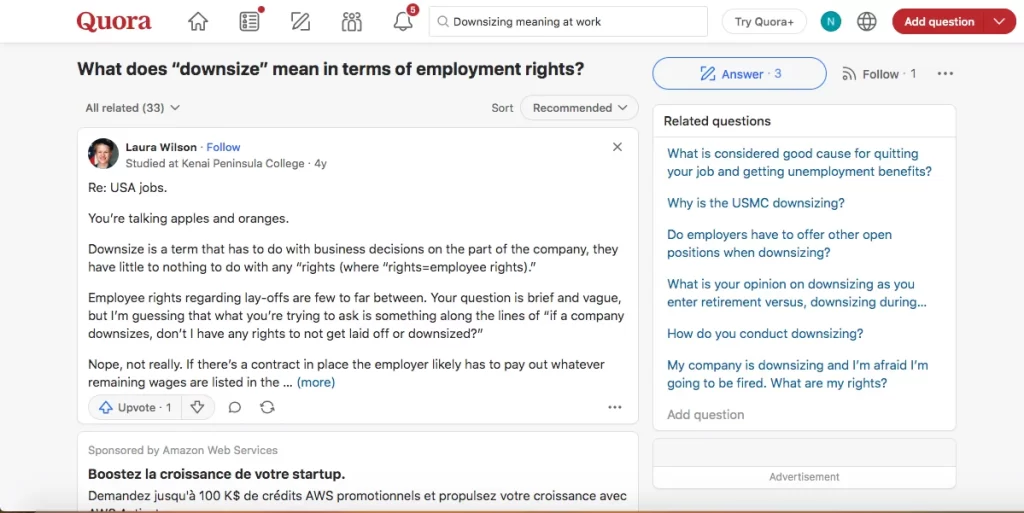
Quora users’ perspectives focus on warning signs, underlying causes, selection processes, and the human and organizational dynamics that often go unspoken in formal analyses.
Early Warning Signs on the Shop Floor
Rafael Angel LopezFerrer shares a vivid snapshot of the weeks leading up to a major downsizing in the early 1990s,
“You arrive early Monday morning to find supervisors in twos, reading off the same hot sheet while walking and talking fast, and not paying attention to much else. You feel an ‘electric’ tension in the air, and you haven’t even clocked in.”
“There’s talk of farming out some of our work to Tijuana or El Centro. You hear that Boeing, not McDonnell-Douglas, won the bid for that ‘victory purchase’ by Kuwait.”
“The Human Resources Department set up a ‘career transition resource room’ in an empty office. Despite the rush, the production pace has relaxed visibly. There’s suddenly more open parking at the plant lot. There’s no overtime at all.”
A Defensive Posture in Uncertain Markets
Byrne M. frames downsizing as a strategic retreat to “weather the storm”,
“Downsizing means the company is shifting to a defensive position to better survive a forecasted downturn in that company’s industry. As such, the number of people needed to handle the anticipated reduced volume is less. Their excess cost is eliminated by a layoff from the company’s labor force. Labor is typically the largest cost in most organizations.”
Retreating from Unprofitable Markets
David Phillips explains a pattern seen in small and mid‑sized businesses,
“A company usually goes through a downsizing after one or two years of losing money. They find out which markets they are making money in and those in which they are losing money and then downsize by getting out of the markets that are losing money. This generally involves many layoffs of good employees in the process of downsizing.”
Selection and Legal Complexities

Brant Serxner delves into the often opaque criteria for choosing who stays and who goes,
“Big picture answer: It’s about the short‑term money. Those two always apply. Don’t believe anyone who tells you otherwise.”
“There can also be legal reasons behind who gets the axe. There are laws and rules about how a company has to go about downsizing in order to avoid discriminating against older workers, gender classes, racial classes, or other protected groups. Along this line, there can also be union rules protecting some people or pushing others forward first.”
“Some companies have explicit layoff rules where they categorize everyone as, for example, an A, B, C performer, or by their percent against evaluation goals, and they automatically dump the C’s—or the bottom 10%.”
Combining Downsizing with Strategic Growth
Francisco Javier Elenes Velasco offers a case study from a small company facing a 20% market contraction,
“First, we reduced payroll by 20%, reducing employees by 20%. At the VP level, we (four VPs and myself) voluntarily reduced our salary by 20%. In parallel, we tried two strategic actions to grow income, based on P‑C‑M (Product‑Channel‑Market) analysis: we launched a new product and used a new distribution channel for an existing product.”
The Human Toll from the Inside
Reena Vivek Kumar recounts the emotional burden of enacting layoffs as an HR Manager,
“My COO, who looked visibly disturbed after the meeting, called me three days hence and conveyed the decision of management to downsize the team… I was extremely saddened at the turn of events…and then I checked the list…‘Lo and behold, at the end of the list was my name.’”
“I was bewildered…I stood stupefied…But I regained my composure soon…being the HR Manager, I could not afford to be emotional and had to carry out my last job deftly.”
The Role of Organizational Development in Transition
Vana Prewitt clarifies how an OD practitioner can cushion the blow of technological or process‐driven downsizing,
“My role was to plan the transition management during the process of reallocating human assets into more productive roles… New data management systems were being implemented that would cause every employee to change something about their jobs. Some jobs simply vanished; others were brand new.”
“A self‑directed training plan gave every one of those workers an opportunity to save their jobs. Some took it. Most did not. Their choice.”
“Engaging rotating members of affected employees through the cycle of testing the new software for flaws… They became familiar with the software and were less afraid. They told their friends, which helped them accept the change.”
Conclusion
Downsizing represents one of the most challenging aspects of organizational leadership – balancing financial imperatives with human impacts. When implemented thoughtfully with clear purpose beyond short-term cost cutting, workforce reductions can successfully position companies for sustainable future growth.
However, organizations must recognize that downsizing is never just a financial transaction. It profoundly affects people’s lives, company culture, and stakeholder relationships. The most successful downsizing initiatives acknowledge this reality, approaching the process with transparency, fairness, and compassion while still achieving necessary business outcomes.
As work continues to evolve through technological change and economic shifts, organizations that develop humane, effective approaches to workforce transitions will gain significant advantage in both talent markets and customer perception.
Hire the best candidates
with Wetest.
Create pre-employment assessments in minutes to screen candidates, save time, and hire the best talent.
Try for free