Appointment Letter: Format and Common Mistakes
Hiring & recruiting
Bonica
December 16, 2025
Nothing is more often ignored than getting the appointment letter format right when you’re onboarding someone new.
The interview and salary talks get all the attention, but the appointment letter is the piece of paper that formalizes the whole manager and employee relationship.
It spells out the employment terms in written language. An appointment letter cuts out any confusion for both sides and protects the company if there’s ever a dispute. Yet, a lot of businesses still treat it like just some boring administrative step.
This letter confirms the candidate is officially selected for the job since they accepted the offer. It defines their job title, responsibilities, who they report to, their hours, and their pay in a way that’s structured.
But writing one isn’t always easy. The rules change depending on the role, the type of employment, where you are, and the company policies. Companies sometimes rely on ancient templates that don’t reflect current laws.
That’s why understanding and using the right appointment letter format is such a big deal. In this article, we’re going to cover everything to make sure you start correctly.
Table of Contents
What is an Appointment Letter?
An appointment letter is a formal document that the manager sends out to confirm that a candidate has been chosen for a job and will be hired under the exact terms listed in the letter.
It’s different from an offer letter. The appointment letter is the company’s final confirmation. Once the new employee signs it and sends it back, it turns into a binding record of everything they agreed to about the job.
An appointment letter is all about clarity. It spells out all the vital details like the job title, who you report to, when you start, where you work, how much you get paid, what benefits you get, your hours, probation terms, and all the other stuff about the job.
This letter becomes employees’ proof of employment; they need it all the time for background checks, visa applications, getting loans, or switching jobs later.
It’s great for administrative protection because it documents the exact terms under which the employer hired that person.
Appointment Letter vs Offer Letter vs Joining Letter

The offer letter is always the first thing. It’s a proposal from the company that gives the preliminary terms. It includes the job title they’re thinking of, the proposed salary, a tentative start date, and some basic conditions.
At this point, the details aren’t legally binding. The offer letter is just asking the candidate to accept or negotiate the terms before anything is set in stone.
Once the person accepts that offer, the manager sends out the appointment letter, and that is the formal confirmation that they are hired. This document is way more detailed and authoritative than the offer letter was.
An appointment letter includes the finalized job title, clear job duties, the full compensation breakdown, working hours, the probation period, the notice period, and all the main company policies.
The final piece of paper in the sequence is the joining letter, and the employee is the one who submits this. They hand it in on the first day of work. The employee confirms that they are reporting to the company under the terms listed in the appointment letter. The joining letter just acts as an official declaration of acceptance.
Appointment Letter Format
An appointment letter always follows a simple structure that spells out all the main job terms and clears up any confusion for both the new hire and the company.
Most managers use a standard format that hits a few key sections. The exact specifics can change.
Job Title and Position
The letter should start by clearly stating what job the person is hired for. That means the official job title, and maybe a quick sentence about what the role is all about.
Being clear here makes sure nobody is confused about the job name.
Start Date and Work Location
The exact start date is one of the most important details!
The letter should specify the exact day the employee is expected to report, along with the primary location where they’ll work, or if the job is hybrid or remote. This sets the timeline for onboarding.
Salary Details

The appointment letter must include the employee’s salary or the structure of their pay in precise detail.
This covers the annual or monthly pay, how often they get paid, any bonuses, or other allowances.
Some companies even mention a separate salary breakdown to be transparent.
Probation Period
The letter has to clearly say how long it lasts and the rules for when the employee officially gets confirmed, if the job has a trial period.
This section should cover what’s expected of their performance and the notice period during this trial time.
Who They Report To
The letter must name the department the new employee will report to. The employee should be able to understand their spot in the company hierarchy right from the start.
Working Hours and Schedule
Being clear about the work schedule and any overtime rules prevents misunderstandings later.
Employers need to specify exact shift times for jobs that don’t follow a traditional 9-to-5.
Benefits and Perks
This part shows the cool benefits the employee gets, like health insurance, retirement plans, paid time off, and any company perks.
The letter should at least mention the main benefits.
Notice Period
This clause explains how much warning either the employee or the company has to give if they want to end the job.
Putting this up front helps avoid fights during firings or resignations.
Termination Conditions
A good appointment letter quickly outlines the reasons why someone might get fired, such as performance issues, bad conduct, restructuring, or other reasons.
The detailed rules will be in the HR manual, but the letter should still reference them.
Confidentiality and Rules
Most companies include a confidentiality clause to protect internal data and sensitive information.
This section might also reference the company’s code of conduct that the employee must follow.
Signatures and Acceptance
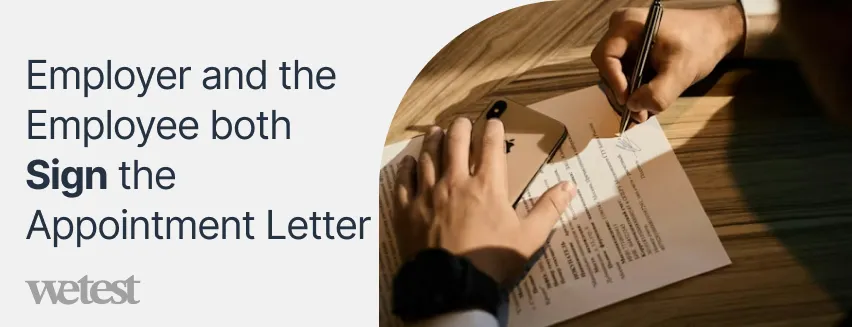
The letter finishes with spaces for both the employer and the employee to sign. This confirms everyone agrees to the terms.
The manager asks the employee to sign and send back a copy by a certain date.
A Customizable Appointment Letter Template
Nobody wants to deal with a million different templates. A lot of companies are switching to just using a flexible appointment letter format that you can adjust for any kind of employment.
I’m giving you a customizable template that works for every type of role. Just change the few clauses that matter.
[Company Letterhead]
Date: [Insert Date]
To,
[Employee/Contractor Name]
[Address]
Subject: Appointment for the Position of [Job Title]
Dear [Name],
We are pleased to confirm your appointment as [Job Title] with [Company Name], effective [Start Date]. This engagement is classified as [Full-Time / Part-Time / Contract], and you will report to [Manager Name] at [Location / Remote].
Your compensation will be [Salary/Rate Amount], payable on a [monthly/weekly/per-project] basis. A detailed compensation structure or rate schedule is enclosed where applicable.
If your role includes a probation period, it will last [X months], after which your performance will be reviewed for confirmation. Your expected working hours are [Working Hours], unless otherwise specified for project-based or contract arrangements.
Should either party wish to end this engagement, a notice period of [X days/weeks] will apply unless governed differently under your contract terms or local labor laws.
Please sign and return the enclosed copy of this letter by [Return Date] to confirm your acceptance of the terms mentioned above.
We look forward to your contribution to [Company Name].
Sincerely,
[Employer Name]
[Designation]
[Company Name]
[Signature]
Common Mistakes in Appointment Letters
Small businesses make the same mistakes without meaning to when they write up appointment letters.
These errors might seem fine at first, but they can lead to big arguments!
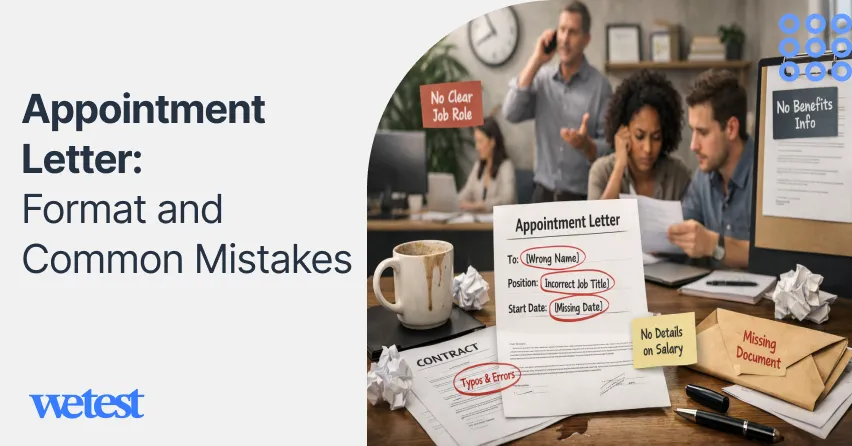
One of the most frequent mistakes is using vague job titles. If a letter just says “Executive,” the employee won’t fully grasp what they’re supposed to be doing.
Another common thing people miss is a clear start date or probation period. A lot of employers just assume the candidate knows these details from their verbal offer, but you can’t refer back to it later if it’s not written clearly in the letter.
Companies often forget to even mention who the person reports to, leaving the new hire lost about their boss on day one.
Working hours are another big spot where things get ambiguous. You have to define the expectations around hours or the weekly workload. Employees might assume more flexibility than the company is ready to give if you aren’t clear.
Compensation details are also a problem if the salary breakdown isn’t spelled out. Employers sometimes fail to say if the pay is gross or net or if it includes bonuses.
A lot of appointment letters just fail to explain the benefits properly. They need to be clearly listed in writing so there’s no misinterpretation.
Skipping the confidentiality and intellectual property clauses is another huge oversight. Small businesses think these aren’t important.
Notice periods are also commonly forgotten. Terminations can get sudden if those requirements are vague. The termination conditions need to be described, not detailed, so employees understand what could get them fired.
Tone inconsistency happens, too. Some letters sound too casual, while others read like a dense legal book.
Conclusion
An appointment letter is the foundational document that defines the whole job relationship. It sets clear expectations to protect the company and the new hire.
By understanding all the key parts of a good letter, companies can make sure things are clear and stop arguments before they even start.
It’s just as important to skip all those common mistakes, too. Knowing exactly how to fix and correct those errors can prevent legal trouble and keep trust strong between everyone.
Having an accurate appointment letter just shows that your company is committed to being transparent and using effective HR practices.
Taking the time to build a customizable template saves everyone time and cuts down on confusion.
A Quora Rundown
Quora users have shared perspectives on how appointment letters are issued and the practical issues employees face when these letters are missing.
When and Why Appointment Letters Are Issued
Appointment letters are issued after a candidate completes the entire selection process. According to Jayaraman Shreedhar,
“An Appointment Order is generally issued once the entire selection process is complete and the candidate is selected. It is basically a legal contract containing the terms and conditions of employment for the selected candidate.”
He emphasizes that most companies only issue these letters after collecting all relevant documents.
Ekansh Kochar discusses that an appointment letter is “an official communication between an employer and a candidate who is selected for a job position. It is a legal document that confirms the appointment of the candidate for a particular job opportunity. The letter has various details about the KRA (Key Responsibility Areas) of the new candidate, remuneration, incentive structure, bonus, joining date, etc.”
This shows the letter’s role as both a confirmation of selection and a record of employment terms.
Distinguishing Appointment Letters from Other Job Documents
Many candidates are confused about the differences between job documents. Quora users explained these distinctions with clarity.
Prem Singh writes:
“Offer letter: You get this from HR after selection, offering you the job. Job letter: Sent along with your CV to enquire about vacancies. Joining letter: Filled on the day of joining to inform that you have started work. Appointment letter: Provided upon joining, detailing your job profile, package, and company terms.”
Ankit Khungar simplifies this further,
“Appointment Letter: a legal binding letter prepared by a company to confirm that a position has been offered and accepted with mutual agreement on terms. Joining Letter: drafted by the individual to confirm acceptance of the position offered.”
Shilpa SM adds: “Once the candidate accepts the offer, an acceptance mail is sent to the employer confirming the joining date. Some companies just share the salary break-up initially and give the hard copy of the offer letter once the candidate joins. There is no separate concept of an appointment letter as such.”
Legal Significance of Appointment Letters
The legal implications of appointment letters were discussed by Ritesh Maity:
“Appointment letter assures the employee an employment for certain terms and conditions, and once the employee accepts such appointment letter, an employer-employee relationship is established between the two. It does not matter whether the appointment letter has been accepted by the employer before the actual date of joining. Once issued and accepted, a legal contract is made between the two.”
This aligns with Ekansh Kochar’s view that the appointment letter confirms the legally binding terms of employment.
Common Challenges When Appointment Letters Are Missing
Balasundaram Ethiraj recounts a scenario.
“No action can be taken against the employer, because you have not been given any letter to prove that you are employed in that company. The employer can easily say that you are on training without remuneration, and as your performance is not up to expectations, you have been stopped from work. If your answer is no to having an offer letter or appointment letter, better keep quiet.”
This shows the risks of joining a company without receiving proper documentation.
Tips from Users on Handling Appointment Letters
Quora users also share practical advice for candidates.
Jayaraman Shreedhar advises that companies complete internal processes before issuing an appointment order. This helps candidates know when to expect their letters and avoid unnecessary follow-ups.
Shilpa SM discusses proactive communication. If a candidate accepts an offer, sending a confirmation email ensures that both the joining date and terms are clearly recorded.
This practice reduces the likelihood of miscommunication.
Observations on Modern Practices
Some users note that the traditional appointment letter format is evolving.
Many companies now provide a digital offer letter first, followed by a formal appointment letter after joining.
Shilpa SM mentions that in several companies, “they first share the salary break-up with selected candidates, negotiations happen if any, and then a full-fledged official offer letter is rolled out with the joining date. There is no separate concept of appointment letter as such.”
This trend shows the growing digitization of HR processes.
FAQs
What is an appointment letter and how is it different from an offer letter or joining letter?
An appointment letter is the document an employer sends after a candidate accepts the job offer and all pre‑employment checks are complete. An offer letter expresses the employer’s intent to hire. A joining letter shows that the employee has accepted the appointment.
Is an appointment letter legally binding?
Yes, an appointment letter functions as a legally binding document once signed by both parties. It formalizes the job offer and converts it into a contract.
What should be included in an appointment letter?
Job title and responsibilities, start date and location, compensation and pay frequency, working hours, probation period, reporting manager or structure, benefits, notice period, termination conditions, confidentiality clauses, and signatures.
What if I never received an appointment letter before joining?
You may lack a concrete contract. Many employers view the offer letter as a preliminary employment term that is finalized only upon issuance of the appointment letter.
Can appointment letters be used for part-time employees?
Yes. Appointment letters are valid for any employment type.
Does signing the appointment letter guarantee permanent employment?
Not necessarily. The letter defines the terms of employment. Continuation depends on the successful completion of contract terms.
Hire the best candidates
with Wetest.
Create pre-employment assessments in minutes to screen candidates, save time, and hire the best talent.
Try for free