
Bonica
July 31, 2026
Sometimes hiring an AI engineer is extremely difficult and most of the time, the result is not what you had hoped. You think you found the right person, and then a few months later, you are dealing with delays, mistakes, and projects that never work the way you planned.
This post aims to facilitate the whole process and also reducing the risk of a mis-hire. You’ll find out what to look forward to, how to assess their actual skill level, and mistakes other teams make.
With these strategies in mind, you will be less likely to end up with substandard projects or AI systems that no one would want to use.
There are many teams that make poor hires in AI jobs and that’s one of the primary reasons that their main projects aren’t actually produced.
If you want to establish a strong AI team without wasting time and money, the following article will provide you with easy and practical methods that you can take.
Table of Contents
What Is an AI Engineer and What Do They Do?
An AI engineer develops AI solutions for a real business problem.
They work with data, code, and models. Their role is to make your team’s job easier by turning an AI idea into something that is usable.
Typical activities they do:
Clean and organize data: They first clean and organize your data. When data is disorganized, the result would be disappointing.
They choose the right technique: They choose which method to apply to a problem according to the issue. It might be machine learning, computer vision, embeddings, RAG or fine-tuning.
Check the model: They determine if the model gives informative, reliable responses. A feature that is successful in a model does not always work in the real world.
Launch and run it: They deploy the AI tool to your application, website or even the whole process. After that, they watch how it works over the course of time.
Then they observe its performance over time.
Do all AI engineers need a very deep understanding of LLMs? No.
Some work more with traditional machine learning, data systems, or computer vision, and rely heavily on solid software skills to make those solutions run in real products.
However, LLM skills are important if you are looking to build a chatbot, AI assistant, or company knowledge tool.
Ask them questions like: “Which would you use for our project: embeddings, RAG, or fine-tuning? And why?”
They don’t need to be fancy, their answer only needs to be logical. If they can articulate the trade-off(s), that’s good. Be wary of using complicated AI terms.
Types of AI Engineers You Can Hire
Not every AI engineer does the same job. That is why hiring “an AI person” is too vague. You need the person who matches your actual problem.

Here are the main types:
Machine Learning Engineer
This person builds, tests, and improves machine learning models. Hire one if you need prediction systems, recommendations, fraud detection, or models that must work at scale.Data Engineer
This person prepares the data before the AI work begins. They clean messy data, connect different data sources, and build pipelines. If your data is scattered or unreliable, start here.Prompt Engineer or LLM Specialist
This person works with large language models. They help with prompts, embeddings, RAG, and fine-tuning. Hire one if you are building a chatbot, AI assistant, or internal knowledge tool.AI Researcher
This person explores new methods and advanced ideas. You may need one if your problem is unusual, experimental, or too complex for standard AI methods.
Ask yourself this first: are you trying to fix messy data, launch a model, build an AI assistant, or solve something new?
That answer tells you who to hire.
If you have more than one problem, do not expect one person to fix everything. Start with your biggest bottleneck, then build from there.
Signs Your Business Needs an AI Engineer
Not sure if you need an AI engineer yet? Look at what is slowing your team down.
You may need one if:
Your data is a mess
Your data lives in too many places, has missing details, or does not match across systems. AI will not fix that on its own. Someone needs to clean it, connect it, and make it usable.
Your current model gives bad results
Maybe predictions are wrong. Maybe the model worked in testing but fails with real users. An AI engineer can check what went wrong and improve it.Your team repeats the same tasks every week
If people spend hours tagging emails, sorting documents, writing reports, or routing support tickets, AI may help automate part of that work.Decisions take too long
If managers wait days for reports or insights, an AI engineer can help build faster systems for finding patterns and sharing useful information.Your competitors are moving faster
Other businesses in your industry are already leveraging AI to streamline workflows and boost customer service, and falling too far behind the curve can adversely impact your business.
Test out a small project first, before taking on a full-time job. Use a low code AI tool to automate email tagging, weekly reports, or even sorting documents. If this makes things easier or more accurate, you’ll be in a better position to justify hiring.
Essential Skills Every AI Engineer Must Master for Successful Projects
Not every AI skill matters equally once the project leaves the whiteboard. Some skills directly affect whether the model works, ships, and keeps working after launch.
Start with Python. Most AI tools and frameworks rely on it, so the engineer should write clean code, not just copy scripts from a notebook. A small test, like building a basic sentiment analyzer from sample reviews, can show a lot.
Next, check machine learning and model evaluation. They should know how to choose the right model, measure performance, spot overfitting, and explain why a result is reliable.
MLOps matters too. A trained model is not useful if no one can deploy, monitor, or update it. Ask about production work, Docker, cloud tools, and model tracking.
For chatbot or generative AI projects, look for prompt engineering and LLM judgment. They should know when to use RAG, embeddings, or fine-tuning.
Finally, do not ignore data handling. Bad data quietly ruins good models.
These skills help prevent weak performance, wasted compute, delayed launches, and AI systems that look impressive but fail in real use.
How to Hire an AI Engineer Step by Step
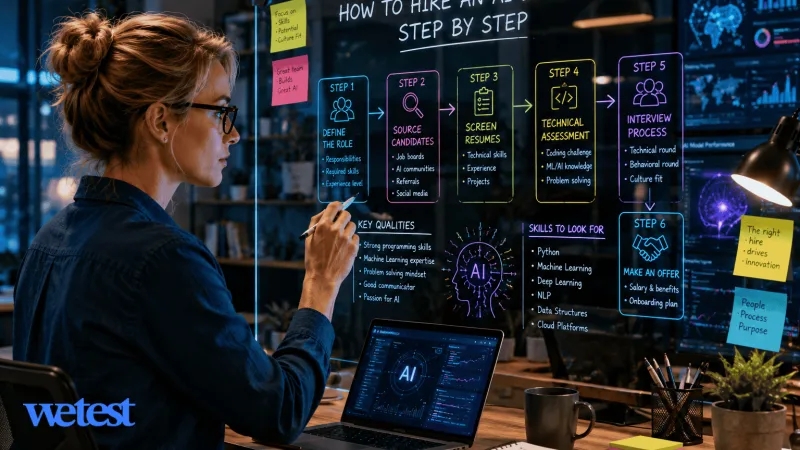
Hiring an AI engineer should not start with a job post. It should start with a clear problem. Otherwise, you may hire a smart person for the wrong job, which is a very expensive way to create confusion.
Follow these steps to reduce bad hires and wasted time. In early screening, you can also use different screening tests like a PHP programming test if the role needs strong backend or integration work around your AI systems.
Step 1- Define Your AI Project and Business Goal
Write down the exact problem you want AI to solve.
Do you need to predict customer churn, automate support tickets, improve search, clean data, or build an AI chatbot?
Be specific. “We need AI” is useless. “We need to classify 10,000 customer messages by topic every month” is much better.
Step 2- Choose the Right Type of AI Engineer
Do not hire a “general AI person” without knowing what you need.
Different problems need different roles:
Need prediction models? Hire an ML engineer.
Have messy data? Start with a data engineer.
Need deployment and monitoring? Look for an MLOps engineer.
Building chatbots or AI assistants? Consider a prompt engineer or LLM specialist.
Wrong role, wrong result.
Step 3- Write a Clear AI Engineer Job Description
The project description, tools/databases, and expected outcome should be clear in your job description.
Don’t include a long list of skills, but rather essential skills. Do not use special terms such as Python or model evaluation, MLOps, RAG, prompt engineering, or cloud tools unless they are relevant to the project.
Step 4- Source Candidates from the Right Platforms
Check outside of standard job sites.
Recommended sites include LinkedIn, GitHub, Kaggle, AI communities, technical Slack groups, referrals and certain hiring boards.
In the case of senior jobs, an experienced AI recruiter can filter out robust candidates more quickly.
Step 5- Screen for Real AI Project Experience
Look for proof, not buzzwords.
Ask what they built, what data they used, how they tested the model, and whether it reached production.
A Stanford AI Index report notes that many companies still struggle to move AI from experiments into real business use. That is why practical experience matters.
Step 6- Test Practical AI Problem-Solving
Give candidates a small task tied to your use case.
For example, ask them to clean messy data, design a simple RAG workflow, review model output, or explain how they would monitor model accuracy after launch.
A structured candidate assessment process helps you compare practical AI skills more fairly before the final interview.
For AI engineering roles, focus on the skills that match the project: Python, machine learning, data science, problem solving, or communication.
The goal is not to make candidates do free work. It is to see how they think, explain trade-offs, and handle the kind of AI problem your business actually needs solved.
Step 7- Ask Scenario-Based Interview Questions
The interview should test how the candidate thinks, not how many AI terms they can repeat.
Focus on how they explain trade-offs, handle unclear requirements, and connect technical choices to business goals.
A strong AI engineer should be able to explain why one approach is safer, faster, cheaper, or more reliable than another.
They should talk about data quality, testing, deployment risk, model limits, and expected business value. If their answers stay vague or sound like copied definitions, that is a warning sign.
This step helps you avoid hiring someone who looks strong on paper but cannot make practical decisions when the project gets messy.
Step 8- Compare Candidates with a Hiring Scorecard
Score each person on technical skill, project fit, communication, production experience, and problem-solving.
Before you hire, check three things: your data is usable, your use case is clear, and someone inside your company can manage the project.
Without that, even a strong AI engineer will spend more time fixing chaos than building value.
How to Write an AI Engineer Job Description That Attracts the Right Candidates
A good AI engineer job description should make the role clear before anyone applies. Vague phrases like “AI rockstar,” “must know everything,” or “build AI solutions” do the opposite.
They attract mismatched applicants, confuse strong candidates, and waste your interview time.
It’s better to keep the structure simple:
Role overview: Explain what the engineer will do in plain language.
Business problem: Say what problem you want AI to solve.
Responsibilities: List the daily work, like building models, cleaning data, testing outputs, or deploying systems.
Required skills: Include only must-have skills, such as Python, machine learning, MLOps, prompt engineering, or RAG.
Nice-to-have skills: Add extras, but do not pretend every bonus skill is required.
Tools: Mention your actual stack, like AWS, Azure, GCP, Docker, vector databases, or LLM APIs.
Success metrics: Explain how you will measure results.
Hiring process: Tell candidates what steps to expect.
LinkedIn research has shown that job posts with clear expectations and skills tend to perform better because candidates can quickly judge fit before applying.
A clear job description saves time before interviews even start. You get fewer random applicants and more people who understand the role, the tools, and the business goal.
Best AI Engineer Interview Questions for Evaluating Real Skills
Good AI engineer interview questions should reveal how a candidate thinks when the work gets messy. Not how well they memorized terms like “transformer,” “RAG,” or “fine-tuning,” then released them into the room like trained pigeons.
Use questions that test judgment, trade-offs, and practical problem-solving.
You can also use AI interview tools to structure the interview, compare candidate answers, and reduce guesswork during screening.
Ask questions like:
Messy data: “Your company has customer data from different sources, with missing fields and duplicate records. What steps would you take before building an AI model?”
Model failure: “You trained a model with 95% accuracy, but users say the results are bad. How would you investigate what went wrong?”
Deployment: “A model works well in a notebook but fails after deployment. What would you check first?”
Business impact: “How would you decide whether an AI feature is worth building or if a simpler automation would solve the problem?”
LLM judgment: “When would you use RAG instead of fine-tuning for a company knowledge assistant?”
Monitoring: “After launch, what metrics would you track to make sure the model still performs well?”
A strong candidate should explain their process in plain language. They should mention data quality, edge cases, user feedback, testing, monitoring, cost, privacy, and business goals.
Since AI engineers often work with product, data, and leadership teams, add a few communication skills interview questions to check whether they can explain technical decisions clearly.
Weak answers usually stay vague. “I would improve the model” is not an answer. It is fog with a keyboard.
Still, interviews are not enough. Combine these questions with a small skills test based on your real use case. That gives you a clearer view of how the candidate actually works.
Common Mistakes to Avoid When Hiring AI Engineers
Hiring the wrong AI engineer can turn a promising project into a slow, expensive mess. You may end up with models that never reach production, data pipelines no one can maintain, or AI features that do not solve the original business problem.
This section helps you catch the most common hiring mistakes before they cost you time, budget, and team trust.
Mistake: Expecting one AI engineer to fix everything
One person may not be able to clean years of messy data, build models, deploy systems, monitor performance, and manage stakeholder expectations alone. That is not a job description. That is a cry for help with a salary range.
Do this instead: Separate the work into clear needs: data, modeling, deployment, and product integration. Then hire for the biggest bottleneck first.
Mistake: Confusing AI engineers with data scientists
Data scientists often focus on analysis and insights. AI engineers usually build, deploy, and maintain AI systems. The overlap exists, but they are not always interchangeable.
Do this instead: Match the role to the output you need.
Mistake: Ignoring MLOps skills
A model that only works in a notebook is not enough. Without deployment, monitoring, and retraining, performance can drop after launch.
Do this instead: Ask about production experience, model monitoring, and version control.
Mistake: Skipping technical tests
Interviews can hide weak practical skills. People can sound smart while avoiding real work. Humanity’s oldest trick.
Do this instead: Give a small task based on your actual business problem.
Mistake: Overvaluing big-company names
A famous employer does not guarantee fit for your data, tools, budget, or team.
Do this instead: Prioritize relevant project experience over logo-heavy resumes.
Structured hiring helps too. Research from Google’s hiring studies found that structured interviews are more reliable than unstructured ones because candidates are judged against the same criteria. That means fewer gut-feeling decisions and fewer bad hires.
How to Onboard AI Engineers for Faster Project Success
A strong AI engineer can still struggle if onboarding is messy. They need context, access, and clear goals before they can build anything useful.
Use a simple 30/60/90-day timeline.

Day 1: Tools and context
Give access to code repositories, cloud platforms, documentation, dashboards, communication channels, and project boards. Explain the business problem in plain language: what the model supports, who uses it, and what success looks like.
Week 1: Data and system walkthrough
Show them your data sources, pipelines, models, APIs, and known issues. Introduce the product owner, data owner, engineering lead, security contact, and main users.
First 30 days: Small improvement or prototype
Start with one focused task, such as cleaning a data pipeline, testing a RAG prototype, improving model evaluation, or reducing false positives.
First 60 days: Deeper ownership
They should suggest practical improvements, document risks, and prepare stronger systems for production.
First 90 days: Measurable impact
Expect a clear result: better monitoring, cleaner pipelines, a deployed improvement, or a useful internal AI tool.
Good onboarding prevents duplicated work, broken pipelines, security risks, unclear ownership, and models that solve the wrong problem.
Hiring AI Engineers vs Outsourcing: Cost, Value, and ROI
Do not compare only price. Compare outcomes.
A full-time AI engineer may cost more upfront, but they can build long-term systems and improve models over time. Outsourcing may be better for a short prototype, audit, or proof of concept.
Option | Best for | Main costs | Watch out for |
Full-time AI engineer | Long-term AI products, internal systems, ongoing model work | Salary, recruiting time, tools, cloud costs, benefits, training | Slow hiring, high salary expectations, wrong role fit |
Freelancer or contractor | Short tasks, audits, prototypes, model fixes | Hourly/project fee, onboarding time, tool access | Limited availability, less long-term ownership |
AI agency or vendor | Fast prototypes, specialized builds, MVPs | Vendor fees, support costs, maintenance, future changes | Dependency, unclear handoff, weak internal knowledge |
AI hiring is not cheap. SHRM reports the average cost per hire is nearly $4,700, and AI engineer salaries can also be high. Coursera cites U.S. AI engineer median salary figures around $145,080, based on Bureau of Labor Statistics data.
But ROI should come from the result, not the invoice.
For example, a $40k outsourced prototype may be smart if it validates a support chatbot in 8 weeks. But if that chatbot becomes a core product feature, a full-time AI engineer may create more value through monitoring, updates, and long-term ownership.
Also count hidden costs: delays, cloud usage, failed handoffs, unused models, and maintenance nobody planned for.
Future AI Engineer Skills and Hiring Trends to Watch
AI hiring is moving away from flashy demos and toward reliable systems. Companies need AI engineers who can build tools that work in production, stay secure, and improve after launch.
The most important skills to watch are MLOps, AI security, model testing, LLM fine-tuning, RAG, and AI governance.
These skills matter because real AI work does not stop when a model gives one good answer. Engineers must monitor performance, protect company data, test accuracy and hallucinations, manage costs, and document how the system works.
For example, if you are hiring for an internal knowledge assistant, check whether candidates can design RAG, test answer quality, secure sensitive data, and monitor failures.
Update AI job descriptions every 6–12 months. Outdated skills age fast.
Final Thoughts
Before you hire an AI engineer, make the candidate prove they can solve the kind of problem they will actually face on the job.
No guessing. No hiring based only on resumes. No letting a confident interview answer replace practical evidence. If your project depends on messy data, model deployment, RAG, prompt engineering, or AI automation, test that exact skill before the final decision.
Keep the test small. Make it realistic.
For example, ask the candidate to clean a sample dataset, review model output, design a simple retrieval workflow, or explain how they would monitor an AI feature after launch. Their answer will show how they think, where they struggle, and whether they understand real business constraints.
FAQs
How much does it cost to hire an AI engineer?
AI engineer costs vary by location, seniority, and project type. A full-time hire includes salary, recruiting time, tools, cloud costs, and benefits. For short projects, a contractor or agency may be cheaper than hiring full-time.
Where can I find AI engineers to hire?
Good places include LinkedIn, GitHub, Kaggle, AI communities, niche tech recruiters, and specialist AI hiring platforms. Reddit discussions also show founders often search in LLM and startup communities for practical AI talent.
Should I hire an AI engineer or an AI developer?
Hire an AI engineer if you need model design, evaluation, deployment, and production reliability. Hire an AI developer if the work is more about integrating AI APIs, building app features, or connecting LLM tools into a product.
What should I test before hiring an AI engineer?
Test the skills tied to your actual use case. For example, ask candidates to clean messy data, design a RAG workflow, evaluate model output, or explain deployment risks.
Do I need a full-time AI engineer for my first AI project?
Not always. If you are testing an idea, a contractor or outsourced prototype may be enough. If AI becomes a core product feature, a full-time engineer usually makes more sense because they can maintain, monitor, and improve the system over time.
Hire the best candidates
with Wetest.
Create pre-employment assessments in minutes to screen candidates, save time, and hire the best talent.
Try for free