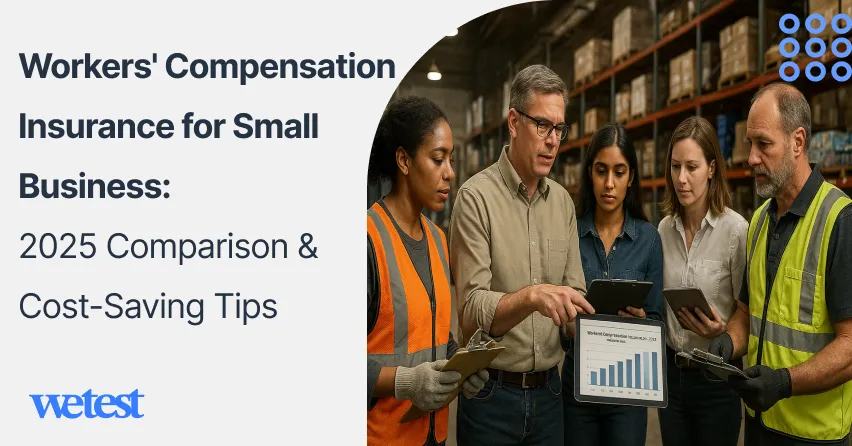
Workers’ Compensation Insurance for Small Business: 2025 Comparison & Cost-Saving Tips
EmploymentHuman resources
Bonica
December 5, 2025
Running a small business means you’re handling daily stuff to making sure your team is taken care of. But let’s be real, accidents happen even in the safest places.
That’s why workers’ compensation insurance for small businesses isn’t just one more thing on a giant checklist. It’s one of the most critical protections you can have.
You’re legally required to have workers’ comp coverage the second you hire your very first employee. You could face huge fines that could destroy a small business if you skip it.
Workers’ compensation insurance steps in right when an employee gets hurt or sick because of their job. It pays for all the essentials and covers a portion of their lost wages while they recover.
It also handles disability benefits and gives death benefits to the employee’s family.
Since your premiums are based on things like your payroll size, industry classification, and your claims history, even just one claim can change what you pay.
Picking the best workers’ compensation provider feels overwhelming. Different carriers have different prices and claims handling processes. This article explains how the coverage works and helps you compare the top insurers so you can make a choice you feel good about.
Table of Contents
Why Small Businesses Need Workers’ Compensation Insurance
Running a small business means you’ve got super tight budgets and lean teams, so even just one workplace injury causes huge financial pain. That’s why having Workers’ Compensation insurance is an absolute must.
It protects your employees and the whole company’s stability. Workers’ Comp steps in to provide critical benefits when an employee gets hurt or sick because of their job.
It covers all the costs from medical expenses to emergency care, rehab, prescriptions, and any other care. It also helps them get back to work through structured programs. These protections are vital for small businesses that cannot absorb unexpected bills.
Workers’ Comp minimizes your legal risk. Without this policy, employees could sue the business for negligence. Workers’ Comp works as an exclusive remedy system.
Your Workers’ Comp premiums are calculated based on your payroll and risk factors like your class codes and your experience modification rate.
Just one serious claim can raise what you pay for years, which is why taking care of safety and having proactive coverage is so crucial.
It’s a foundational part of managing risk. It keeps your employees protected and lets you keep operating confidently.
How Workers’ Compensation Works
The whole process kicks off with an injury report. The employee tells their supervisor, and then the business files a Workers’ Comp claim with the insurer.
Once that claim is open, the insurance company looks at everything. They review the circumstances and all medical paperwork, then approve the necessary benefits.
These benefits almost always include medical treatment, hospital stays, tests, physical therapy, prescriptions, and any care they might need.
Depending on how bad the injury is, workers might get paid for temporary disability, permanent partial disability, or permanent total disability. And in the terrible cases where someone dies, Workers’ Comp also provides death benefits and covers funeral expenses for their family.
Workers’ Comp is all about managing risk from the employer’s point of view. Because this system stops most employee lawsuits, it cuts down on your legal exposure and shields the business from having to pay medical bills or lost wages directly out of pocket.
Most insurance companies include services like claims management, safety assessments, and return-to-work programs.
How Premiums Are Calculated
Every insurance company uses basically the same formula, but class codes, payroll, and your experience modification rate (EMR) impact what you pay.
Class codes
Workers’ Compensation class codes are just official labels that reflect how risky the work your employees do is.
High-risk jobs like construction and manufacturing have way higher class code rates because people get hurt more often there.
Low-risk jobs like office work or professional services usually have lower rates.
You could either pay too much or face a huge bill later during an audit if you get class code wrong
Payroll
The second huge factor is payroll. Workers’ Comp is billed per $100 of payroll, so the more people you have and the more you pay them, the higher your premium is going to be.
This structure makes sense because it means the bill scales with the actual size of your team and their exposure.
The insurer does an audit to compare what you estimated your payroll would be versus what you actually paid at the end of every policy year.
EMR
It is the factor that rewards safe workplaces and punishes unsafe ones. An EMR of 1.0 is average. Anything below 1.0 gets you a discount, and anything above 1.0 makes your premium more expensive.
Your EMR is based on your claims history over the last three years. Just one serious injury can spike your EMR. This means you’ll pay higher premiums for several years.
Insurers also look at smaller things like whether you have safety programs, return-to-work initiatives, how often you file claims, deductible options, and state rules.
You can make your workplace safer and classify your staff correctly by knowing what drives these premiums. It also helps you keep your payroll records accurate and pay less for Workers’ Comp over time.
Top Workers’ Compensation Policies and Carriers for Small Businesses

You need to figure out how all the big carriers are different regarding what they charge, how they handle claims, their digital tools, and what they know about your industry.
Insurers vary in how they help small businesses and help you save money later on. The top insurers offer a good combination of being financially strong and having specific risk-management programs for different industries.
The Hartford is one of the most trusted providers overall for small businesses. They’re available pretty much everywhere and have great claims handling. They are particularly good if you want access to professional risk engineering and those structured programs.
Next Insurance is popular for small businesses that want an online quote. Their AI system gives you instant pricing and an easy online dashboard. This is a huge win for freelancers and startups. The only issue is that Next might not be ideal if you have complex operations in multiple states.
biBERK offers some of the most competitive pricing you can find. They have lower premiums since there’s no broker fee markup. Small businesses looking for affordable coverage go with biBERK. Their customer support is more self-service.
Travelers is a great match for small businesses in those medium-risk fields. They have strong safety programs, and they underwrite policies specific to those industries. Travelers is reliable, but getting a quote might be a little slower than with the newer companies.
State Farm is big with local businesses like restaurants and retail shops because they give you that personalized service. You’ll like State Farm if you prefer having someone to talk to face-to-face. What they offer can depend on your state and industry.
Pie Insurance is focused on small businesses that want to save money. They use tech to assess your risk. They offer lower premiums if you qualify. They aren’t always the best fit for those high-risk industries.
Employers Insurance is another solid choice for low-risk service businesses. They offer consistent pricing and have simple claims management. They are helpful for low-hazard job types.
Ways to Lower Your Workers’ Compensation Costs
One of the best things you can do is invest in safety programs at work. Insurance companies reward employers who have low injury rates. The safer your workplace is, the lower your risk looks to them.
Another massive factor is putting a return-to-work program in place. These programs let injured employees do modified work while they’re still recovering. This prevents those expensive disability claims that are the main reason your premiums jump up.
Stay in touch with the injured worker and coordinate closely with their doctors. This ensures claims don’t stay open longer than they need to. Insurers decide your renewal price partly on how well you handle claims.
Small businesses should also review their class codes to make sure every single employee is classified correctly. Even tiny mistakes can increase your premiums. A quick check-in with your agent every so often can uncover those hidden savings.
A Quora Rundown
Small business owners on Quora share experiences that inform you more than the textbook definitions of workers’ compensation insurance.
The Legal and Liability Lens
Brad Kirby didn’t mince words about the risks of going without coverage.
“Workers’ Compensation Insurance offers benefits to workers who are temporarily or permanently disabled due to a work-related accident… If you don’t carry this insurance, the business is at risk for extensive future legal liability if an employee becomes injured on the job.”
For Brad, the takeaway is avoiding catastrophic lawsuits that can sink a small operation.
Shamim Ahammed pointed out that workers’ comp is designed to help both parties.
“Employers have a legal responsibility to their employees to make the workplace safe. However, accidents happen… To protect employers from lawsuits and to provide medical care and compensation for lost income, in almost every state, businesses are required to buy workers compensation insurance.”
The Self-Employed and Exemptions Question
Several Quora users tackled a gray area. Do solo entrepreneurs need workers’ comp?
Insurance defense lawyer Ellen Harman answered:
“If it is just one person, probably not. However, most entrepreneurs form a corporation which creates a separate legal person which employs the real person… If the business contracts with others, the customer may require proof of insurance coverage.” — *Ellen Harman*
She added an example:
“Interesting query: if you start a new, legal pot growing business, is that an agricultural enterprise? Well known insurance risk fact: Agricultural work is some of the most hazardous work out there.” — *Ellen Harman*
Brett Arthur explained the role of exemptions.
“If you have an FEIN or EIN for the company, typically you would need to file for a worker’s comp exemption in your state… But vendors are now requiring proof of work comp coverage to finalize a contract. This means if no employees to provide coverage for, you would have to revoke the exemption with the state.”
Self-Insurance and Group Options
Lyra Yeretzian is a former claims examiner. She explained that large companies sometimes rely on self-insurance.
“I worked for one employer who paid high dollar deductibles and then had insurance cover the claim at a specific dollar level. That was done by employers who were very large.”
But she also noted alternatives for smaller players.
“One other option I know of that helps save money is joining a group of employers in the same type of business with good safety records to purchase insurance. For example, a group of welding businesses.”
Ethan Andrew Kosmin discussed self-insurance versus traditional policies.
“Self-insuring gives businesses more control… but exposes the business to significant financial risk. A single large claim could potentially bankrupt a small business.”
Vendor Demands and Contractual Realities
Brett Arthur’s comment shows the growing trend of vendors demanding proof of coverage. Jeff Ashendorf is a tax attorney:
“Workers comp not only provides protection to employees… it prevents those employees from suing the employer for those injuries. Otherwise, an employee who was injured at work could wipe an employer out.”
Safety Programs as a Cost Lever
Lyra Yeretzian observed how safety programs cut claim costs.
“I worked for one employer that had ungodly costs. When they instituted a safety program and were consistent about following it, their costs went down dramatically.”
Jeff Ryan added:
“Work Comp premiums in most states will be impacted positively or negatively by loss experience… Pay your premiums on time and avoid cancellations… Work with a local Independent Insurance Agent to help you find the best rate.”
Experience Modifiers and Payroll Size
John is a veteran with the CIC designation. He discussed how payroll size triggers experience ratings.
“Your WC premium may be adjusted once your payroll surpasses certain thresholds for 3 more years… A mod of 1.05 portrays a 5% surcharge; one of .95 a 5% credit.”
The Role of Independent Agents
Neil Marcus pointed out the importance of independent insurance agents for small businesses.
“Small business owners, your best source of information is your local Independent Agent. He not only does Worker’s Compensation, but he does your property & liability needs as well!”
Affordability and Exemptions
Jeff Ashendorf pointed to wide variations in state exemptions. This patchwork of exemptions means business owners can’t assume one state’s rules apply in another. As he put it:
“A small business can always get WC coverage; whether it’s ‘affordable’ depends on its definition of affordable.”
Conclusion
Protecting your team and your business has to be your number one priority. Workers’ compensation insurance for small businesses gives you crucial coverage against on-the-job injuries, illnesses, and any potential lawsuits.
A good policy makes sure your employees get the care they need, covering everything from medical bills and replacing lost wages to disability and death benefits, and it protects your business from financial disaster.
To pick the right policy, you need to know how they calculate the cost. It all depends on your payroll, class codes, and your EMR. You can cut those costs even more by putting in safety programs, managing claims quickly, and setting up return-to-work initiatives.
Small business owners have ways to buy coverage now. You can use online platforms for fast quotes, talk to an agent if you want someone to guide you personally, or get bundled policies that combine it with general liability and other business insurance.
You just need to compare the carriers and look for features that fit your specific industry. That’s how you make the best choice.
Investing in Workers’ Comp is a core piece of risk management for any small business. Your business stays compliant, and you can focus on growing with total confidence with the right coverage in place.
FAQs
Do I need workers’ compensation insurance for my small business?
Yes, even small businesses with just one employee are legally required to carry workers’ compensation.
What does workers’ compensation insurance cover?
It covers medical expenses, rehabilitation, disability benefits, lost wages, and even death benefits for work injuries or illnesses.
What isn’t covered by workers’ comp?
Workers’ comp usually won’t cover injuries from drug/alcohol use, self-inflicted harm, or accidents occurring off the job (like commuting).
How much does workers’ comp insurance cost?
Costs vary based on payroll, class codes (job risk), location, and your claims history. On average, small businesses pay around $45/month.
How are workers’ comp premiums calculated?
Premiums are based on your industry’s classification code, payroll (per $100), your past claims (experience modification rate / EMR), and other risk adjustments.
What is an experience modification rate (EMR)?
EMR is a multiplier that adjusts your premium based on your company’s claims history compared to similar businesses. A rate below 1.0 lowers your costs; above 1.0 raises them.
What happens if I don’t have workers’ compensation insurance?
If your state requires it and you don’t carry it, you risk legal penalties, fines, stop-work orders, and potentially huge out-of-pocket costs or litigation.
Can I buy workers’ comp insurance online?
Absolutely. Many insurers allow you to get an instant workers’ comp quote online, make a purchase, and manage your policy digitally.
Hire the best candidates
with Wetest.
Create pre-employment assessments in minutes to screen candidates, save time, and hire the best talent.
Try for free