Do you want to get better at workforce management but feel confused by all the mixed advice?
You’re not alone. Many companies, 63% to be exact, say workforce problems are their biggest challenge. It’s important to understand this key part of business now more than ever.
In this simple guide, you will learn what makes up a workforce. You will also read about the 7 important workforce models that are changing today’s business world. Later, you will discover how workforce planning can affect your profits.
Whether you are an experienced leader or a new manager, these helpful ideas will change how you build, manage, and improve your most valuable resource—your people.
Let’s dive in.
Table of Contents
Understanding Workforce Basics

The word “workforce” may sound simple, but it is important for each organization’s success. In this article, you will learn what a workforce really is, how different workforce models can be used, and why it is vital to get this right more than ever in today’s fast-changing business world.
Companies spend about 70% of their operating costs on employee expenses. This means knowing these concepts is not just useful, it is crucial for the survival and growth of any business.
We will explore everything from the history of work ideas to new models that are happening in our digital era. This will suggest useful plans and ideas to use in your organization right away.
What Defines a Workforce in Modern Organizations

At its core, a workforce represents the collective human capital deployed by an organization to achieve its objectives. This encompasses all individuals contributing labor—whether full-time employees, contractors, or gig workers.
Workforce management goes beyond simple headcount tracking. It involves strategic planning, deployment, productivity optimization, and development of the people who power your organization’s outcomes.
Modern workforce management integrates:
- Strategic workforce planning aligned with business goals
- Optimized scheduling and resource allocation
- Skills and competency management
- Performance analytics and improvement
- Employee experience and engagement initiatives
Rather than viewing their workforce as a cost center, effective organizations treat it as their primary value driver, central to executing strategy and creating competitive advantage.
Historical Evolution of Workforce

The concept of workforce has transformed dramatically throughout economic history:
Agricultural Era (Pre-1800s): Work centered around family units and apprenticeship models with limited formal workforce structures.
Industrial Revolution (1800s-1940s): The rise of factories created standardized work hours, specialized roles, and the first formal workforce management systems.
Post-War Era (1940s-1980s): This period saw the dominance of lifetime employment models, strong labor unions, and the emergence of human resources as a discipline.
Information Age (1980s-2000s): Knowledge work gained prominence, with increasing workforce mobility and the beginning of remote work options.
Digital Era (2000s-Present): We’re now experiencing unprecedented workforce fragmentation with gig economies, automation, global talent pools, and hybrid working models becoming standard.
This evolution reflects broader economic and technological shifts, with each era demanding new approaches to organizing and managing human labor.
What Makes a Workforce Effective?

An optimized workforce consists of several interconnected elements:
Skills and Capabilities: The collective knowledge, abilities, and expertise your workforce possesses.
Structural Alignment: How roles, teams, and reporting relationships are organized to execute strategy.
Cultural Elements: The shared values, behaviors, and norms that shape how work gets done.
Systems and Processes: The technologies and workflows that support and enhance human performance.
Leadership: The direction, motivation, and development provided at all levels.
Engagement Drivers: The factors that influence discretionary effort and commitment.
The most effective workforces demonstrate alignment across these components, creating a coherent system where each element reinforces the others rather than working in isolation.
Differences Between Workforce Management and Human Resources

While closely related, workforce management and human resources represent distinct organizational functions:
Scope: Workforce management encompasses all labor contributors (including non-employees), while HR typically focuses primarily on traditional employees.
Time Horizon: Workforce management emphasizes both immediate operational needs and long-term capability building, whereas HR often prioritizes systems, policies, and programs.
Primary Metrics: Workforce management measures productivity, capability gaps, and labor optimization. HR typically tracks hiring success, program implementation, and compliance.
Key Activities: Workforce management centers on deployment, skills development, and performance. HR concentrates on recruitment, benefits administration, and employee relations.
In progressive organizations, these functions collaborate closely while maintaining their distinct focus areas—HR building the systems that enable effective workforce management.
7 Essential Types of Workforce Models to Know

It’s worth noting before we go into each model that these seven options give us strategies to connect talent with business goals.
Full-Time Traditional Employees
The conventional model of full-time, permanent employment remains the workforce backbone for many organizations despite significant shifts toward alternative arrangements.
Key Benefits:
- Deep organizational knowledge and cultural alignment
- Higher loyalty and retention when managed effectively
- Consistent availability and dedicated focus
- Clearer legal frameworks and compliance pathways
Primary Challenges:
- Higher fixed costs and reduced flexibility during downturns
- Potential skill stagnation without intentional development
- More complex termination processes in many jurisdictions
- Increased benefit and administrative overhead
Organizations maintaining primarily full-time workforces should focus on building agility through cross-training, flexible work arrangements, and strong development pathways to offset the potential downsides of this model.
Part-Time Workers
Part-time employment offers a middle ground between full-time commitments and more contingent arrangements. According to the Bureau of Labor Statistics, over 25 million Americans work part-time.
Strategic Advantages:
- Cost-effective coverage for variable demand periods
- Access to talent segments seeking reduced hours (parents, students, semi-retired professionals)
- Reduced benefit expenses while maintaining employment relationship
- Potential pathway to full-time roles for promising talent
Implementation Best Practices:
- Design roles specifically for part-time success rather than simply reducing hours
- Create clear advancement paths to prevent two-tier workforce perceptions
- Implement robust knowledge-sharing systems to maintain continuity
- Analyze workflow patterns to identify optimal part-time deployment opportunities
Organizations like Trader Joe’s and Costco demonstrate that part-time workforces can deliver exceptional performance when these positions are thoughtfully designed and valued.
Remote and Hybrid Workforce
Perhaps no workforce model has experienced a more rapid transformation than remote work. Research from Gartner indicates that 82% of company leaders plan to permit remote working at least part-time going forward.
Key Considerations:
- Clear delineation between fully remote versus hybrid (partial in-office) arrangements
- Technology infrastructure requirements for seamless collaboration
- Modified performance measurement focusing on outcomes over visibility
- Cultural adaptations to maintain cohesion across distributed teams
Success Factors:
- Intentional communication practices to prevent information asymmetry
- Redesigned workflows that account for asynchronous collaboration
- Equitable advancement opportunities for remote and in-office staff
- Manager capability development for distance leadership
Organizations mastering remote and hybrid models gain access to broader talent pools and often report productivity increases, though success requires deliberate design rather than merely allowing work-from-home as a perk.
Contingent and Gig Economy Workers
The contingent workforce—comprising freelancers, independent contractors, and gig workers—has grown substantially, with over 57 million Americans participating in freelance work according to Upwork.
Organizational Advantages:
- Rapid access to specialized skills for specific projects
- Significantly reduced fixed labor costs and administrative burden
- Ability to scale workforce up or down with minimal friction
- Exposure to diverse perspectives from workers engaged across multiple organizations
Management Approaches:
- Develop clear scoping processes for contingent engagements
- Create streamlined onboarding for rapid productivity
- Build knowledge transfer mechanisms to capture insights from temporary talent
- Monitor classification compliance to avoid regulatory issues
Most mature organizations maintain a core-periphery model, surrounding stable full-time roles with contingent workers for specialized needs and variable capacity.
Outsourced Workforce

Outsourcing involves contracting entire functions or processes to third-party specialists rather than managing individual contingent workers.
Optimal Use Cases:
- Non-core functions requiring specialized expertise (e.g., IT support, payroll)
- Activities with significant economies of scale across organizations
- Processes with clear metrics and service level definitions
- Functions requiring 24/7 coverage that would be costly to staff internally
Implementation Considerations:
- Rigorous provider selection beyond simple cost comparison
- Clear governance structures for ongoing management
- Thoughtful transition planning to minimize disruption
- Regular evaluation against both internal alternatives and competitive providers
Successful outsourcing requires treating providers as strategic partners rather than merely vendors, with intentional knowledge integration between your organization and service providers.
Managed Service Providers
Managed service providers (MSPs) represent a more integrated outsourcing model, taking full responsibility for outcomes rather than simply providing staff augmentation.
Distinctive Features:
- Performance-based contracts focused on results, not headcount
- Provider responsibility for talent acquisition and management
- Typically includes technology platforms alongside human resources
- Often incorporates continuous improvement commitments
Best Applications:
- Technical functions requiring specialized talent management
- Areas needing rapid capability development
- Functions benefiting from standardized global delivery models
- Processes requiring significant technology enablement
Organizations like IBM, Accenture, and Cognizant have built massive businesses delivering workforce capabilities through MSP models, offering clients flexibility while maintaining high quality standards.
Blended Workforce Models

Most sophisticated organizations now employ blended workforce models, strategically combining multiple approaches rather than relying on a single model.
**Design Principles**:
- Map critical capabilities against strategic priorities to determine core versus flexible needs
- Analyze work characteristics (predictability, specialization, volume fluctuation) to select optimal models
- Consider full lifecycle costs rather than simple hourly rate comparisons
- Evaluate cultural and coordination requirements across different workforce segments
Integration Challenges:
- Creating a cohesive culture across diverse employment arrangements
- Ensuring knowledge flows between workforce segments
- Maintaining quality consistency across different models
- Managing complex coordination across varied worker types
Research from Deloitte indicates that organizations with well-designed blended workforces demonstrate 30% higher innovation metrics and better business agility than those with more homogeneous models.
Why Workforce Planning Matters

You should understand the role of strategic workforce planning as the core of your business strategy.
5 Critical Ways Workforce Impacts Business Performance
Your workforce directly drives organizational performance through five key mechanisms:
- 1. Execution Capacity: Your ability to deliver products and services depends directly on having the right number of qualified people in the right roles.
- 2. Innovation Generation: Research from MIT indicates that diverse, engaged workforces generate 80% more innovative ideas than homogeneous, disengaged teams.
- 3. Customer Experience: Employees directly shape customer perceptions. Gallup research shows units with engaged employees achieve 10% higher customer ratings.
- 4. Cost Structure: With labor typically representing 40-70% of operating expenses, workforce optimization dramatically impacts margins.
- 5. Organizational Agility: Your ability to pivot during market shifts depends on workforce adaptability, with high-performance organizations showing 4.4x greater capacity to redeploy talent quickly.
Understanding these linkages allows leaders to approach workforce decisions as strategic investments rather than simple cost considerations.
How Effective Workforce Management Gives You an Edge

Strategic workforce management creates sustainable advantages through several mechanisms:
- Capability Development: Organizations systematically building critical skills outperform competitors during market transitions.
- Culture Cultivation: Companies like Southwest Airlines and Zappos demonstrate how distinctive cultures create inimitable competitive advantages through their workforces.
- Talent Magnetism: High-performance workforce environments attract higher-caliber talent, creating a virtuous cycle of capability building.
- Operational Excellence: Optimized workforce deployment drives higher productivity and quality, translating directly to market advantage.
McKinsey research indicates companies in the top quartile of talent management practices outperform industry peers in total returns to shareholders by more than 22 percentage points.
The Financial Impact of Strategic Workforce Deployment
The financial implications of workforce decisions extend far beyond direct labor costs:
Revenue Effects:
- Sales capacity constraints directly limit growth potential
- Employee engagement correlates with 21% higher profitability (Gallup)
- Capability gaps create missed market opportunities
Cost Implications:
- Turnover expenses average 33% of annual salary per departed employee
- Productivity variances between top and average performers range from 50-800%
- Workforce utilization directly impacts operational efficiency
Balance Sheet Considerations:
- Workforce capabilities represent unrecorded intangible assets
- Contingent workforce models shift fixed to variable costs
- Talent development creates future economic benefits
Leaders should develop comprehensive financial models for workforce decisions rather than focusing solely on immediate payroll impacts.
Your Workforce Powers Organizational Agility

In volatile markets, workforce agility becomes a critical competitive differentiator:
Skill Adaptability: Organizations with strong learning cultures adapt 25% faster to market changes than those with rigid skill models.
Deployment Flexibility: Companies with workforce mobility systems redeploy talent 4x faster during market shifts.
Capacity Variability: Well-designed blended workforce models allow for 15-30% capacity adjustments without structural changes.
Innovation Responsiveness: Cross-functional, diverse teams identify emerging opportunities 37% faster than traditional departments.
Building these agility factors requires intentional design rather than occurring naturally—organizations must invest in learning infrastructure, internal talent marketplaces, and flexible operating models.
Developing a Strong Workforce in Changing Markets

Accurately assessing current skills and future needs is the foundation of building a strong workforce.
Essential Skills Assessment
Effective workforce development begins with rigorous skills assessment, identifying both current capabilities and future needs:
Assessment Approaches:
- Performance-based evaluation of demonstrated capabilities
- Multi-rater feedback provides diverse perspectives
- Technical skill certifications and knowledge testing
- Self-assessment combined with manager validation
Critical Components:
- Current state mapping against required competencies
- Future skills forecasting based on strategic direction
- Gap analysis prioritizing development needs
- Bench strength evaluation for critical roles
Leading organizations like IBM and AT&T conduct enterprise-wide skills inventories annually, mapping their workforce capabilities against strategic needs to guide both development and acquisition strategies.
Creating Effective Training Programs for Different Workforce Types
One-size-fits-all training approaches fail in today’s diverse workforce landscape. Effective development requires tailored approaches:
For Traditional Employees:
- Blended learning journeys combining formal and on-the-job development
- Clear career pathways with milestone-based learning
- Mentorship and coaching programs for contextual knowledge
- Leadership development pipelines for succession planning
For Contingent Workers:
- Rapid onboarding systems focused on immediate productivity
- Just-in-time learning resources accessible on demand
- Project-specific capability building tied to deliverables
- Knowledge sharing platforms capturing insights
For Blended Teams:
- Collaborative learning experiences building shared understanding
- Cross-training initiatives to increase flexibility
- Common language and methodology training
- Team-based skill development tied to collective outcomes
Organizations demonstrating training excellence like Accenture and SAP typically invest 3-4% of payroll in development activities, significantly above the cross-industry average of 1.7%.
Technology’s Role in Modern Workforce Management

Technology has transformed from a supporting element to a central component of workforce strategy:
Core Technologies:
Workforce analytics platforms providing predictive insights
Skills ontology systems mapping capabilities across the organization
Labor optimization tools for scheduling and deployment
Learning experience platforms delivering personalized development
Talent marketplaces facilitating internal mobility
Implementation Success Factors:
- Strong data governance ensuring quality inputs
- Change management supporting technology adoption
- Integration across workforce management systems
- Balanced metrics combining efficiency and effectiveness
Organizations effectively leveraging these technologies report 18% higher workforce productivity and 30% lower turnover according to research from Josh Bersin Academy.
Building Inclusive Workforces
Beyond compliance requirements, inclusive workforce practices deliver substantial performance benefits:
Business Impact of Inclusion:
Diverse teams outperform homogeneous groups by 35% on complex tasks
Inclusive organizations are 1.7x more likely to be innovation leaders
Companies with diverse leadership achieve 19% higher revenues
Accessible workplaces tap into underutilized talent pools
Practical Implementation Approaches:
Structured inclusion of diverse perspectives in decision processes
Bias mitigation through process redesign rather than just awareness
Accessibility by design in physical and digital environments
Belonging initiatives creating psychological safety across differences
Leaders like Microsoft, Accenture, and Mastercard demonstrate that inclusion isn’t just about representation statistics but requires comprehensive cultural and systemic approaches to realize performance benefits.
Measuring Workforce Effectiveness

Workforce measurement involves using both quantitative and qualitative measures.
Productivity Metrics That Matter for Teams
Move beyond simplistic productivity measures with metrics that capture true value creation:
Value-Based Metrics:
- Revenue per employee (or per FTE)
- Contribution margin per workforce dollar
- Cycle time for key business processes
- Quality metrics specific to function or industry
Against Common Pitfalls:
- Avoid activity metrics that don’t connect to outcomes
- Incorporate quality alongside quantity measures
- Balance short-term output with sustainable capacity
- Consider team productivity over individual measures
Organizations like Toyota and Google demonstrate that sophisticated productivity measurement focuses on system optimization rather than individual utilization.
Engagement and Satisfaction

Employee engagement directly impacts performance, with engaged teams showing 23% higher profitability according to Gallup research:
Modern Measurement Approaches:
- Pulse surveys providing frequent, focused feedback
- Passive data analysis from collaboration tools and systems
- Sentiment analysis from communication platforms
- Predictive models identifying engagement risks
Key Engagement Indicators:
- Discretionary effort behaviors
- Knowledge sharing and collaboration patterns
- Innovation and improvement suggestions
- Advocacy in recruitment and customer contexts
Leading organizations like Cisco and Microsoft supplement traditional engagement surveys with real-time analytics, creating more responsive management systems.
Workforce Stability Patterns
Workforce stability drives consistency and reduces costly turnover, but it requires nuanced measurement:
Sophisticated Retention Metrics:
Regrettable vs. non-regrettable turnover differentiation
Early tenure attrition as a quality of hire indicator
Critical role stability tracking
Retention cost impact analysis
Predictive Approaches:
Risk modeling based on comparison to departure patterns
Stay interview insights from current employees
Manager effectiveness correlation with retention
Engagement trend analysis as a leading indicator
Organizations exhibiting retention excellence like Edward Jones and HubSpot focus not just on aggregate turnover rates but on targeted retention of high-value talent through predictive approaches.
ROI Calculation Methods for Workforce Investments

Demonstrating return on workforce investments requires rigorous methodologies:
Evaluation Frameworks:
- Kirkpatrick’s four levels (reaction, learning, behavior, results)
- Phillips ROI Methodology including monetary conversion
- Human capital ROI models connecting capability to outcomes
- Balanced scorecards linking workforce to strategic objectives
Practical Application Approaches:
- Control group comparisons demonstrating intervention impact
- Longitudinal analysis tracking changes over time
- Multi-factor analysis isolating workforce contribution
- Direct participant output measurement pre and post-intervention
Companies like Discover Financial and Verizon systematically track workforce investment returns, finding that well-designed initiatives typically deliver 3-5x return on initial investment.
Future Trends Reshaping Workforce Management

The future of workforce management is changing because of emerging trends.
How AI and Automation Will Transform Workforce Needs
Artificial intelligence and automation are fundamentally reshaping workforce requirements:
Emerging Impact Areas:
- Task automation eliminates routine components of many roles
- Decision augmentation enhances human judgment with AI support
- Skill shelf-life compression requiring continuous relearning
- New roles emerging at human-machine interface points
Strategic Response Approaches:
- Job redesign integrating AI capabilities rather than simple replacement
- Reskilling pathways for displaced task performers
- Human-centric work identification focusing on comparative advantages
- Ethical framework development for augmentation decisions
McKinsey Global Institute projects that 30% of work hours globally could be automated by 2030, requiring unprecedented workforce transition planning.
The Growing Importance of Workforce Adaptability

Adaptability is becoming the defining workforce characteristic in volatile environments:
Key Adaptability Dimensions:
- Learning agility and knowledge acquisition speed
- Comfort with ambiguity and changing conditions
- Cross-functional collaboration capability
- Resilience during disruption and setbacks
Building Adaptive Capacity:
- Exposure to varied experiences and challenges
- Psychological safety enabling experimental approaches
- Feedback-rich environments supporting continuous adjustment
- Change narrative skills building collective adaptability
Organizations demonstrating adaptability excellence like Mastercard and Adobe report 32% better performance during market disruptions compared to less adaptable competitors.
New Skills Requirements for Tomorrow’s Workforce
The skills landscape is shifting dramatically as we move deeper into the digital age:
Emerging Critical Skills:
Data literacy and analytical reasoning
Digital collaboration across distributed environments
Human-machine collaboration capabilities
Complex problem solving in ambiguous contexts
Skills Development Approaches:
Immersive learning experiences in simulated environments
Micro-credentialing supporting continuous skill building
Peer-to-peer learning networks accelerating knowledge flow
Experience mapping creating intentional skill acquisition
According to the World Economic Forum, 85 million jobs may be displaced while 97 million new roles emerge by 2025, requiring massive skill transformation initiatives.
Preparing for Demographic Shifts in Workforce Composition

Significant demographic changes will reshape workforce dynamics in coming years:
Key Demographic Trends:
- Multi-generational workforces spanning 5+ decades of age range
- Geographic shifts in talent availability and demand
- Changing participation patterns across population segments
- Educational attainment variations impacting skill pipelines
Strategic Responses:
- Life-stage appropriate work arrangements attracting diverse demographics
- Knowledge transfer systems preventing expertise loss
- Global talent strategies accessing emerging skill pools
- Education partnerships bridging preparation gaps
Organizations proactively addressing demographic shifts like Bank of America and Unilever demonstrate higher talent attraction success and knowledge retention compared to reactive competitors.
A Quora Rundown
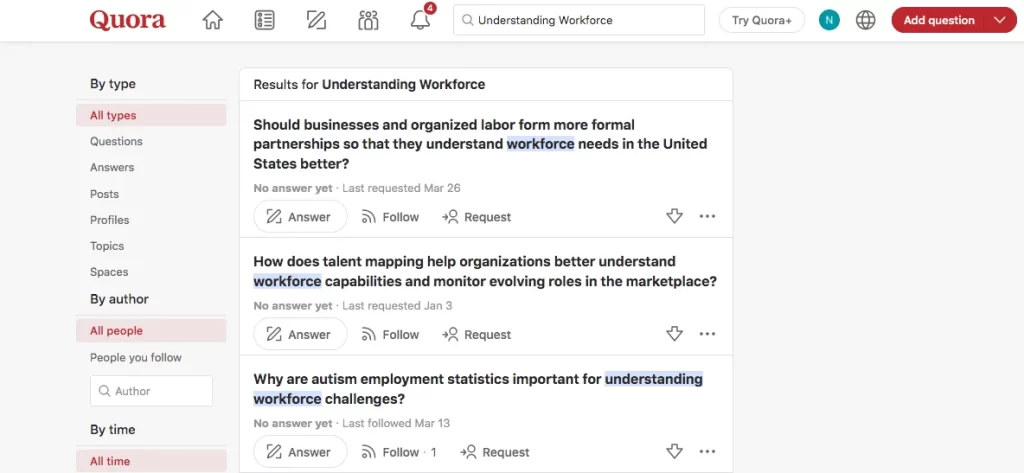
Quora users offer practical feedback on workforce planning and the need for continual upskilling.
Workforce Development
Edgar Teoxon is the workforce development head at ADEC Innovations. He discusses a hands-on approach. He explains,
“Workforce Development is a support department in many companies that deals with the developmental needs of its own human workforce. It usually focuses on the technical training aspect of each employee—from foundation skills to more specific, advanced training. It also deals with performance improvement coaching and develops programs to supplement the career development of every member of the workforce.”
Tasha Walsh has firsthand experience with federal programs. She recalls her time working with workforce development initiatives. She adds,
“Workforce Development is a program that I had the privilege to work with. It is a federally funded program that assists displaced or unemployed workers with job skills and training techniques, equipping them with the tools needed to secure a new job.”
Workforce Planning and Manpower Needs

Quora users discuss strategic planning to meet manpower requirements.
Dmitry Gavryukhin is an IT outsourcing consultant. He considers workforce planning as an analytical balancing act. He notes,
“Strategic workforce planning is an analytical process of keeping in balance your business goals, both short-term and long-term, and the means of achieving these goals. This involves tracking employee history, utilizing time-tracking software, and gathering real-time reports to make the future of your business predictable and safe.”
Sowmya Kusumanchi elaborates,
“Human resource planning ensures that people are available to keep operations running smoothly. It is a tool to assure the future availability of manpower by determining the number and type of employees needed, coping with external changes, and recruiting talented personnel.”
Walt Nicholes adds a practical cautionary tale,
“Without proper workforce planning, you might suddenly face too few employees affecting production or too many, impacting payroll and profitability. I once experienced a situation where new hires had no seating, computers, or even phone lines for weeks.”
Staying Competitive
Ajackus focuses on delivering secure and scalable business solutions,
“With the fast-changing economy, the speed of innovative change increases significantly. There’s a continuous requirement for employees to add new skills and specialized knowledge. Upskilling isn’t just a nice-to-have; it’s essential to remain competitive. It fills the expertise gap through continuous training and has huge monetary implications for organizations worldwide.”
Conclusion
The organizations that thrive in the coming years will be those that treat workforce strategy as a central business imperative rather than a supporting function.
Start by assessing your current workforce against future needs, identifying critical gaps in capabilities, deployment models, and management approaches. Develop targeted initiatives addressing your highest impact opportunities, whether in skill development, model diversification, or technology enablement.
Remember: your workforce isn’t just a cost center—it’s your primary source of competitive advantage in an increasingly knowledge-based economy.
The strategic decisions you make about your people will determine your organization’s ability to execute, innovate, and adapt in a rapidly changing world.
Hire the best candidates
with Wetest.
Create pre-employment assessments in minutes to screen candidates, save time, and hire the best talent.
Try for free