
Bonica
October 13, 2023
Imagine you’re part of a team striving to achieve a shared goal. As the days pass, you notice some colleagues excelling while others struggle.
How do you ensure everyone’s efforts are recognized and improved in this dynamic environment?
This is where skills performance evaluation is a critical process that helps individuals and organizations harness their strengths, address weaknesses, and chart a path toward continuous improvement.
In this article, we’ll delve into skills performance evaluation, uncovering its significance, methods, and how it plays a pivotal role in personal and professional growth.
Table of Contents
Definition of Skills Performance Evaluation
At its core, skills performance evaluation is a structured and systematic process used in organizations to assess an individual’s or a team’s competence and effectiveness in carrying out their tasks and responsibilities.
It goes beyond simply measuring output; it involves a comprehensive analysis of the skills, knowledge, behaviors, and abilities contributing to achieving desired outcomes.
In essence, it’s the method by which we answer questions like, “How well is an employee performing in their role?” or “What specific areas need improvement to enhance overall productivity?” This makes skills performance evaluation a core part of any employee performance evaluation system.
How Does a Skills Performance Work

A skills performance evaluation operates as a well‑orchestrated process designed to provide a holistic view of an individual’s abilities and contributions.
It typically begins with establishing clear criteria and expectations for the role or task. Then, data is meticulously collected, often through various assessment methods like self‑reviews, manager evaluations, and peer feedback.
This data collection phase is followed by a careful analysis, where strengths and areas needing improvement are identified. The heart of the process lies in providing constructive feedback and actionable insights to the evaluated individual.
It’s a two‑way street where open communication and collaboration between the evaluator and the evaluated play a crucial role. Together, they devise strategies for growth and development, setting the stage for ongoing improvement.
Organizations may use different methods for skills performance evaluation, such as rating scales, 360‑degree feedback, or goal‑based reviews, depending on their culture and needs.
Types of Skills Performance Evaluation Methods
Skills performance evaluation can be done using different methods, and many organizations blend several to get a complete picture of performance.
Rating scales and competency matrices:
- Managers score employees against predefined skill levels, behaviors, and performance standards.
- Supports consistent decisions and comparisons across teams and roles.
360‑degree feedback:
- Collects input from managers, peers, direct reports, and sometimes clients.
- Especially useful for assessing soft skills like communication, leadership, and collaboration.
Skills tests, case studies, and simulations:
- Includes technical tests, coding challenges, role‑plays, or practical tasks.
- Measures how employees apply their knowledge in realistic scenarios.
Goal‑based and KPI‑driven reviews:
- Tracks progress toward specific targets over time.
- Combines quantitative results with qualitative feedback to show what employees achieve and how they achieve it.
What Is the Purpose of Skills Evaluation
The purpose of Skills Evaluation is multifaceted, serving both individuals and organizations in various ways. Primarily, it offers a structured mechanism to gauge the effectiveness and competency of employees or team members.
This assessment isn’t just about quantifying performance and understanding how well skills align with job requirements and organizational goals. For individuals, it provides valuable insights into their strengths, areas for improvement, and opportunities for career growth.
At the organizational level, it aids in making informed decisions about training, resource allocation, and performance management. Moreover, Skills Evaluation fosters accountability and motivation by acknowledging achievements and identifying areas for development.
Benefits and Challenges of Skills Performance Evaluation
Skills performance evaluation offers clear benefits for both employees and organizations. It helps individuals understand how their skills match job expectations, highlights strengths, and identifies specific areas for development, which can support promotions, role changes, and long‑term career planning.
For organizations, structured skills evaluation makes it easier to spot skill gaps, design targeted training programs, and allocate people to roles where they can add the most value. It also supports fairer decisions around pay, recognition, and advancement by relying on consistent criteria instead of informal impressions.
However, there are also challenges to consider. Poorly designed evaluation systems can feel bureaucratic, time‑consuming, or confusing, especially if criteria are unclear or forms are overly complex. If managers are not trained, evaluations can become inconsistent or overly subjective, which reduces trust in the results.
There is also a risk of bias, such as favoring people who are more visible or who have similar backgrounds to the evaluator. Employees may feel anxious or defensive if feedback is delivered poorly or used mainly for punishment rather than development. To overcome these challenges, organizations need clear processes, training for evaluators, and a strong focus on fairness and communication.
Why Skills Performance Evaluation Creates Long‑Term Value
Skills performance evaluation does more than score employees; it helps organizations move toward a skills‑based model where people are matched to work based on what they can actually do, not just their job title or years of experience. When skills data is collected consistently, companies can redeploy talent more flexibly, support internal mobility, and respond faster to changing business needs.
A clear evaluation system also strengthens employees’ sense of fairness and transparency. When people understand which skills are valued, how they are assessed, and how results influence opportunities, they are more likely to see decisions as legitimate and to engage with feedback instead of resisting it.
Over time, this combination of better talent decisions and higher trust creates long‑term value: stronger performance, higher retention of key people, and a culture where continuous learning is seen as part of everyday work rather than a separate HR initiative.
From my perspective, the biggest difference between a useful skills performance evaluation and a box‑ticking exercise is follow‑through. When managers actually use the results to shape coaching conversations, project assignments, and day‑to‑day feedback, employees start to see the process as a real tool for growth instead of just another HR form.
Requirements to Apply for a Skills Performance Certificate
Here is a list of the key requirements organizations typically set when applying for a skills performance evaluation certificate or implementing a formal skills evaluation framework:
- Clear role and competency definitions
Before any evaluation can take place, the organization must define each role’s responsibilities and the specific skills and behaviors expected from employees in those roles. This usually includes a competency framework or skills matrix that outlines technical skills, soft skills, and performance standards for each position. - Documented evaluation criteria and process
The organization needs a written evaluation policy that explains how skills performance evaluations will be carried out. This should cover:
- The criteria used to assess performance (e.g., quality of work, collaboration, problem‑solving).
- The frequency of evaluations (e.g., annually, semi‑annually, or project‑based).
- The methods used (self‑assessment, manager review, 360‑degree feedback, etc.).
- How results will be recorded and communicated.
3- Trained evaluators

Managers, team leaders, or HR professionals who conduct evaluations must be trained in:
- Applying the criteria consistently.
- Avoiding bias and unfair treatment.
- Providing constructive, actionable feedback.
This helps ensure the SPE process is fair, credible, and reliable across the organization.
4- Employee participation and consent
Employees should be informed about the purpose of the skills performance evaluation, how it works, and how the results will be used. In many organizations, employees are asked to:
- Agree to development plans based on the results.
- Complete self‑assessments.
- Discuss evaluation outcomes in review meetings.
5- Reliable data and documentation
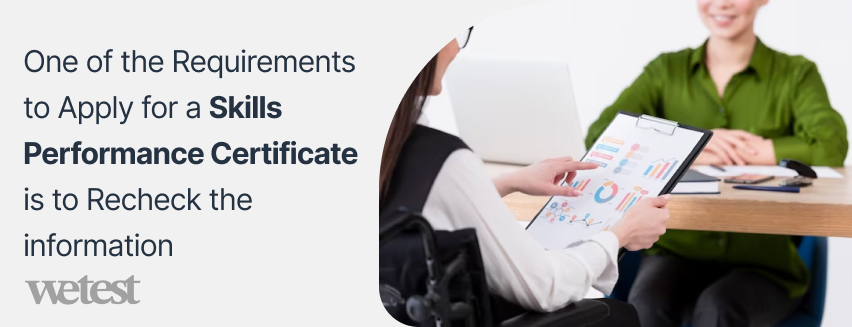
To support the evaluation, organizations must gather and maintain relevant information, such as:
- Performance records (goals achieved, projects completed, KPIs).
- Feedback from managers, peers, or clients.
- Training and development history.
This documentation forms the evidence base for issuing an SPE certificate or confirming that the employee has demonstrated the required level of skill.
6- Development and follow‑up plan
A skills performance evaluation is not complete without a plan for improvement and growth. Organizations should:
- Identify strengths and areas for development.
- Agree on specific goals and timelines.
- Provide access to training, coaching, or mentoring.
The SPE certificate should reflect not just current performance but a commitment to ongoing development.
7- Review and approval by HR or leadership
Finally, HR or designated leaders typically review evaluation outcomes to:
- Ensure consistency across departments.
- Validate that criteria were applied correctly.
- Approve the issuance of any formal certificates or recognition tied to the skills performance evaluation.
These requirements help make the skills performance evaluation process transparent, fair, and useful for both employees and the organization.
How To Implement Skills Performance Evaluation in Your Organization
Implementing skills performance evaluation starts with defining the roles and competencies that matter most for your business. HR and leaders should agree on a simple skills matrix that lists the key technical and soft skills for each role, with clear performance indicators.
Next, choose the evaluation methods that fit your culture and resources, such as rating forms, 360‑degree feedback, skills tests, or goal‑based reviews, and decide how often evaluations will take place and how results will be recorded.
Train managers and evaluators so they apply the criteria consistently, give constructive feedback, and understand how to avoid common biases, then explain the purpose of the process to employees to build trust and buy‑in.
It often helps to start with a small pilot in one team, gather feedback, and refine the forms and timelines before rolling the process out more widely across the organization.
In my experience, starting simple is often better than trying to launch a perfect, complex system. A clear skills matrix, one or two evaluation methods, and honest feedback conversations can deliver more value than an advanced tool that nobody has time to use properly.
How Skills Evaluation Supports HR Decisions and Career Growth
Skills performance evaluation gives HR clearer data for decisions about promotions, lateral moves, and succession planning, instead of relying only on tenure or informal impressions.
The results also guide learning and development, helping HR design focused training or coaching when teams score lower on specific skills, such as problem‑solving or customer communication.
In some organizations, skills evaluation is linked to pay and bonuses, especially where high performance or scarce skills are rewarded, but this requires transparent criteria and clear communication so employees understand how their skills affect rewards.
For employees, skills evaluation acts as a roadmap for career growth, showing which skills matter most, where they stand today, and what they need to develop to move into future roles inside or outside their current organization.
Practical Examples of Skills Performance Evaluation in the Workplace
Consider a customer service team where response time and satisfaction scores are critical metrics. A skills performance evaluation might combine call monitoring, customer feedback, and a skills checklist that rates abilities such as active listening, problem‑solving, and product knowledge, leading to targeted coaching for agents who need support.
In a software development team, managers may use code reviews, project outcomes, and technical assessments to evaluate skills such as programming, debugging, and collaboration. The results can guide decisions about who is ready to lead projects, who should mentor others, and which developers would benefit from additional training in specific tools or frameworks.
For leadership roles, organizations often rely on 360‑degree feedback to assess skills like strategic thinking, communication, and team building. By gathering input from peers, direct reports, and senior leaders, companies can identify high‑potential employees and design individual development plans that prepare them for future leadership positions.
Future Trends in Skills Performance Evaluation

As we move forward into an increasingly dynamic and digital world, the landscape of skills performance evaluation is poised for remarkable transformation. One prominent trend on the horizon is the integration of advanced technologies, such as artificial intelligence and data analytics.
These innovations will streamline the evaluation process, providing real-time feedback and data-driven insights.
Additionally, we can anticipate a shift towards a more holistic approach, focusing on job-specific skills and soft skills like adaptability, communication, and emotional intelligence.
Finally, the emphasis on continuous learning and development is expected to intensify, with personalized training programs becoming the norm.
The future of skills performance evaluation promises to be dynamic, tech-savvy, and geared towards fostering the growth and adaptability of individuals and organizations alike.
Key Metrics for Evaluating Your Skills Performance System
To ensure that skills performance evaluation is effective, organizations should track specific metrics related to both process and outcomes. On the process side, useful indicators include completion rates of evaluations, timeliness of reviews, and the percentage of employees who receive documented feedback and development plans.
Outcome metrics help show whether the evaluation system is making a real difference. Examples include changes in employee engagement scores, retention rates in key roles, internal promotion rates, and improvements in performance indicators such as quality, productivity, or customer satisfaction after development actions are taken.
Organizations can also monitor the impact of skills‑based decisions, such as whether teams with clearer skills data experience fewer skill gaps or faster project delivery. Over time, reviewing these metrics allows HR and leadership to refine the evaluation process, adjust training investments, and ensure that skills performance evaluation continues to support both business goals and employee growth.
Conclusion
Skills performance evaluation is more than a formal HR exercise; it is a structured way to align employee skills with real business needs while supporting continuous growth and employee performance improvement.
When done well, it helps organizations spot skill gaps, design targeted development, and move toward a skills‑based model where people are matched to work based on what they can actually do.
For employees, a clear and transparent evaluation process builds trust, shows which skills matter most, and turns feedback into a roadmap for career progress rather than just a one‑time judgment.
Over time, this combination of better decisions, fairer processes, and ongoing development creates long‑term value for both individuals and organizations, making skills performance evaluation a core part of any modern workplace strategy.
If you are designing or updating your approach, focusing on clarity, consistency, open communication, and a clear link to employee performance improvement will help ensure that skills performance evaluation supports not only short‑term reviews but also long‑term talent and business goals.
FAQs
Why is skills performance evaluation important for employees?
It helps employees understand how well they’re performing, highlights strengths and weaknesses, and provides clear guidance for career growth and development.
How can organizations ensure fair and unbiased skills performance evaluation?
They can train evaluators on bias, use clear and consistent criteria, involve multiple reviewers where possible, and keep the process transparent and well‑documented.
Are there different methods of conducting skills performance evaluation?
Yes. Common methods include self‑assessments, manager reviews, and 360‑degree feedback that gathers input from peers, subordinates, and supervisors.
How often should skills performance evaluations be done?
Many organizations conduct formal evaluations annually or semi‑annually, and supplement them with regular check‑ins or informal feedback throughout the year.
What should employees do after a skills performance evaluation?
They should review the feedback carefully, clarify any points with their manager, set specific improvement and development goals, and follow through with agreed training or actions.
Hire the best candidates
with Wetest.
Create pre-employment assessments in minutes to screen candidates, save time, and hire the best talent.
Try for free