Understanding Sabbatical Leave Rules: A Guide for Employees and Employers
Employee relations
Bonica
June 3, 2025
We all know the grind of today’s work world. But what if you could press pause, recharge, and come back even better? Sabbatical leave, once seen as a rare academic treat, is now a powerful way for companies to hold onto their best talent.
If you’re an employee dreaming of extended time off or an employer looking to offer this amazing benefit, getting the details right is important.
Table of Contents
Introduction to Sabbatical Leave in Modern Workplaces

Discover how modern organizations are leveraging sabbatical programs to boost employee well‑being, foster innovation, and strengthen retention.
What Is a Sabbatical and Why It Matters
A sabbatical is an extended break from work. It can last anywhere from a month to a full year. You can press pause on your regular duties. A sabbatical is designed for deep personal growth, learning, or pure rejuvenation.
Studies show a whopping 76% of workers struggling with burnout. Sabbaticals are becoming the ultimate reset button. They give professionals the vital space to return full of new perspectives that regular PTO can’t provide.
The Evolution of Sabbatical Leave Policies
Sabbaticals originated in academia, where professors would take every seventh year for research and scholarly pursuits. Today, they’ve expanded well beyond university settings.
Companies like Adobe, Intel, and Goldman Sachs have implemented robust sabbatical programs, recognizing their value in talent retention. The shift began in the tech industry but has spread across sectors as organizations compete for top talent with benefits beyond standard compensation packages.
Key Benefits of Sabbatical Programs for Organizations
Smart employers recognize that sabbaticals aren’t just employee perks—they’re strategic business investments. Organizations with established sabbatical programs report:
- – 87% higher retention rates among sabbatical-eligible employees
- – Increased productivity upon employee return
- – Opportunities for leadership development as other team members step into temporary roles
- – Enhanced employer branding and recruitment advantage
- – Reduced burnout-related costs (including healthcare expenses and turnover)
When Netflix implemented its sabbatical program, they saw a 25% decrease in voluntary departures among eligible employees—proof that these programs deliver measurable ROI.
Legal Framework Governing Sabbatical Leave Policies

Learn the key federal, state, and international regulations that shape how sabbaticals must be structured to remain compliant and fair.
Federal and State Regulations for Extended Leave
Unlike some countries, the United States has no federal laws specifically addressing sabbatical leave. This means employers have significant flexibility in designing their programs, but they must still navigate relevant employment laws.
Key considerations include:
- – Compliance with ERISA (Employee Retirement Income Security Act) if sabbaticals are considered an employee benefit plan
- – Anti-discrimination requirements to ensure eligibility criteria don’t disproportionately impact protected groups
- – State-specific laws that may impact extended leave offerings
California, for example, requires sabbatical programs to treat all employees in similar positions equally to avoid potential discrimination claims.
International Sabbatical Leave Laws to Consider
For multinational organizations, navigating sabbatical policies becomes more complex. Several countries have established sabbatical frameworks:
- – Belgium offers a “career break” system allowing 1-5 years of partially compensated leave
- – Australia has long service leave after 7-10 years with an employer
- – Denmark provides educational leave options with government subsidies
Companies with global workforces must consider these variations when creating consistent yet compliant sabbatical policies.
7 Essential Components of Effective Sabbatical Policies

Explore the seven must‑have elements that ensure your sabbatical program runs smoothly.
Eligibility Requirements and Service Qualifications
Most organizations establish clear tenure requirements before employees qualify for sabbatical leave. Typical benchmarks include:
- – 5-7 years of continuous service for first sabbatical eligibility
- – Satisfactory performance reviews or standing
- – Clear waiting periods between sabbaticals (often 5+ years)
REI’s approach exemplifies best practices: employees become eligible after 15 years of service, with sabbaticals repeating every 5 years thereafter—creating a sustainable long-term retention incentive.
Duration Options: From One Month to One Year
Effective sabbatical policies offer clear guidelines on leave duration. Some organizations provide:
- – Scaled options based on tenure (e.g., 1 month after 5 years, 2 months after 10)
- – Standard durations across the organization (commonly 4-12 weeks)
- – Extended options for specific purposes like education or volunteer work
McDonald’s offers a “McSabbatical” that provides 8 weeks of paid leave after 10 years of service—a clear, consistent approach that employees can plan toward.
Compensation Models During Sabbatical Periods
Compensation structures vary widely across sabbatical programs:
- – Fully paid sabbaticals (most common in tech and finance)
- – Partially paid leaves (often 50-80% of regular salary)
- – Unpaid sabbaticals with benefit continuation
- – Hybrid models with decreasing compensation for longer durations
Intel pays 100% of salary for an 8-week sabbatical after 7 years—a generous approach that ensures financial barriers don’t prevent participation.
Benefits Continuation During Extended Absence
Clear policies regarding benefits are essential for any sabbatical program. Top considerations include:
- – Health insurance continuation (and who covers premiums)
- – Retirement plan contributions during absence
- – Impact on other benefits like stock vesting or bonus eligibility
- – Life insurance and disability coverage maintenance
Adobe maintains full benefits during sabbaticals, treating the time as continuous employment for all benefit purposes—removing a major concern for employees considering extended leave.
Position Protection and Return Guarantees
Employees need assurance that taking a sabbatical won’t derail their career. Effective policies address:
- – Whether employees return to the same role, level, or team
- – Any limitations or exceptions to position guarantees
- – Process for situations where original positions are eliminated
- – Impact on promotion timelines or performance evaluations
Patagonia guarantees return to the same or comparable position after sabbatical completion—creating the security employees need to fully disconnect.
Application and Approval Process Guidelines
A transparent application process prevents confusion and ensures fair implementation. Key elements include:
- – Application deadlines (typically 3-6 months before proposed start)
- – Required approvals and decision timeline
- – Criteria for evaluating competing requests
- – Appeal options for denied applications
Deloitte requires applications submitted 6 months in advance with department head and HR approval—creating a predictable process that allows for proper planning.
Documentation Requirements for Both Parties
Sabbatical agreements should clearly document expectations for both parties. Essential documentation includes:
- – Written agreement outlining all terms and conditions
- – Return-to-work commitment details (if applicable)
- – Contact protocols during absence
- – Requirements for activity reports or outcomes
Microsoft uses a formal sabbatical agreement that both parties sign, outlining all terms and creating a clear reference document if questions arise later.
Implementing Sabbatical Leave as an Employer

Understand the step‑by‑step process for launching a sabbatical policy, from drafting the document to managing financial impact and communications.
Creating a Comprehensive Sabbatical Policy Document
Your sabbatical policy should address all critical elements while remaining accessible. Include:
- – Purpose statement explaining organizational objectives
- – Clear eligibility criteria and application procedures
- – Compensation and benefits information
- – Return-to-work expectations
- – Examples or scenarios to illustrate policy application
Keep language straightforward and avoid legal jargon that might create confusion. Consider including a FAQ section addressing common questions.
How to Calculate the Financial Impact of Sabbaticals
Responsible implementation requires understanding the financial implications. Calculate:
- – Direct costs (continued compensation and benefits)
- – Indirect costs (temporary replacement or productivity adjustments)
- – Long-term savings (reduced turnover and recruiting expenses)
- – Potential ROI through retention and engagement improvements
Companies like Vistaprint have found that their sabbatical programs pay for themselves through reduced recruitment costs alone—with productivity and innovation gains representing additional return.
Managing Workflow During Employee Sabbaticals
Successful sabbatical programs include strategies for maintaining operations during employee absence:
- – Cross-training initiatives prior to departures
- – Documentation of key processes and responsibilities
- – Clear delegation plans for critical functions
- – Development opportunities for team members covering additional responsibilities
- – Temporary role adjustments or contract support where necessary
MeetUp uses sabbaticals as leadership development opportunities, allowing junior team members to temporarily step into expanded roles—creating a dual benefit.
Communication Strategies for Sabbatical Programs
Effective communication ensures your sabbatical program delivers maximum value:
- – Introduce the program through multiple channels (all-hands meetings, intranet, benefits guides)
- – Feature sabbatical success stories in internal communications
- – Create sabbatical planning resources for managers and teams
- – Regularly remind employees of eligibility milestones
- – Celebrate returning employees and their experiences
Clif Bar maintains a “sabbatical wall” featuring photos and stories from employee sabbaticals—reinforcing the program’s value and inspiring others to participate.
Navigating Sabbatical Leave as an Employee

Get practical advice on how to assess your eligibility, build a compelling case, and plan every detail of your time away.
Steps to Determine Your Sabbatical Eligibility
Before approaching management about a sabbatical:
1. Review your employee handbook or benefits documentation
2. Calculate your tenure based on policy requirements
3. Check performance evaluation standings if relevant
4. Consider timing in relation to team projects or business cycles
5. Assess your manager’s likely receptiveness based on department needs
Be thorough in your research—approaching the conversation fully informed demonstrates professionalism and increases your chances of approval.
Planning Your Sabbatical: Timeline and Checklist
Successful sabbaticals require thoughtful planning. Create a timeline including:
- – 12 months before: Research company policy and begin conceptualizing your sabbatical
- – 6-9 months before: Prepare and submit your formal request
- – 3-6 months before: Create transition documentation and begin cross-training colleagues
- – 1-3 months before: Finalize handoff plans and set communication expectations
- – 2-4 weeks before: Conduct comprehensive handoff meetings
Use project management tools to track all preparation tasks and ensure nothing falls through the cracks.
Making a Compelling Case for Your Sabbatical
Frame your sabbatical request to highlight organizational benefits:
- – Connect your plans to professional growth relevant to your role
- – Identify specific skills or perspectives you’ll gain
- – Propose a detailed transition plan minimizing disruption
- – Highlight potential innovations or improvements you might bring back
- – Demonstrate your commitment to the organization post-sabbatical
One marketing manager successfully secured sabbatical approval by proposing international travel that would expose her to emerging global trends relevant to the company’s expansion goals.
Financial Planning for Reduced-Pay Sabbaticals
If your sabbatical involves reduced or no compensation, prepare financially:
- – Create a sabbatical-specific savings plan at least 12-18 months in advance
- – Calculate all ongoing expenses during your absence
- – Consider health insurance and benefits continuation costs
- – Build a buffer for unexpected expenses (approximately 15-20% of your budget)
- – Explore passive income opportunities during your absence if necessary
Financial stress defeats the purpose of a sabbatical—thorough planning ensures you can focus on the experience rather than worrying about finances.
Creative Sabbatical Models for Different Industries

See how academia, tech, nonprofits, and other sectors tailor sabbatical structures to fit their unique goals and constraints.
Paid vs. Unpaid Sabbatical Program Structures
Organizations implement various financial structures based on their resources and objectives:
- – Tech companies often offer fully paid sabbaticals to remain competitive
- – Nonprofits might use unpaid models with benefit continuation
- – Manufacturing sectors frequently implement partially paid models
- – Some organizations tie compensation to sabbatical purpose (e.g., higher pay for educational pursuits)
Salesforce offers 7 days of paid volunteer time that can be combined with sabbatical time—creating flexibility while supporting community impact.
Academic Sabbaticals: Traditional Approaches and Benefits
The original sabbatical model still thrives in academia:
- – Typically offered every 7 years for tenured faculty
- – Often requires proposals with specific research or scholarly outputs
- – Usually provides partial salary (50-100%)
- – May include travel or research stipends
- – Requires formal reporting upon return
These programs continue to drive innovation and knowledge advancement in higher education institutions worldwide.
Corporate Sabbaticals: Case Studies and Success Stories
Companies across sectors have implemented successful sabbatical programs:
- – Patagonia’s Environmental Internship Program allows employees to work with environmental nonprofits while receiving full pay
- – Adobe’s sabbatical program offers 4 weeks paid leave after 5 years and 5 weeks after 10 years
- – Cisco provides a 30-day “Time2Give” sabbatical for volunteering at nonprofits
These programs demonstrate the diverse approaches possible within corporate environments.
Nonprofit Sabbatical Programs and Their Unique Features
Nonprofit sabbaticals address sector-specific challenges:
- – Leadership sustainability in organizations dependent on founders
- – Burnout prevention in emotionally demanding work
- – Skill development despite limited professional development budgets
- – Knowledge transfer in specialized roles
The Durfee Foundation’s Sabbatical Program specifically targets nonprofit leaders, providing $45,000 grants to support extended breaks—recognizing the unique pressures of nonprofit leadership.
Measuring the ROI of Sabbatical Programs

Find out which metrics you should track to prove the business value of sabbaticals.
Employee Retention Impact After Sabbatical Implementation
The most measurable benefit of sabbaticals is typically improved retention:
- – Track retention rates among sabbatical-eligible employees vs. non-eligible groups
- – Compare turnover costs to sabbatical program expenses
- – Monitor post-sabbatical tenure (employees often stay 2-3 years beyond their sabbatical)
- – Calculate the “loyalty dividend” of longer average employee tenure
When Morningstar implemented sabbaticals, they saw a 23% increase in retention among employees who utilized the benefit—translating to millions in saved recruitment costs.
Productivity and Innovation Metrics to Track
Beyond retention, sabbaticals can spark measurable performance improvements:
- – Compare pre and post-sabbatical performance evaluations
- – Track new project initiatives following sabbatical returns
- – Measure team productivity changes after leader sabbaticals
- – Survey managers about observable differences in returning employees
3M found that employees returning from sabbaticals generated 25% more patent applications in the year following their return—demonstrating tangible innovation benefits.
Workplace Culture Transformation Through Sabbaticals
Sabbaticals can drive broader cultural shifts:
- – Measure engagement scores before and after program implementation
- – Track changes in employer review ratings on platforms like Glassdoor
- – Monitor internal application rates for open positions
- – Survey employees about perceived organizational commitment to wellbeing
Companies implementing sabbaticals often see engagement scores rise across the organization—even among employees not yet eligible for the benefit.
Cost-Benefit Analysis of Organizational Sabbatical Programs
Comprehensive ROI assessment should consider all financial factors:
- – Program administrative costs (typically 5-10% of direct expenses)
- – Compensation continuation expenses
- – Temporary replacement costs where applicable
- – Reduced turnover savings (typically $50,000-$150,000 per retained professional)
- – Productivity improvements (often 15-20% post-sabbatical)
- – Recruitment marketing value
Most organizations find sabbatical programs become cost-positive within 2-3 years of implementation when all factors are considered.
Common Challenges and How to Overcome Them

Identify the typical roadblocks in sabbatical administration and learn strategies to address coverage, reintegration, and policy misuse.
Addressing Coverage Issues During Employee Absence
The most immediate challenge is maintaining operations during sabbaticals:
- – Create “sabbatical coverage plans” as standard documentation for all roles
- – Develop cross-training matrices identifying backup capacity for key functions
- – Consider rotating temporary project team structures during absences
- – Explore fractional or contract support for specialized functions
- – Use sabbaticals as development opportunities for high-potential employees
QuickBooks rotates responsibilities during sabbaticals, creating a “knowledge cross-pollination” that actually improves organizational resilience.
Preventing Sabbatical Policy Abuse and Misuse
Clear guidelines prevent potential issues:
- – Establish defined purposes aligned with organizational values
- – Consider requiring sabbatical proposals or plans
- – Implement appropriate notice periods (typically 3-6 months)
- – Create reasonable intervals between eligibility periods
- – Maintain documentation of all approvals and agreements
Thoughtful policy design prevents most problems before they occur.
Reintegrating Employees After Extended Sabbaticals
The return process is crucial for realizing sabbatical benefits:
- – Schedule structured re-onboarding meetings
- – Create “catch-up” documentation for returning employees
- – Plan formal knowledge-sharing about sabbatical insights
- – Allow adjustment time before full workload resumption
- – Conduct 30/60/90-day check-ins after return
LinkedIn uses “reverse onboarding” processes for returning sabbatical-takers, ensuring smooth transitions back into the workplace.
Adjusting Policies Based on Organizational Feedback
Sabbatical programs should evolve based on experience:
- – Conduct surveys with sabbatical participants upon return
- – Gather manager feedback about program impact
- – Review annual participation rates and approval/denial patterns
- – Assess financial implications against projected models
- – Make incremental adjustments rather than wholesale changes
The most successful programs implement annual review cycles to continuously refine their approach.
A Quora Rundown
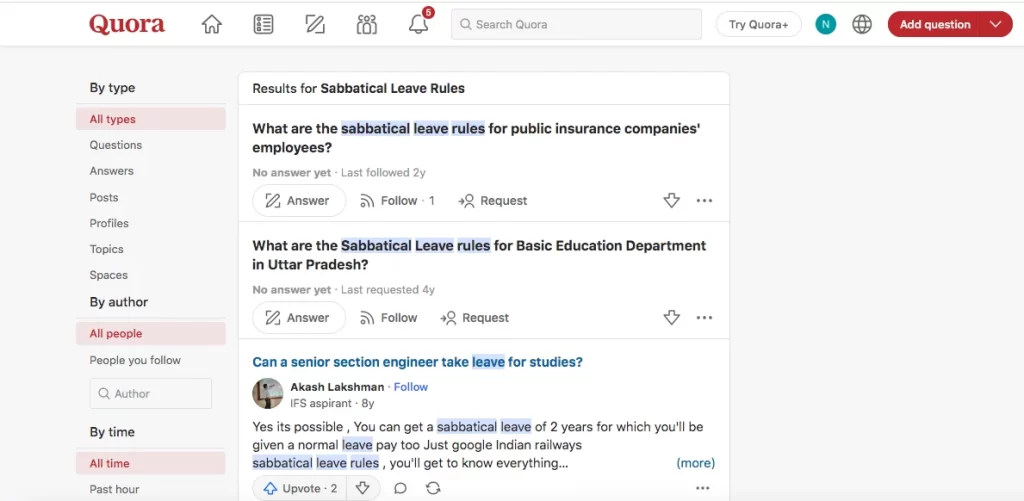
Real-life stories from everyday people paint a better picture than standard HR documents. Here’s what users across Quora had to say.
The Roots and Evolution of Sabbaticals
Norman Owen is an Honorary Professor at The University of Hong Kong. He offered a thoughtful reflection on the term’s origins,
“Traditionally, a ‘sabbatical’ leave was called that because of its similarity to the Sabbath—one day of rest per week. Many universities followed the practice of granting a year’s leave more or less automatically after six years of service—so it was also ‘one out of seven off.’”
Norman emphasized that the definition of sabbatical has evolved,
“Even the term ‘sabbatical’ has all but disappeared in some contexts… policies are probably not consistent even within a single university.”
The Corporate vs Academic Divide

Sabbaticals are still predominantly seen in academia, but the corporate world is slowly catching on. Jay Lee noted,
“As far as I know, the only places I’ve encountered it as a technical term is in academia… though some companies have started to adopt loosely sabbatical-like policies.”
Shriram Krishnamurthi is a professor at Brown University. He highlighted that while academia tends to offer more flexibility, some corporate programs are beginning to resemble sabbaticals,
“Some entities have more formal ‘leave to learn something new’… Usually these are tied to specific objectives, unlike a sabbatical, which can be far more free-wheeling.”
The TCS Example
In the private sector, tech companies like Tata Consultancy Services (TCS) have begun to offer sabbaticals, but with specific conditions. Nik Pan, an ASE at TCS, provided a comprehensive breakdown of how the system works there.
“TCS provides sabbatical leave for employees who wish to pursue higher education… maximum of 2 years or 730 days… Sabbatical is not applicable for part-time courses.”
He added that approvals hinge on both manager and HR sign-off, and there’s a strict leave application sequence involving exhaustion of paid leave, followed by leave without pay.
Importantly, TCS offers continued health insurance coverage during sabbaticals, though employees must pay the premium upon return.
When Things Go Wrong
Not all sabbatical experiences are smooth. Kent Aldershof, a Harvard MBA, shared a cautionary note,
“What are the potential downsides to taking time off for a Sabbatical without telling your company about it in advance? Maybe none—if you don’t consider being summarily fired a downside.”
It’s a sharp but critical reminder that sabbaticals must be formally arranged.
Conclusion
The sabbatical landscape continues to evolve:
- – Shorter, more frequent sabbaticals (mini-sabbaticals of 4-6 weeks)
- – Purpose-specific programs aligned with organizational missions
- – Remote work integration creating location flexibility
- – Earlier eligibility timelines as competition for talent increases
- – Technology sabbaticals focused on digital detox and wellbeing
Forward-thinking organizations are adapting sabbatical structures to match changing workforce expectations and needs.
Building a Sustainable Sabbatical Program
Long-term success requires thoughtful program design:
- – Ensure financial sustainability through proper budgeting
- – Create scalable administrative processes
- – Build sabbatical planning into workforce development strategies
- – Maintain consistent communication about program benefits
- – Regularly reassess eligibility criteria against retention goals
Programs designed with sustainability in mind become powerful cultural differentiators rather than short-lived perks.
Final Recommendations for Employers and Employees
For employers considering sabbatical implementation:
Start small, measure thoroughly, and expand gradually. Even modest sabbatical offerings can deliver significant benefits when thoughtfully designed and clearly communicated.
For employees pursuing sabbatical opportunities:
Research thoroughly, plan meticulously, and propose confidently. Frame your sabbatical in terms of mutual benefit, and you’ll dramatically increase your chances of approval.
Sabbaticals represent one of the most powerful tools for balancing organizational performance with employee wellbeing. When implemented thoughtfully, they create sustainable high-performance cultures where both businesses and individuals thrive.
Hire the best candidates
with Wetest.
Create pre-employment assessments in minutes to screen candidates, save time, and hire the best talent.
Try for free