
Resignation Acceptance Email: Best Practices and Common Mistakes to Avoid
Human resources
Bonica
July 29, 2025
When someone on your team quits, your email back really shows off what your company’s about. If you just hit “send” on a boring “I accept your resignation,” it’s like slamming a door shut.
But if you write something like, “Hey, thanks for everything you did—best of luck!” it suddenly feels way more human, less robotic, and keeps things cool for later on.
In this guide, I’m gonna walk you through some quick tips to make your responses sound like you actually care, not like a stiff memo from HQ.
We’ll go over what to say (and what not to say, because corporate buzzwords are the worst), plus a few half-baked templates you can rip off right now—no drama.
Table of Contents
Introduction to Resignation Acceptance Communication

When someone hands in their notice, how you answer actually matters—a lot more than you’d think. That follow-up email isn’t just ticking a box. It’s about saying “got it,” spelling out what happens next, and setting the mood for their final days at the company. And honestly, it’s one of the last chances you get to make them think, “Hey, my time there was pretty cool.”
These emails do a few gigs at once: they lock in that you’ve officially accepted the resignation, lay out the next steps, and let everyone know what to expect until the person’s last day. But the real kicker? It’s your last shot to leave a good taste in their mouth.
Oh, and here’s a fun stat: a LinkedIn survey from 2023 found that 76% of pros would actually think about going back if they left on good terms.
So yeah—your little reply can impact your company’s rep, future hiring, and whether you ever see that person walk back through your door.
Understanding the Purpose of Resignation Acceptance Emails

It’s all about making sure everyone’s on the same page during a big change.
The Professional Significance of Proper Resignation Responses
Think of a good resignation acceptance email like more than boring paperwork. It’s a quick way to show your crew—and the person leaving—that you run a tight ship and actually care about everyone, not just the folks still clocking in.
When handled correctly, these communications:
– Provide legal documentation of employment termination
– Establish clear expectations for the departure process
– Demonstrate organizational maturity and professionalism
– Set the foundation for possible future relationships
How Acceptance Emails Impact Company Culture and Reputation
How you respond to departures ripples throughout your organization.
And the person who just quit? They’re probably telling their network (and venting on Glassdoor) about how smooth—or messy—their exit was.
Fun fact: a 2022 Randstad study showed that 57% of job hunters bail on companies with bad exit reviews. So yeah, how you say goodbye can actually scare off future talent.
Key Objectives Every Resignation Response Should Achieve
An effective resignation acceptance email should: formally acknowledge and accept the resignation, express proper appreciation for the employee’s contributions, clearly communicate next steps and what’s expected, maintain a professional, respectful tone regardless of circumstances, preserve the relationship for potential future interactions, and protect the organization legally and operationally.
Alright, let’s break down the must-haves you need to include in your reply.
7 Essential Elements of an Effective Resignation Email

Let’s break down what really makes these emails work.
Professional Acknowledgment of Employee’s Decision to Leave
First things first: kick off your email by spelling out that you got the resignation and you’re on board with it. Drop in the person’s name, what they do, and their official last day. That way, nobody’s left guessing about when they’re really out the door.
Example: “This email confirms acceptance of your resignation from your position as Marketing Manager at XYZ Company, effective September 15, 2023.”
Expressing Appropriate Gratitude for Their Contributions
Take time to recognize the employee’s specific contributions to the organization. Personalize this section based on their achievements, tenure, and impact. Avoid generic statements that feel insincere.
Example: “Your leadership in developing our content strategy resulted in a 45% increase in engagement over the past year. Your strategic thinking and creativity have made a lasting impact on our team’s success.”
Clear Communication About Final Work Arrangements

Outline expectations for the employee’s remaining time, including:
– Work schedule adjustments (if any)
– Ongoing project responsibilities
– Any changes to reporting structure
– Remote work arrangements (if applicable)
Clarity here prevents confusion and ensures essential work continues during the transition period.
Information on Exit Procedures and Documentation Requirements
Providing a full overview of all the administrative stuff for departing employees is super important.
This usually includes: scheduling the exit interview, managing the return of company property (like laptops, badges), finishing all the documentation requirements, and navigating the final timesheet submission process.
To give the employee an even bigger hand, consider adding a checklist or a calendar with all the key dates.
Details About Final Compensation and Benefits Processing
Address financial matters clearly and completely:
– Final paycheck timing and delivery method
– Unused vacation/PTO payout information
– Benefits continuation options (COBRA details)
– Retirement account information
– Stock option or equity considerations
Be precise about dates and processes to avoid post-employment confusion and inquiries.
Instructions for Knowledge Transfer and Transition Planning
Outline your expectations for knowledge transfer:
– Documentation of current projects and processes
– Training of replacement or interim staff
– Client or vendor relationship transitions
– Access to systems and files after departure
Providing structure for this process ensures critical information isn’t lost when the employee leaves.
Maintaining Positive Professional Relationships After Departure
You should always end your communication with forward-looking language that helps build continued professional relationships.
This includes an invitation to stay connected professionally, information about alumni networks or groups, details on reference provision, and the potential for future opportunities if it’s right.
This final piece just sets the stage for a continued professional relationship that could benefit both parties.
A Quora Rundown
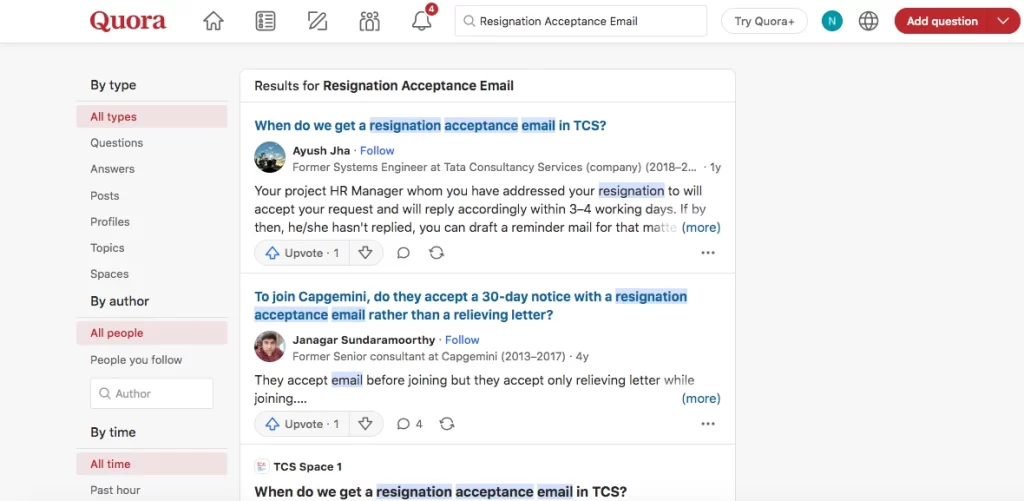
Quora users discuss how to follow up when your resignation acknowledgement goes unanswered.
Crafting a Direct Follow-Up
If your first resignation email doesn’t get a reply, your follow-up should be short and direct, not desperate.
Vinod Kumar Menon notes:
“Dear Sir/Madam or HR,
I would like to bring to your attention that I am still awaiting response/acknowledgement from your end with regards to my resignation mail dated \[date].
Yours sincerely,
\[Your Name]”
As Menon points out, “in 99.9% of cases … your notice period starts immediately, irrespective of the fact whether your employer responds to your resignation or not.” Copying both your manager and HR ensures everyone sees the chain.
Automating and Escalating the Process
Some organizations still handle exits manually. Automation and strategic escalation can help.
greytHR notes,
“When you’re in a fix … better to follow up tightly as otherwise your notice period gets postponed further.
1. Call at least once a day and check the status.
2. Email at least once a day to remind of the pending review.
3. If you get a signal of intentional delay, escalate to the Department Head or Head of HR.
4. If that fails, escalate to the CEO or Director.”
Establishing a Paper Trail for Your Notice
Keeping a record of every reminder is your best legal safeguard.
Stephen McKinnis states,
“Remind them as the weeks come to a close … state in writing/email or text, today is the \_\_\_\_ date and just to remind you my last day will be Jan \_\_\_, 2020. Then when the day approaches you have let them know the entirety of your notice … you will have created a track record that is documented electronically.”
Balancing Formality with Interaction

Not every culture or company treats email as sufficient notice. In some workplaces, a brief conversation remains a useful courtesy.
Martin Turner notes,
“The normal path, if it’s a good working relationship, is … tell your manager face to face that you’re leaving, then email your resignation as a PDF to HR. You then reply confirming receipt, terms, and thank them.”
Tony Krznarich adds:
“The day you decide to quit, go to HR. Don’t tell anyone, only HR the day you leave. … Leave your area neat. Have instructions for your replacement if applicable.”
Navigating Organizational Nuances
Large enterprises have sign-off processes. Procedural awareness can ease your exit.
Seshagiri Rao Tipirneni:
“Accepting resignation is a time-taking process in larger organisations. … The papers move up from your immediate boss to line managers to the CEO/MD. Once all approvals and no objection certificates are obtained, HR issues the relieving letter.”
Joe Francis adds:
“If you work in IT, I’ve never heard of resignations being ignored. In lower-paid, high-turnover roles, silence may reflect the company’s norms rather than malice.”
5 Common Mistakes in Resignation Acceptance Emails

Let’s look at what to avoid when writing these emails.
Responding with Negative Emotions or Unprofessional Language
A big mistake is letting your disappointment seep into your email. Your acceptance email should stay professional.
Avoid:
– Expressing disappointment in the employee’s decision
– Questioning their judgment or new opportunity
– Using passive-aggressive language
– Making the situation about your inconvenience
– Guilt-tripping language about team impact
Instead, focus on acknowledging their decision respectfully and managing the transition professionally.
Failing to Address Important Transition Details
When an employee leaves, if you give incomplete info, it totally generates more work for everyone and just makes things seem disorganized.
Frequently, what’s missed is unclear final day expectations, missing details about benefit continuation, vague knowledge transfer requirements, incomplete equipment return instructions, and a lack of clarity about final compensation.
To streamline the departure process, it’s essential to give comprehensive information right away.
Overlooking Legal and Compliance Considerations

Resignation acceptances create a paper trail that may be referenced in future legal situations. Failing to consider compliance issues can create risk for your organization.
Watch out for:
– Making promises about references you can’t keep
– Including information that contradicts company policies
– Failing to mention required confidentiality or non-compete obligations
– Overlooking state-specific requirements for final pay or documentation
– Making comments about protected characteristics (age, gender, etc.)
When in doubt, have HR review your acceptance email before sending.
Missing Opportunities for Constructive Feedback Collection
The resignation process offers valuable opportunities for candid feedback, but some companies just fail to use it well.
Instead of just a generic “exit interview” mention, consider: showing them their feedback can improve the workplace, pointing out exactly what kind of insights would be super helpful, giving them options for how to share their thoughts (in person, in writing, or online), promising that whatever they share will be kept private, and letting them know you genuinely care about what they experienced.
Neglecting to Establish Terms for Future References
If expectations about future references are unclear, it can lead to awkward moments and potential legal issues. This important topic has to be addressed.
Your email should clarify the company policy on references, specifically who will serve as the reference contact, outline what information will be provided, establish how reference requests should be directed, and include any required documentation for reference requests.
This clarity benefits both the departing employee and your organization.
Step-by-Step Guide to Writing Acceptance Emails

Let’s walk through exactly how to craft these important messages.
How to Structure Your Resignation Acceptance Message
1. Subject Line: Keep it simple and clear (e.g., “Acceptance of Resignation – [Employee Name]”)
2. Opening Paragraph: Formally acknowledge the resignation with key details:
– Confirmation of acceptance
– Effective end date
– Position title
3. Second Paragraph: Express appreciation and highlight contributions
4. Middle Paragraphs: Detail logistical information:
– Exit procedures
– Transition responsibilities
– Final compensation details
5. Closing Paragraph: Maintain the relationship and extend well wishes
6. Signature: Include your name, title, and contact information
This structure ensures you cover all necessary information.
Tailoring Your Response to Different Employment Situations
Different resignation scenarios require different approaches:
For Long-Term Employees (5+ years)
– Include more personalized appreciation
– Reference specific long-term contributions
– Consider mentioning company milestones they participated in
For Short-Term Employees (<1 year)
– Focus on specific projects completed
– Keep the tone professional but concise
– Ensure all procedural details are especially clear
For Remote Employees
– Provide detailed instructions for returning equipment
– Specify virtual exit interview processes
– Include technical details for system access termination
For Leadership Positions
– Address team communication planning
– Include information about succession announcements
– Provide clarity on client/partner relationship transitions
Balancing Professionalism with Personal Connection
The most effective resignation responses strike a balance between formal business communication and human connection. Achieve this balance by:
– Using the employee’s preferred name in the greeting
– Referencing specific contributions that demonstrate your familiarity with their work
– Including a personal well-wish that reflects your knowledge of their next steps
– Maintaining professional language throughout while avoiding cold, templated-sounding phrasing
Remember that this communication may be saved and referenced by the employee for years to come. It should reflect well on both you and the organization.
Sample Templates for Various Resignation Scenarios
Standard Professional Resignation
“`
Subject: Acceptance of Resignation – [Employee Name]
Dear [Employee Name],
This email confirms that I have received and accepted your resignation from your position as [Position] at [Company Name], effective [Last Day of Employment].
I want to thank you for your [time period] of dedicated service to our team. Your contributions to [specific projects or achievements] have been valuable and will continue to benefit the company moving forward.
During your remaining time with us, please work with [Manager/HR Contact] to ensure a smooth transition of your responsibilities. They will schedule an exit interview and provide details about returning company property and completing necessary paperwork.
Your final paycheck will be [mailed/direct deposited] on [Date] and will include payment for [unused vacation/applicable benefits]. [HR Contact] will reach out separately regarding benefits continuation options.
We wish you success in your future endeavors. Please don’t hesitate to reach out if you need anything during this transition.
Best regards,
[Your Name]
[Your Title]
[Contact Information]
Resignation During Critical Project
Subject: Acceptance of Resignation – [Employee Name]
Dear [Employee Name],
I am writing to confirm acceptance of your resignation as [Position], effective [Last Day]. While we’re disappointed to see you go, especially during the [Project Name] implementation, we respect your decision and wish you well.
Your contributions to [specific achievements] have been significant, and we appreciate your [X years/months] with the company.
Given the critical nature of [Project Name], I’d like to discuss a transition plan that ensures continuity. Could we schedule time this week to outline knowledge transfer requirements and identify which responsibilities need immediate attention?
[HR Contact] will reach out regarding exit procedures, final compensation, and benefits details. Your final paycheck will be processed on [Date] and include [relevant details].
Thank you again for your contributions to our team. I hope our professional paths cross again in the future.
Best regards,
[Your Name]
[Your Title]
[Contact Information]
Best Practices for Handling Difficult Resignation Situations

Let’s explore how to navigate those trickier moments when someone resigns.
Managing Unexpected or Sudden Resignation Acceptances
Responding to an employee’s resignation with scant notice requires a measured approach.
It’s vital to promptly acknowledge the resignation, even as you process the wider implications.
You should request, but not demand, a brief transition meeting if at all possible. Your immediate focus needs to be on capturing critical knowledge through documentation or recordings.
Prepare to implement a swift plan to cover essential duties. And, through the entirety of the challenging situation, uphold a professional tone.
Remember that your response sets an example for remaining team members watching how the situation unfolds.
Addressing High-Impact Departures in Critical Positions
When important employees leave, there are extra things you need to think about.
You should specifically recognize all the big things they’ve done. You’ll also need to ask for detailed notes on all their current projects and who they work with. It might be a good idea to offer them extra money if they can stay longer to help with the handover.
You need to have a good plan for telling clients and other important people what’s happening.
Make sure there’s a clear schedule for them to pass on their knowledge, with specific things they need to hand over. And, if it makes sense, you could even have them transition out slowly, maybe by coming back as a consultant for a bit.
These steps help protect organizational continuity while respecting the employee’s decision.
Navigating Resignations During Crucial Business Periods
When an employee leaves during a really busy or important time, the timing makes the resignation extra tough.
You need to recognize the timing, but don’t show that you’re annoyed. Your main goal should be to focus on what can get done before they leave.
Make passing on knowledge for urgent projects a top priority. You might want to offer flexible ways for them to help out a bit after they’ve left.
Make sure you have clear backup plans for the rest of the team. And always thank them for any extra help they give during the handover.
Your professional handling of this situation preserves relationships and sets a positive example.
Responding When Employees Join Competitors
When an employee leaves to join a competitor, there are extra things you need to think about. You should keep your tone professional and not show any disappointment.
Make sure you mention any non-compete or confidentiality agreements they signed. Be very clear about how information should be kept secure during their last days.
You’ll need to change your handover plans to protect sensitive information.
If it’s necessary, think about cutting off their system access right away. And if you’re worried about important company secrets, talk to a lawyer.
Balancing professionalism with appropriate business protection is essential in these situations.
Digital Etiquette for Resignation Communications

Let’s talk about how to keep things professional when resigning online.
Appropriate Response Timing for Resignation Emails
When an employee submits their resignation, timing matters:
– Acknowledge receipt of the resignation within 24 hours
– Send the formal acceptance email within 1-2 business days
– Schedule any transition meetings within the first week of notice
– Follow up on outstanding items at least one week before departure
Prompt responses demonstrate respect and allow maximum time for transition planning.
Email Format and Tone Considerations
How your email looks and sounds makes a big difference in how it’s taken.
Use a clear, straightforward subject line. Call the employee by the name they like to use. Keep the whole email sounding professional and positive.
Use short paragraphs and bullet points to make it easy to read. Put all your contact details in there. And always check it over carefully so you don’t make mistakes or sound wrong.
Remember that resignation emails may be forwarded or saved, so maintain professionalism throughout.
When to Follow Up with Additional Communication
A single email rarely covers all aspects of the resignation process. Plan for:
– An initial acceptance email with core information
– Follow-up communications about specific exit procedures
– Transition meeting invitations and summaries
– Final day logistics coordination
– Post-departure thank you communication
Each communication should have a clear purpose and add value to the process.
Coordinating with HR for Consistent Messaging
When managers and HR are on the same page, the employee’s experience goes much more smoothly.
They need to decide who tells the employee what information. If it makes sense, they should share drafts of messages before sending them. It’s critical to make sure the information about benefits and final pay is always the same.
They should also work together on setting up exit interviews and getting feedback. And finally, they need to agree on how references will be handled and what communication can happen later.
This coordination prevents contradictory information and demonstrates organizational professionalism.
Leveraging Resignation Acceptance for Future Improvement

Let’s see how accepting a resignation can actually help us improve.
How to Use Exit Processes for Organizational Learning
Every resignation offers learning opportunities:
1. Analyze patterns in resignation reasons and timing
2. Identify common themes in exit interview feedback
3. Evaluate manager responses to resignations for training opportunities
4. Compare retention rates across departments and managers
5. Track post-resignation sentiment through alumni interactions
This systematic approach transforms individual departures into organizational intelligence.
Turning Resignation Patterns into Retention Strategies
Smart companies don’t just let people leave; they learn from it.
They try to spot early problems by looking at why people are quitting. This helps them figure out what to do for jobs where people leave a lot.
They also use this info to make better career paths, based on why people usually go. If their pay isn’t fair, they fix salaries where the market isn’t aligned.
And importantly, they deal with any cultural problems that people mention when they leave.
This transforms resignation management from reactive to strategic.
Building an Alumni Network Through Positive Departures
Forward-thinking organizations maintain relationships with former employees:
1. Include information about alumni networks in resignation responses
2. Create formal alumni communication channels
3. Invite former employees to appropriate company events
4. Establish a rehiring process that welcomes returning talent
5. Leverage alumni for referrals and industry intelligence
A 2023 PwC study found that companies with active alumni networks report 25% higher quality of referral hires and reduced recruitment costs.
Conclusion
The way you handle employee resignations directly impacts your company culture, reputation, and future hiring success. A thoughtful, professional resignation acceptance email isn’t just good etiquette—it’s good business.
Remember these essential practices:
– Respond promptly and professionally, regardless of circumstances
– Include comprehensive transition information
– Express genuine appreciation for contributions
– Maintain relationships for potential future opportunities
– Learn from each departure to strengthen your organization
By treating departing employees with respect and managing the process effectively, you transform what could be a negative experience into an opportunity for continued connection and organizational growth.
For employers committed to professional hiring and retaining positive relationships even when employees depart, explore our pre‑employment test library to assess candidates with confidence.
Hire the best candidates
with Wetest.
Create pre-employment assessments in minutes to screen candidates, save time, and hire the best talent.
Try for free