Understanding Disparate Treatment vs Disparate Impact in the Workplace
Employee relations
Bonica
June 13, 2025
Want to know why your seemingly neutral workplace policies might still be landing you in hot water? The answer lies in understanding two critical discrimination concepts that every employer needs to master.
So, here’s the real scoop: it’s easy to think that “treating everyone the same” covers all the bases at work. But trust me, employment discrimination law is a lot more intricate.
Companies are getting tripped up and losing serious money because they don’t grasp the vital difference between intentionally treating people unfairly and having policies that unintentionally disadvantage certain groups. I want to make this clear for you.
In this guide, I’ll break down exactly how these two types of discrimination work, which one is trickier to defend against, and the concrete steps your organization can take to protect itself from these kinds of claims.
Table of Contents
Introduction to Workplace Discrimination Concepts

Employment discrimination claims filed with the EEOC hit 73,485 in 2022 alone. That’s not just a statistic—it’s a warning sign.
Why Employment Discrimination Laws Matter Today
Despite the fact that we have had civil rights laws for ages, workplace discrimination is still a major issue. According to a Gallup poll conducted recently, more than half, that is to say, 61% of workers in the U.S have either witnessed or experienced various types of discrimination such as race, gender, age, or sexual orientation. It highlights that this isn’t something that’s just gone away.
These incidents aren’t just morally problematic—they’re expensive. The average employment discrimination settlement in 2022 was $40,000, with many cases reaching six or seven figures.
As one federal judge noted in a recent ruling: “Employment discrimination law has evolved to recognize not just the obvious cases of bias, but the subtle ways workplace policies can perpetuate historical inequities.”
The Two Primary Forms of Discrimination Explained
Employment discrimination comes in two distinct forms:
“Disparate treatment” is when an employer chooses to discriminate against someone because of their race, gender, or age. It’s intentional!
“Disparate impact” is when a rule that looks okay on paper ends up unfairly hurting a protected group more than others.
Consider having a height requirement for a job that ends up excluding more women.
How the EEOC Defines Workplace Discrimination
The Equal Employment Opportunity Commission (EEOC) is the federal government’s go-to source to ensure that companies do not discriminate. When making a job decision based on someone’s protected characteristics, rather than their abilities to do the job or their performance, is considered discrimination.
Protected characteristics include:
– Race and color
– National origin
– Sex (including pregnancy, sexual orientation, and gender identity)
– Religion
– Age (40 and older)
– Disability
– Genetic information
The EEOC explicitly recognizes both intentional discrimination and practices that appear neutral but have discriminatory effects.
What Is Disparate Treatment Discrimination?

Disparate treatment is the most straightforward form of discrimination—it’s treating someone differently because of who they are.
Key Elements of Intentional Discrimination Claims
To prove disparate treatment, a plaintiff needs to show:
1. They belong to a protected class
2. They were qualified for the position or benefit in question
3. They suffered an adverse employment action (firing, demotion, etc.)
4. Similarly situated employees not in their protected class were treated more favorably
The critical element here is intent. The plaintiff must demonstrate that the employer acted with discriminatory motive, which can be challenging without direct evidence.
As employment attorney Sarah Johnson explains: “Disparate treatment cases hinge on proving what was in the decision-maker’s mind—rarely do we have a smoking gun.”
5 Common Examples of Disparate Treatment
1. Targeted Termination: Firing an employee because they’ve reached age 60, while retaining younger employees with similar performance
2. Biased Promotion: Repeatedly passing over qualified women for management positions while promoting less-qualified male colleagues
3. Pay Discrimination: Paying Hispanic employees less than non-Hispanic employees for the same work
4. Discriminatory Discipline: Punishing Black employees more harshly than white employees for identical policy violations
5. Harassment: Creating or allowing a hostile work environment based on a protected characteristic
How to Recognize Direct Evidence vs Circumstantial Evidence
Direct Evidence is the “smoking gun” that clearly shows discrimination:
– Explicit statements like “we need younger workers” or “this isn’t a job for women”
– Written policies that explicitly discriminate
– Recorded conversations revealing bias
Circumstantial Evidence requires inference but can still build a compelling case:
– Statistical patterns showing disparities in hiring, firing, or promotions
– Suspicious timing between protected activity and adverse actions
– Inconsistent application of policies
– Shifting explanations for employment decisions
Most disparate treatment cases rely on circumstantial evidence since employers rarely leave direct evidence of discrimination.
The McDonnell Douglas Burden-Shifting Framework
When direct evidence isn’t available, courts use the McDonnell Douglas framework (from a 1973 Supreme Court case) to analyze discrimination claims:
1. Employee’s Prima Facie Case: The employee must establish basic elements suggesting discrimination occurred
2. Employer’s Legitimate Reason: The burden shifts to the employer to articulate a non-discriminatory reason for the action
3. Employee’s Proof of Pretext: The employee must then show the employer’s stated reason is false and merely a pretext for discrimination
This framework creates a roadmap for evaluating circumstantial evidence cases, allowing plaintiffs to prove discrimination without a “smoking gun.”
Defining Disparate Impact

While disparate treatment focuses on intentional discrimination, disparate impact addresses policies that seem neutral but disproportionately harm protected groups.
Understanding the “Adverse Effect” on Protected Groups
Disparate impact occurs when a policy or practice:
– Appears neutral on its face
– Disproportionately affects a protected group
– Isn’t justified by business necessity
What distinguishes this kind of discrimination is the fact that there is no intent to discriminate on anyone’s part. The focus is not on the motive behind the policy, it is all about the effect of the policy.
For instance, all firefighters should be able to lift 200 pounds. This rule can screen out a disproportionate number of female applicants. If this is not necessary for doing the job safely, this might be disparate impact discrimination, even if gender bias was not the intent.
When Neutral Policies Become Discriminatory in Practice
Common policies that can create disparate impact include:
– Height/weight requirements that disproportionately screen out women or certain ethnic groups
– Criminal background checks that may disproportionately affect racial minorities due to systemic issues in the criminal justice system
– English language proficiency requirements for positions where perfect English isn’t necessary for job performance
– Degree requirements for positions where the educational background isn’t essential to job duties
– Strength tests that may screen out more women or older workers
The Supreme Court first recognized disparate impact in the 1971 case Griggs v. Duke Power Co., where the Court struck down aptitude tests that disproportionately excluded Black applicants and weren’t related to job performance.
Statistical Analysis in Proving Disparate Impact
Statistics are the backbone of disparate impact claims. Courts look for a “substantial disparity” between protected and non-protected groups.
The state uses the “four-fifths rule” as a guide: disparate impact may result if the selection rate of members of a protected group is less than 80% of the rate for the group with the highest selection rate.
For instance, if 80% of male applicants pass a physical test while only 40% of the female applicants pass, the female pass rate is only half of the male’s rate (50%) which is significantly below the 80% threshold.
Courts also use statistical significance tests to know if the disparities were due to mere random instance.
Business Necessity Defense: When Is It Valid?
Employers can defend a challenged practice by showing that it is job-related for the position in question and consistent with business necessity”.
A valid business necessity defense requires showing:
1. The policy measures skills or attributes essential to job performance
2. These skills/attributes cannot be measured in a less discriminatory way
3. The policy is applied consistently
Courts scrutinize these defenses. In a case involving a police department’s physical fitness test, the court accepted the business necessity defense because the department proved the test measured abilities directly related to officer safety and public protection.
In another case involving a retail company’s strength test for all warehouse positions, the court rejected the defense because many warehouse positions didn’t require the tested strength levels.
7 Key Differences Between Treatment and Impact Claims

Understanding the distinctions between these discrimination types is crucial for both preventing and defending against claims.
Intent Requirements: Proving Discrimination Motives
Here’s the key difference: For “disparate treatment,” you have to get inside the employer’s head and prove they had a discriminatory reason for what they did. The main thing you’re asking is: “Were they intentionally discriminating?”
But for “disparate impact,” you don’t need to prove any bad intentions. The only thing that matters is the result: “Does this policy unfairly disadvantage a protected group?”
This is huge because it means even if an employer thought they were doing the right thing, they can still be on the hook if their policies have a discriminatory effect.
Evidence Standards That Determine Case Outcomes
Disparate Treatment cases rely on:
– Direct statements showing bias
– Comparative evidence showing different treatment
– Suspicious timing of adverse actions
– Inconsistent application of policies
Disparate Impact cases depend on:
– Statistical evidence showing disproportionate effects
– Expert testimony analyzing those statistics
– Evidence about job requirements and business necessity
– Alternative practices that could achieve the same goals with less adverse impact
Protected Classes Affected by Each Type

While all protected classes can experience both forms of discrimination, certain patterns emerge:
Disparate Treatment claims are more commonly based on:
– Age discrimination (explicitly targeting older workers)
– Sex discrimination (overt gender bias)
– Race discrimination (explicit racial bias)
– Disability discrimination (refusing reasonable accommodations)
Disparate Impact claims frequently involve:
– Racial disparities from seemingly neutral policies
– Gender disparities in physical requirements
– Age impacts from technology requirements
– Religious impacts from scheduling or appearance policies
Legal Defenses Available to Employers
Disparate Treatment defenses include:
– Legitimate, non-discriminatory reasons for the action
– Same-actor inference (if the same person hired and fired the employee)
– After-acquired evidence of employee misconduct
Disparate Impact defenses include:
– Business necessity
– Job-relatedness
– Statistical challenges (questioning whether the disparity is significant)
– BFOQ (Bona Fide Occupational Qualification)—a narrow defense where a protected characteristic is itself necessary for the job
How Courts Evaluate Discrimination Claims Today

The legal landscape for discrimination claims continues to evolve, with courts refining standards for both types of claims.
Landmark Supreme Court Cases Shaping Current Law
Disparate Treatment Landmarks:
– McDonnell Douglas v. Green (1973): Established the burden-shifting framework
– Price Waterhouse v. Hopkins (1989): Recognized mixed-motive discrimination
– Bostock v. Clayton County (2020): Extended Title VII protection to LGBTQ+ employees
Disparate Impact Landmarks:
– Griggs v. Duke Power Co. (1971): First recognized disparate impact theory
– Wards Cove Packing Co. v. Atonio (1989): Increased plaintiff’s burden
– Ricci v. DeStefano (2009): Addressed tension between disparate impact and treatment
These cases have created a complex legal framework that continues to develop with each new decision.
Burden of Proof
The burden distribution differs significantly between the two claim types:
For Disparate Treatment:
1. Employee establishes a prima facie case
2. Employer articulates a legitimate reason
3. Employee proves the reason is pretextual
For Disparate Impact:
1. Employee proves statistical disparity from a specific practice
2. Employer proves business necessity
3. Employee can still win by showing alternative practices exist
The shifting burden creates strategic considerations for both sides in litigation.
Recent Legal Trends in Discrimination Litigation
Recent court decisions have created several emerging trends:
1. Intersectionality Recognition: Courts increasingly recognize discrimination based on combinations of protected characteristics (e.g., discrimination against Black women specifically)
2. Algorithmic Discrimination: New challenges involving AI hiring tools that may perpetuate historical biases
3. Expanded Protected Classes: Growing recognition of discrimination based on sexual orientation, gender identity, and other characteristics
4. Heightened Statistical Standards: Courts demanding more sophisticated statistical analyses in disparate impact cases
As one federal judge noted in a 2022 opinion: “The line between disparate treatment and disparate impact continues to blur as our understanding of implicit bias and structural discrimination evolves.”
Preventing Both Forms of Discrimination

Prevention is far less costly than litigation. Here’s how to protect your organization.
Creating Policies That Mitigate Discrimination Risk
Effective anti-discrimination policies should:
1. Clearly prohibit both intentional discrimination and practices with discriminatory effects
2. Establish multiple reporting channels for discrimination concerns
3. Guarantee protection from retaliation for those who report concerns
4. Outline specific investigation procedures that ensure fair evaluation of complaints
5. Specify consequences for policy violations at all organizational levels
Update these policies regularly to reflect legal developments and organizational changes.
How to Conduct Effective Impact Assessments
Before implementing potentially problematic policies, conduct an impact assessment:
1. Identify the business goal the policy aims to achieve
2. Analyze potential adverse impacts on protected groups
3. Collect and analyze relevant data to measure potential disparities
4. Consider less discriminatory alternatives that achieve the same goal
5. Document your analysis and justification for the chosen approach
For example, before implementing a new hiring test, analyze pass rates by demographic group, validate the test’s job-relatedness, and consider whether other assessment methods might achieve your goals with less disparate impact.
Training Management to Recognize Discriminatory Patterns
Effective training programs should:
1. Teach managers to recognize both obvious bias and subtle patterns
2. Provide practical scenarios that illustrate the difference between treatment and impact discrimination
3. Address implicit bias and how it affects decision-making
4. Train on proper documentation of employment decisions
5. Emphasize consistency in policy application
Research shows interactive training with real-world examples is more effective than lecture-based approaches.
Documentation Practices That Protect Your Organization
Proper documentation provides your best defense against discrimination claims:
1. Record the specific, job-related reasons for all employment decisions
2. Maintain consistent evaluation criteria for similar situations
3. Preserve statistical data on hiring, promotions, and terminations
4. Document all accommodation requests and how they were addressed
5. Keep records of policy changes and the business justifications behind them
As one employment attorney puts it: “In discrimination cases, your documentation is often your most important witness.”
Real-World Case Studies of Workplace Discrimination

Examining actual cases provides valuable lessons about both forms of discrimination.
Analyzing Recent High-Profile Disparate Treatment Cases
Case 1: IBM Age Discrimination
In 2018, ProPublica investigated IBM’s systematic effort to replace older workers with younger ones. Evidence included executive emails discussing the need for “fresh blood” and “early professional hires.” The company settled multiple cases after emails revealed explicit age-based targeting.
Key Lesson: Direct evidence of discriminatory intent creates nearly indefensible liability.
Case 2: Walmart Gender Discrimination
Walmart faced allegations of systematically denying women equal pay and promotion opportunities. Though the Supreme Court rejected a nationwide class action in Dukes v. Walmart (2011), smaller regional lawsuits have succeeded, resulting in substantial settlements.
Key Lesson: Even without a “smoking gun,” patterns of differential treatment can establish liability.
Lessons from Major Disparate Impact Settlements
Case 1: Target’s Criminal Background Checks
In 2018, Target paid $3.7 million to settle claims that its criminal background check policy disproportionately screened out Black and Hispanic applicants. The policy disqualified applicants for convictions unrelated to job duties.
Key Lesson: Criminal background policies must be narrowly tailored to job requirements.
Case 2: Physical Ability Tests at Dial Corporation
Dial Corporation paid $3.3 million to settle EEOC claims that its strength test for entry-level jobs had a disparate impact on female applicants. The test required lifting weights that exceeded what was actually needed for the positions.
Key Lesson: Employment tests must accurately reflect essential job functions.
How Companies Successfully Transformed Their Practices
Case 1: Google’s Pay Equity Initiative
After facing scrutiny for potential gender pay gaps, Google implemented comprehensive pay equity analyses, adjusted salaries where disparities couldn’t be explained by legitimate factors, and created standardized compensation practices.
Result: Reduced unexplained pay gaps and decreased discrimination claims.
Case 2: Starbucks’ Hiring Reforms
After discrimination allegations, Starbucks restructured its hiring process to include diverse interview panels, standardized interview questions, and blind resume reviews. The company also set specific diversity goals with accountability mechanisms.
Result: Increased workforce diversity and decreased discrimination complaints.
A Quora Rundown
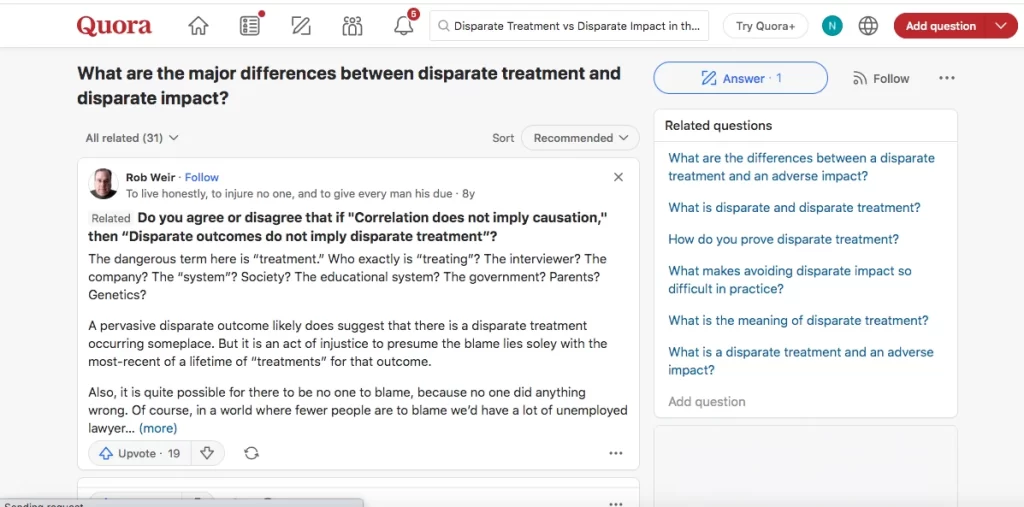
Below is a summary of real-world insights from Quora users on discrimination.
Culture vs. Intent
Joshua P. Hill has worked in HDTV Research. He reminds us that cultural factors outweigh formal discrimination in some contexts. He notes that, despite historic bias against Asians, today “culture often (though not always) plays a larger role than discrimination,” citing the emphasis in some Asian communities on “hard work and education” and “Tiger Mom” parenting.
“This country has long discriminated more against Asians than Hispanics… these days, culture often (though not always) plays a larger role than discrimination.”
Tracing Disparate Impact from Outcomes
Richard Aubrey is a retired insurance professional. He emphasizes starting with statistical differences and “working backwards” to find the policy filters that created them. He explains,
“You see a difference and you presume this is a disparate impact of some discriminatory practice… your primary evidence is the difference in outcome—college admits, for example.”
Direct vs. Indirect Evidence Framework
Alice Baker is a former law school professor. She clarifies that indirect discrimination in legal terms refers to the method of proof, not the harm itself.
“Direct evidence is explicit admissions of bias and indirect evidence relies on patterns, such as hiring a less-qualified non-protected candidate or statistical anomalies. Indirect evidence… requires the trier of fact to make a logical inference from a set of facts.”
Self-Interested Attention to Discrimination

Asim Qureshi is a LinkedIn writer. He offers a psychological angle. People passionately oppose discrimination when they themselves are the target but remain less concerned about issues affecting others.
“Women tend to like posts highlighting discrimination against women… and aren’t nearly as bothered when it happens to others.”
Historical Lessons on Indirect Racism
Curtis Harter is a U.S. Army Veteran. He recounts from the 1990s, where a neutral “last in, first out” layoff policy at a NASA contractor led to the involuntary termination of every black engineer.
“By the time the effect of their seemingly fair ‘last in, first out’ was realized, the damage was done.”
Appearance and Religious Policies
Karen L Singer Zander is a former Senior Master Sgt, USAF. She highlights a policy that disproportionately penalized black women,
“White females can pin up straight hair. Black females cannot pin up afro-textured hair… the regulation penalizes Black women unless they want to shave their head.”
Her example shows how grooming rules force costly or harmful accommodations.
Conclusion
The distinction between disparate treatment and disparate impact is more than a legal technicality—it’s a framework for creating truly inclusive workplaces.
Developing a Comprehensive Anti-Discrimination Strategy
Effective discrimination prevention requires a multifaceted approach:
1. Regular policy reviews to identify potential disparate impacts
2. Ongoing training for all employees, especially managers
3. Diverse hiring panels to minimize individual bias
4. Clear reporting mechanisms for discrimination concerns
5. Regular data analysis to identify problematic patterns before claims arise
Organizations that take these steps proactively not only reduce legal risk but often see improved employee engagement and performance.
Resources for Employers and HR Professionals
For additional guidance, consider these authoritative resources:
– EEOC Guidelines: The EEOC website offers detailed guidance on compliance
– Society for Human Resource Management (SHRM): Provides best practices and policy templates
– Local EEOC offices: Offer free trainings and consultation
– Industry-specific guidelines: Many industries have specialized resources for their unique challenges
When to Seek Legal Counsel on Discrimination Matters
While prevention is ideal, seek legal counsel immediately when:
– Receiving a discrimination complaint from an employee
– Noticing statistical disparities in employment outcomes
– Implementing policies that might have disparate impacts
– Receiving an EEOC charge or similar agency complaint
– Restructuring or conducting layoffs that might affect protected groups disproportionately
Early legal consultation is almost always less expensive than defending against a fully-developed claim.
Understanding the difference between disparate treatment and disparate impact isn’t just about legal compliance—it’s about creating a workplace where every employee has an equal opportunity to succeed based on their merits and contributions.
Hire the best candidates
with Wetest.
Create pre-employment assessments in minutes to screen candidates, save time, and hire the best talent.
Try for free