Defamation Case Meaning Explained: Types, Examples, and Penalties
Employee relations
Bonica
June 6, 2025
Ever been called something you’re not? Ever been called something you’re not? Ever had a casual insult feel like it went too far, actually harming your good name? You might be dealing with defamation.
In our super-connected digital world, a reputation can be shattered in seconds with just a few taps on a keyboard or a quick comment. Get this: defamation cases shot up by 34% in 2023 alone, according to the Judicial Statistics Board! It’s clear this isn’t just a minor issue.
This guide offers the solution: a straightforward breakdown of defamation law. We’ll cover everything from libel versus slander to real cases that changed how we see things, so you’ll know exactly what defamation is and what steps you can take.
Table of Contents
Understanding Defamation Law: Core Legal Concepts

Defamation law exists in that delicate space between free expression and personal reputation.
What Constitutes Defamation in Legal Terms
Defamation happens when someone says something untrue about you that ends up hurting your good name. But not every negative comment qualifies as defamation. Courts look for specific elements to determine if a statement crosses the legal threshold.
For something to count as defamation, it needs to be presented as a fact (not just someone’s opinion), it has to be provably false, and it must actually harm your reputation. So, just saying “he’s annoying” usually won’t qualify. But claiming “she embezzled company funds” when she didn’t? That often does.
The context matters tremendously. A statement made in a private conversation might be treated differently than one broadcast to millions on television or social media.
Key Elements Required to Prove Defamation Claims
You’ll need to prove four essential elements.
1. A false statement purporting to be fact
2. Publication or communication of that statement to a third party
3. Fault amounting to at least negligence
4. Damages, or harm caused to the person who is the subject of the statement
Imagine someone tweets that you were fired for stealing (falsely, of course), and those false claims lead to lost job opportunities. You likely have all the elements for a strong defamation claim.
The burden of proof falls on the plaintiff (the person claiming they were defamed). You should provide evidence for your claim.
How Defamation Laws Vary Across Jurisdictions
Defamation laws aren’t a “one size fits all” kind of thing—they actually change a lot depending on the country, and even by state if you’re in the US. These differences can totally flip the script on how a case turns out. For example, here in the UK and in Australia, the person who made the statement has to prove it was true.
In the US, the plaintiff proves falsity. Some places have “defamation per se,” where some statements are just assumed to be harmful, no need to show actual damage.
Some jurisdictions recognize the concept of “defamation per se,” where certain statements are automatically presumed harmful without requiring proof of damages. These typically include accusations of:
– Criminal activity
– Professional incompetence
– Having a loathsome disease
– Sexual impropriety
Know that the deadline for filing a defamation claim (the statute of limitations) differs. You might have as little as one year or up to three.
The Balance Between Free Speech and Reputation Protection
Defamation law is constantly trying to find the sweet spot between two really important things: letting people express themselves freely and protecting someone’s good name. And guess what? Where you live plays a huge role in which one gets more weight! For example, the United States leans heavily towards free speech, which actually makes defamation cases tougher to win there.
Thanks to their First Amendment, courts set a pretty high bar, especially if the person suing is a public figure. But if you look at countries like Germany and France, they put more emphasis on personal dignity and reputation, making it easier to go after and win defamation claims.
All over the world, judges are fine-tuning this balance all the time, especially with social media creating so many new places for potentially harmful statements.
They’re increasingly looking at things like how many people saw the statement, how long it stays online, and what the person who said it actually intended.
Types of Defamation: Libel vs. Slander

You need to know that its specific type is determined by how the false statement is communicated.
Libel: Written Defamation and Its Legal Implications
Libel is a defamation that’s written or published. This covers everything from old-school newspapers to social media.
Because written stuff creates a lasting record that people can keep finding and sharing, courts usually see libel as potentially more damaging than spoken defamation (slander). That permanence means it can keep hurting someone’s reputation for ages after it first came out.
Examples of libel include:
– A newspaper article falsely claiming a restaurant uses expired ingredients
– A Facebook post accusing someone of professional fraud without evidence
– A blog post making false allegations about someone’s personal character
Since libel creates documentary evidence, proving its existence is usually straightforward—you simply need to show the publication itself. This is why screenshots and archived web pages often become critical evidence in modern defamation cases.
Slander: Spoken Defamation and Proof Requirements
If someone tells a lie about you out loud that hurts your reputation – like in a casual chat or on the radio – that’s slander. The catch? Spoken stuff tends to vanish into thin air, so proving it in court can be a bit trickier.
The transient nature of slander makes it both harder to prove and typically considered less damaging than libel. Without a recording, proving exactly what was said can come down to conflicting testimonies.
For slander cases, courts often require proof of “special damages”—specific financial losses resulting from the defamatory statement—unless the statement falls into certain categories considered inherently harmful (slander per se).
Common examples of slander include:
– False accusations made during a community meeting
– Spreading untrue rumors about someone’s professional conduct to colleagues
– Making false statements about someone during a radio interview
The proof requirements for slander often make these cases more challenging to win than libel cases, unless you can produce recordings or multiple reliable witnesses.
Digital Defamation: Social Media and Online Cases
The internet has created entirely new defamation challenges. Digital defamation is a bit of a mix, pulling in bits from both written (libel) and spoken (slander) defamation, sometimes making those old lines a little blurry.
Think about it: social media posts, online reviews, website comments, and even direct messages can all potentially be defamatory. These digital statements can spread far more widely and rapidly than traditional forms of communication.
Key features of digital defamation include:
– Potential for viral spread reaching millions of people
– Permanence (even “deleted” content can be archived or screenshotted)
– Anonymous or pseudonymous posting that can complicate identifying defendants
– Cross-jurisdictional issues when poster and subject are in different locations
Judges are still figuring out how to handle the whole digital world. In the US, there’s this law called Section 230 that basically gives a free pass to companies like Twitter for whatever users post. So you usually can’t sue the platform itself. But on the flip side, recent court decisions are really highlighting just how much damage digital defamation can cause.
A 2021 case awarded $500,000 to a business owner after a former customer made provably false claims in multiple online reviews that demonstrably impacted the business.
Per Se vs. Per Quod: Categories of Defamatory Statements
Legal systems also sort defamatory statements by their very nature, and this changes what you have to prove to win your case.
Defamation per se is a good example: these are statements that are just so obviously damaging that the law assumes harm, meaning you don’t need to specifically prove damages.
These typically include:
– Allegations of criminal conduct
– Claims that someone has a contagious or loathsome disease
– Statements affecting someone’s business, trade, or profession
– Accusations of sexual misconduct or impropriety
With defamation per se, you don’t have to show actual financial harm. The law just assumes you were damaged because the statement itself was so bad. But then there’s defamation per quod.
These are statements that aren’t obviously harmful on their own, but become damaging because of extra context or an explanation.
For these kinds of claims, you do have to prove “special damages” – that means specific, measurable harm that happened because of the statement. For example, just saying “John visited Chicago last weekend” isn’t harmful by itself. But if John’s spouse was murdered in Chicago that weekend and you’re implying he was responsible, the statement becomes defamatory per quod through context.
7 Notable Defamation Case Examples and Outcomes

The best way to get a defamation law is to check out some real cases. They really bring to life all the rules, the tricky parts, and what can happen when these lawsuits go down.
Celebrity Defamation Cases That Made Headlines
1. Depp v. Heard (2022): This highly publicized case resulted in Johnny Depp winning $10 million in compensatory damages and $5 million in punitive damages (later reduced to $350,000 per Virginia law) after a jury found Amber Heard’s Washington Post op-ed contained defamatory implications. Heard also won $2 million on one counterclaim.
2. Rebel Wilson v. Bauer Media (2017): The Australian actress won a record $4.7 million AUD after magazines falsely portrayed her as a serial liar. Though later reduced on appeal, the case highlighted how damaging false statements can be to a performer’s career.
3. Hulk Hogan v. Gawker Media (2016): This landmark case resulted in a $140 million verdict against Gawker for publishing a sex tape, ultimately forcing the company into bankruptcy. The case raised important questions about privacy, news value, and the limits of media freedom.
Business Defamation: Corporate Reputation Battles Examined
Businesses frequently become involved in defamation disputes, with potentially enormous financial implications:
4. Brokers’ Choice of America v. NBC Universal (2010-2015): This case centered on NBC’s allegedly deceptive editing of an insurance seminar presentation. After years of litigation, the parties reached a confidential settlement after courts recognized the potential for defamation when media selectively edits content.
The increasing importance of online reviews has spawned numerous defamation cases involving businesses:
5. Hassell v. Bird (2018): The California Supreme Court ruled that Yelp couldn’t be forced to remove negative reviews, even when those reviews had been found defamatory by a court. This highlighted the protection platforms enjoy under Section 230 of the Communications Decency Act.
Business defamation cases often involve careful analysis of statements that might be considered opinion (“the food was terrible”) versus factual assertions (“they served expired meat”) that can form the basis of a defamation claim.
Political Defamation: Campaign Rhetoric Gone Too Far
Political discourse often involves harsh criticism, but sometimes crosses into legally actionable territory:
6. Dominion Voting Systems v. Fox News (2023): This case resulted in a historic $787.5 million settlement after Dominion sued Fox News for promoting false claims about the company’s voting machines in the 2020 election. The case demonstrated the potential liability media organizations face when broadcasting unverified claims.
Political defamation cases face special challenges due to the “actual malice” standard established in New York Times v. Sullivan (1964), which requires public officials to prove the defendant knew the statement was false or acted with reckless disregard for the truth.
Online Review Defamation: Modern Consumer Disputes
The explosion of online review platforms has created a new frontier for defamation:
7. Fireworks Restoration Co. v. Hosto (2022): A court awarded $1.5 million to a restoration company after a customer posted demonstrably false reviews claiming the company had stolen from them. The case highlighted that while negative opinions are protected, false statements of fact in reviews can lead to significant liability.
These cases illustrate the challenge of distinguishing between protected opinions and potentially defamatory factual assertions in consumer reviews. Courts generally protect statements like “I wasn’t satisfied with the service” but not false claims like “they stole my jewelry during the repair.”
Legal Defenses Against Defamation Accusations

If you’re accused of defamation, several legal defenses might protect you. Understanding these defenses is crucial whether you’re contemplating making a statement that might be controversial or responding to defamation claims.
Truth as the Ultimate Defense in Defamation Cases
Worried about a defamation claim? Here’s your most powerful weapon: the truth. If you can show that your statement was mostly true, you’ll generally have a complete defense against defamation in the U.S.
This defense applies even if the statement harms someone’s reputation—truth trumps the damage caused. For example, accurately reporting that a doctor lost their medical license for malpractice might hurt their reputation but isn’t defamatory if true.
The burden of proving truth varies by jurisdiction:
– In the US, the plaintiff typically must prove the statement is false
– In the UK and many Commonwealth countries, the defendant must prove the statement is true
Courts don’t require absolute precision—”substantial truth” is typically sufficient. Minor inaccuracies won’t necessarily defeat the truth defense if the “gist” or “sting” of the statement is accurate.
Opinion vs. Fact: When Statements Are Protected
If someone’s just sharing a pure opinion, it’s usually really protected from defamation lawsuits. Our First Amendment makes sure opinions that aren’t trying to trick you with false facts are pretty safe.
Protected opinions typically include:
– Subjective evaluations (“This is the worst restaurant in town”)
– Predictions about the future (“I think their business will fail”)
– Rhetorical hyperbole that no reasonable person would take literally
However, opinions that imply undisclosed defamatory facts can still lead to liability. Saying “In my opinion, he’s an embezzler” might be treated as implying factual knowledge of embezzlement unless you disclose the facts supporting your opinion.
Courts examine context to determine whether a reasonable reader would interpret a statement as fact or opinion. Reviews, editorial sections, and clearly labeled commentary receive stronger protection than statements presented as news reporting.
Privilege Defenses: Absolute and Qualified Explained
Legal privilege protects certain communications even if they contain false and damaging statements. Two main types of privilege exist:
Absolute privilege provides complete immunity from defamation claims for statements made in certain contexts, including:
– Statements made during legislative proceedings
– Testimony in court or other judicial proceedings
– Communications between spouses
– Executive communications by high government officials
Qualified privilege offers more limited protection for statements made in specific contexts with a legitimate interest, such as:
– Employment references
– Business communications about shared interests
– Reports to police or appropriate authorities
– Fair reporting of government proceedings
Qualified privilege can be lost if the statement was made with malice or excessive publication beyond those with a legitimate need to know.
These privileges exist to promote honest communication in important contexts without fear of defamation liability.
Public Figures and the Actual Malice Standard
Public figures face a significantly higher burden when bringing defamation claims, particularly in the United States following the landmark New York Times v. Sullivan case (1964).
Public figures must prove “actual malice,” meaning the defendant either:
– Knew the statement was false, or
– Acted with reckless disregard for whether it was true or false
This standard applies to:
– Government officials
– Celebrities and household names
– Limited-purpose public figures who have thrust themselves into specific public controversies
The actual malice standard makes it much harder for public figures to win defamation cases. This higher standard exists to protect robust public debate about those who influence society.
Courts determine public figure status on a case-by-case basis. Social media influencers, for example, might be considered public figures for some purposes but not others, depending on their reach and the subject matter.
Penalties and Damages in Defamation Cases

When defamation is proven, courts can award various remedies to compensate victims and deter future defamatory conduct. Understanding potential penalties helps assess the risks and potential outcomes of defamation litigation.
Compensatory Damages: Recovering Financial Losses Explained
Compensatory damages aim to restore plaintiffs to their position before the defamation occurred. These damages fall into two categories:
Special damages compensate for specific, quantifiable financial losses directly resulting from the defamation, such as:
– Lost wages or business opportunities
– Decreased earning capacity
– Expenses incurred to counteract the defamation
General damages address non-quantifiable harms like:
– Damage to reputation
– Mental anguish and emotional distress
– Humiliation and loss of standing in the community
Proving special damages often requires substantial documentation showing the direct connection between the defamatory statement and specific losses. For example, a business might need to demonstrate declining sales directly following and resulting from the defamatory statement.
Courts have wide discretion in awarding general damages, which can range from nominal amounts to millions of dollars depending on the severity of the harm and the defendant’s conduct.
Punitive Damages: When Courts Punish Defamatory Conduct
Punitive damages go beyond compensation to punish particularly egregious conduct and deter similar behavior. These damages are relatively rare in defamation cases but can be substantial when awarded.
Courts typically require evidence of:
– Actual malice (knowledge of falsity or reckless disregard for the truth)
– Evil motive or conscious disregard for the plaintiff’s rights
– Particularly outrageous or reprehensible conduct
Many states cap punitive damages or limit them to a multiple of compensatory damages. The Supreme Court has also indicated that punitive damages must bear a reasonable relationship to compensatory damages to satisfy due process requirements.
Notable examples of punitive damages include the $25 million initially awarded against Gawker in the Hulk Hogan case (though later reduced in a settlement) and the $9 million in punitive damages against a major national news network for defaming a small business.
Injunctive Relief: Court Orders to Remove Content
Courts can issue injunctions ordering the removal or retraction of defamatory content. These orders have become increasingly important in the digital age when defamatory content can persist online indefinitely.
Injunctive relief might include:
– Orders to remove specific posts, articles, or reviews
– Requirements to publish retractions or corrections
– Prohibitions against repeating the defamatory statements
Courts traditionally hesitated to issue injunctions against speech due to First Amendment concerns about prior restraint. However, once speech has been judicially determined to be defamatory, courts have become more willing to order its removal, especially from online sources.
The effectiveness of injunctive relief can be complicated by:
– Content that has been widely shared or reposted
– Jurisdictional issues when content is hosted overseas
– Section 230 protections for platforms hosting third-party content
Reputation Restoration: Beyond Monetary Compensation
Beyond monetary damages, defamation remedies increasingly focus on practical reputation restoration:
Court-ordered remedies might include:
– Required retractions with specific visibility requirements
– Declarations of falsity that plaintiffs can use to counter the defamation
– Orders to notify third parties who received the defamatory communication
Some jurisdictions allow for declaratory judgments where courts officially declare statements false and defamatory without necessarily awarding monetary damages. These judgments help plaintiffs clear their names and provide documentation to show others.
Professional reputation management services often complement legal remedies by:
– Creating positive content to push defamatory material down in search results
– Monitoring for continued defamation or reappearance of removed content
– Developing strategies to rebuild damaged reputations over time
The right combination of legal and practical remedies depends on the plaintiff’s specific goals—whether financial compensation, public vindication, or practical reputation restoration.
Filing a Defamation Lawsuit: Step-by-Step Process

Taking legal action for defamation requires understanding the procedural requirements and practical considerations involved in pursuing a case.
Pre-Litigation Requirements for Defamation Claims
Before filing a lawsuit, several preliminary steps may be required or advisable:
Many jurisdictions require formal demand letters or retraction requests before litigation. For example:
– Florida requires a written demand for retraction at least five days before filing suit against media defendants
– Texas has a complex pre-suit notice requirement and opportunity to retract
– California requires demands for retraction in cases against publications
Even when not legally required, demand letters serve several purposes:
– Provide opportunity for resolution without litigation
– Document your attempt to mitigate damages
– Establish the defendant’s knowledge of the false statement
Some jurisdictions also have special procedural rules for defamation cases, such as:
– Higher pleading standards requiring specific allegations about the exact defamatory statements
– Anti-SLAPP statutes that create early hurdles for plaintiffs in cases involving speech on matters of public concern
– Requirements to post bonds or security for potential defendants’ costs
Consulting with an attorney familiar with your jurisdiction’s specific requirements can help avoid procedural pitfalls that might derail your case.
Evidence Collection: Building a Strong Defamation Case
Effective evidence gathering is crucial for defamation claims:
For the statement itself, collect:
– Screenshots or archived versions of online content
– Copies of publications or recordings
– Witness statements from those who heard slanderous statements
– Documentation of when and where the statement was published
To prove falsity, gather:
– Documentation contradicting the false statements
– Witness testimony supporting your version of events
– Expert opinions when relevant (particularly for professional defamation)
For damages, compile:
– Financial records showing losses following the defamation
– Documentation of canceled contracts or opportunities
– Medical records if you sought treatment for emotional distress
– Testimony about harm to reputation from colleagues or community members
Preserving evidence quickly is essential, especially for online content that might be deleted or modified. Professional forensic services can help capture and authenticate digital evidence in ways that will withstand scrutiny in court.
Statute of Limitations: Timeframes for Legal Action
Defamation claims must be filed within strict time limits that vary significantly by jurisdiction:
– Most U.S. states set limits between 1-3 years from publication
– The UK generally allows one year with possible extensions
– Australia typically provides a one-year limitation period
Several complicated issues affect when the clock starts running:
– The “single publication rule” in many jurisdictions means the clock starts at first publication, not when the plaintiff discovers it
– Some jurisdictions apply a “discovery rule” starting the clock when the plaintiff reasonably should have discovered the defamation
– Republication of defamatory content may restart the clock in some circumstances
The emergence of online defamation has complicated these timeframes. Courts continue to grapple with questions like whether updates to websites constitute republication and how to handle content that remains accessible indefinitely.
Given these complexities, consulting an attorney promptly after discovering potential defamation is crucial to preserve your legal rights.
Legal Costs and Considerations Before Filing
Defamation litigation can be expensive and emotionally taxing, requiring careful cost-benefit analysis:
Typical expenses include:
– Attorney fees (often $300-500+ per hour for experienced defamation attorneys)
– Court filing fees and service costs ($200-1,000 depending on jurisdiction)
– Expert witness fees if needed ($1,500-10,000+ depending on expertise)
– Discovery costs including depositions ($1,000-3,000 per deposition)
Beyond direct costs, consider:
– Time commitment for meetings, depositions, and court appearances
– Emotional strain of having personal matters examined in public proceedings
– Potential for unwanted publicity (the “Streisand effect” where attempting to suppress information increases its visibility)
– Difficulty collecting judgments if defendants have limited assets
Alternative approaches might include:
– Negotiated retractions or corrections
– Mediation to reach settlement outside court
– Focus on positive reputation building rather than legal action
– For online defamation, working with platforms to remove content that violates their terms of service
Most defamation attorneys offer initial consultations to help evaluate case strength and develop appropriate strategies based on your specific situation and goals.
The Future of Defamation Law in Digital Age

Defamation law continues to evolve rapidly as technology transforms how information spreads and reputations form. Understanding emerging trends helps navigate this changing landscape.
How Social Media is Reshaping Defamation Standards
Social media platforms present unique challenges for traditional defamation concepts:
Courts increasingly recognize social media’s distinct nature:
– More casual contexts may affect whether statements are viewed as fact or opinion
– Emojis, memes, and other non-textual elements require interpretation
– “Likes,” shares, and retweets raise questions about republication liability
Emerging standards include:
– Recognition that even brief posts can cause substantial reputation damage
– Evaluation of entire conversational threads rather than isolated statements
– Consideration of platform-specific norms and expectations
The ephemeral nature of some content (like Snapchat or Instagram Stories) creates evidence preservation challenges, while the potential for viral spread magnifies potential damages.
Recent cases show courts adapting defamation principles to social media realities. For example, a 2022 ruling found that implied accusations in a Twitter thread, when read as a whole, constituted defamatory statements even though no single tweet contained all elements of the accusation.
International Challenges in Online Defamation Cases
The global nature of online communication creates complex jurisdictional issues:
Key challenges include:
– Determining which country’s laws apply when content published in one jurisdiction is accessed in another
– Enforcing judgments across international boundaries
– Addressing “libel tourism” where plaintiffs file in countries with plaintiff-friendly defamation laws
Countries vary dramatically in their approaches:
– The SPEECH Act in the U.S. prevents enforcement of foreign defamation judgments that wouldn’t satisfy First Amendment standards
– The EU’s “right to be forgotten” allows individuals to request removal of certain content from search results
– Australia’s defamation laws remain significantly more plaintiff-friendly than American standards
The absence of global standards creates uncertainty, with platforms like Meta and Twitter developing their own content policies that sometimes diverge from any single country’s legal standards.
Recent international agreements like the Hague Judgments Convention may eventually provide more consistency in cross-border enforcement, though significant differences in national approaches to free speech will likely persist.
Recent Legal Reforms Affecting Defamation Claims
Several jurisdictions have recently reformed defamation laws to address digital challenges:
Notable changes include:
– Australia’s 2021 reforms introducing a “serious harm” threshold similar to UK standards and creating a new public interest defense
– The UK’s Defamation Act 2013 establishing that businesses must show serious financial loss to bring claims
– U.S. states adopting stronger anti-SLAPP protections against lawsuits targeting protected speech
Emerging reform proposals focus on:
– Platform liability for failing to address defamatory content after notification
– Simplified procedures for removing clearly defamatory digital content
– Balancing removal of harmful content against free expression concerns
Courts are also actively shaping law through decisions addressing novel questions like:
– When tagging someone in defamatory social media content constitutes publication
– Whether algorithmic promotion of defamatory content creates additional liability
– How anonymous online defamation can be addressed through “John Doe” lawsuits and discovery
These reforms reflect the ongoing tension between protecting reputation and preserving free expression in rapidly evolving digital environments.
Protecting Yourself Against Digital Defamation Risks
Proactive strategies can help minimize defamation risks in both directions:
To protect against becoming a defamation victim:
– Set up Google Alerts for your name and business
– Regularly review your online presence and customer reviews
– Consider reputation management services for ongoing monitoring
– Build a strong positive online presence that can withstand occasional negative content
To avoid committing defamation:
– Verify facts before publishing potentially damaging information
– Clearly distinguish between factual statements and opinions
– Be particularly careful with accusations of illegal or unethical conduct
– Understand that adding “in my opinion” doesn’t automatically protect defamatory factual implications
For businesses, additional protective measures include:
– Clear social media policies for employees
– Training on defamation risks, especially for marketing and communications staff
– Review processes for public statements and customer communications
– Cyber insurance that includes defamation coverage
These preventive approaches often prove more cost-effective than litigation after defamation has occurred and damage has been done.
A Quora Rundown
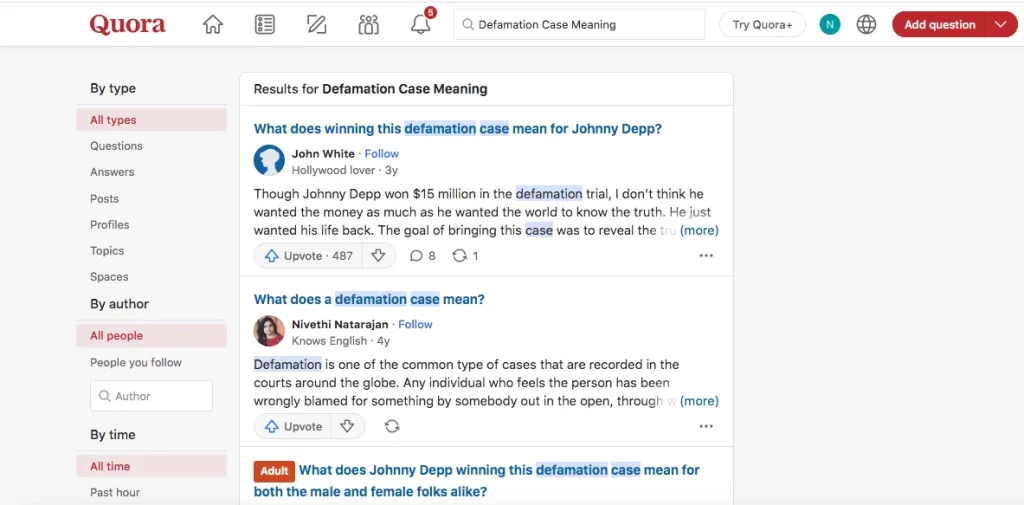
Let’s get to real Quora users’ perspectives on defamation to show how everyday experiences and legal nuances intersect in practice.
Intentional Misrepresentation and Personal Impact
Sabrina Couture shows the emotional toll when lies reshape others’ perceptions,
“Defamation especially and foremostly when done with deliberate intent is when a person or people lie about what you are really like… people perceive you with a false identity of yourself instead of the true identity of yourself.”
She recounts a childhood incident in which a thief wrongly assumed indifference to theft and spread rumors that she “like\[d] people stealing from you,” damaging her reputation.
The Burden of Proving Truth
Philip Ross (Lawyer) discusses a practical hurdle in defamation suits,
“Truth is an absolute defence… but the problem is a practical one; the defendant who pleads truth… has the burden of proving truth. As this is often not easy to do, a person may well be able to sue someone for defamation even though what is being said is true.”
Ross reminds us that “justification” requires solid evidence which can vanish or never exist.
Crude Examples and Civil Remedies
Kirk Stephens (J.D. in Criminal Law, University of Kentucky) offers a scenario,
“If you’d quit slamming meth and banging underage sluts… you’d prolly know the answer already you syphilis ridden, Satan worshipping drug and sex addict. There, I think that’s a pretty good example.”
Stephens’s tirade spotlights how unfiltered slander works mechanically.
Jurisdictional Variations and Criminal Defamation
Anurakti Yadav provides an international lens,
“Defamation… is an offence under section 499 of Indian Penal Code (IPC)… The punishment for criminal defamation comes under section 500 of IPC—two years’ imprisonment or fine or both.”
Her post reminds us that outside the U.S., defamation can be both a tort and a crime, with the state prosecuting defamatory speech.
Digital Defamation and Practical Tips
Esha Tibrewal (Lawyer) distills cyber defamation into everyday scenarios,
“A person Y wrote in his blog… ‘I think that person X hit his wife.’ Statements of opinion are not… fact, and so theoretically protected. But… the average person may… look at your statement as a statement of fact.”
Esha’s examples—false blog posts, wrongful termination rumors—highlight three digital-age realities:
1. Opinion vs. Assertion: “I think” doesn’t guarantee safety if context suggests undisclosed facts.
2. Easy Publication: Blogs and social media let anyone broadcast damaging claims.
3. Evidence Preservation: Screenshots and archives become essential to prove or defend defamation online.
Rumors, Privilege, and Context

An Attorney at Law clarifies how repeating rumors can trigger liability,
“When one repeats a rumor to a third person… he or she is liable for defamation. The statement must be an allegation of fact… The allegation must be false.”
He further notes:
Privilege Defenses: Statements made in judicial proceedings or between spouses may be absolutely privileged.
Context Matters: A critique of someone’s work is an opinion, but calling them a thief “necessarily implies a history of lies” and becomes actionable.
Defamation Exceptions and Defenses
An anonymous user on Indian law forums outlines key exceptions,
“Truth… Consent… Humor… Absolute privilege… Qualified privilege.”
This concise list shows that beyond the primary truth defense, speakers may rely on context-based immunities or prove audience understanding of jest to escape liability.
Conclusion
Defamation law continues to balance the fundamental tension between free expression and reputation protection. As we’ve seen, the digital transformation of communication has created new challenges that courts and legislators are still addressing.
Understanding the core elements of defamation claims, the available defenses, and the practical considerations of pursuing legal action empowers you to protect your reputation while respecting others’ expression rights. When facing potential defamation issues, early consultation with an experienced attorney remains the best way to assess your specific situation and options.
Remember that legal remedies are just one part of effective reputation management. Often, the most effective approach combines legal knowledge with practical communication strategies that build and maintain a positive reputation resilient enough to withstand occasional criticism or even unfair attacks.
Hire the best candidates
with Wetest.
Create pre-employment assessments in minutes to screen candidates, save time, and hire the best talent.
Try for free