
Your Guide to Compassionate Leave: Eligibility, Duration, and Sample Letters
Business strategy
Bonica
August 22, 2025
Compassionate leave is time off work when a family member dies or faces a serious crisis. This type of leave is also called bereavement leave or emergency family leave. It gives you time to grieve, attend funerals, and handle family matters during life’s hardest moments.
Different rules apply depending on where you work. Federal laws provide some protection. State laws may offer more benefits. Your employer’s policies matter most for your specific situation.
Around the world, many countries require employers to give compassionate leave. The United States has fewer legal requirements than most developed nations. This makes understanding your rights even more important.
This guide will teach you everything about compassionate leave. You’ll learn who qualifies and how long you can take off. We’ll show you how to request leave properly. Sample letters are included to help you communicate with your employer.
You’ll also discover your legal rights and protections. We’ll explain what to do if your employer denies your request. The guide covers returning to work and ongoing support options.
Being prepared helps during emergencies. Knowing your options reduces stress when tragedy strikes. This information empowers you to take care of your family while protecting your job.
Table of Contents
Types of Compassionate Leave and Legal Framework

This section outlines the various categories of compassionate leave and the federal, state, and international laws that govern them.
A. Comprehensive Leave Categories
Compassionate leave covers many family situations. The most common reason is death of immediate family members. This includes your spouse, children, parents, and siblings.
Extended family deaths also qualify in many workplaces. Grandparents, in-laws, aunts, uncles, and cousins may be covered. Some employers limit time off for extended family members.
Critical illness requiring family caregiving is another category. When a family member needs immediate care, you may qualify for leave. Family emergencies and crisis situations also count.
Stillbirth and pregnancy loss are increasingly recognized. These tragic events require time for physical and emotional recovery. Many progressive employers now include these situations.
Pet bereavement policies are emerging in modern workplaces. Some companies recognize the deep bond between people and their pets. This is still uncommon but growing.
Military family emergency situations have special protections. Service members and their families face unique challenges. Additional leave options may be available.
Natural disaster family impact can trigger compassionate leave. When disasters affect your family members, employers often show flexibility.
B. State and Local Regulations
California leads with comprehensive bereavement leave laws. Eligible employees get up to five days of paid leave for family member deaths. This applies to companies with five or more employees.
Oregon integrates bereavement with paid family leave programs. Illinois requires unpaid bereavement leave for certain employees. New York continues expanding family leave definitions.
Many cities have their own ordinances. San Francisco, Seattle, and other major cities may offer additional protections beyond state requirements.
C. International Standards and Best Practices
European Union countries typically mandate compassionate leave. Australia provides two days of paid compassionate leave under fair work laws. Canada requires compassionate care benefits through employment insurance.
The United States lags behind most developed nations in required compassionate leave benefits. This makes employer policies more critical for American workers.
Detailed Eligibility Criteria

This section explains who qualifies for compassionate leave based on employment status, relationship to the family member, and qualifying events.
A. Employee Qualification Standards
Most employers require you to work for a certain period before qualifying. This ranges from 90 days to one year depending on company policy.
Full-time employees usually get the most benefits. Part-time workers may receive reduced time or unpaid leave. Contract employees often have limited options.
Probationary periods may affect eligibility. Some companies make exceptions for genuine family emergencies. Union employees often have negotiated benefits that exceed minimum requirements.
Seasonal and temporary workers face the most restrictions. However, some employers extend compassion to all workers regardless of status.
B. Qualifying Relationships Matrix
Immediate family typically includes spouse, children, parents, and siblings. Legal definitions vary by employer and state law.
Step-family members, half-siblings, and adopted children are usually included. Same-sex marriages receive equal recognition under federal law. Domestic partners may qualify depending on local laws.
In-loco-parentis relationships count when you act as a parent figure. Legal guardianship creates family-like relationships for leave purposes.
Cultural family structures may need special consideration. Some employers recognize chosen family relationships in LGBTQ+ communities.
C. Qualifying Circumstances and Events
Both sudden and expected deaths qualify for bereavement leave. Terminal illness diagnosis may trigger immediate caregiving leave. Serious injuries requiring family presence also count.
Missing person situations can qualify when family members disappear. Legal proceedings involving family tragedy may require your presence. Multiple family member incidents receive special consideration.
D. Documentation and Verification Requirements
Death certificates provide official proof of death. Obituaries and funeral programs may be acceptable alternatives. Medical documentation supports illness-related leave requests.
Birth certificates, marriage licenses, and adoption papers prove family relationships. Religious leaders or community leaders may provide attestations for some relationships.
Emergency situations may require verification through police reports or hospital records. Keep copies of all documents for your records.
Duration Guidelines and Time Calculations

This section describes typical leave lengths, factors that influence time off, and methods for calculating your total leave.
A. Standard Duration Framework
Most employers offer three to seven days for immediate family deaths. Extended family members typically receive one to three days. According to workplace surveys, 88% of organizations offer some bereavement leave.
International comparisons show the U.S. provides less leave than most developed countries. However, American companies are gradually increasing duration offerings.
B. Factors Influencing Leave Duration
Closer relationships usually mean more time off. Geographic distance affects travel requirements. Cultural and religious ceremonies may need additional time.
Estate settlement and legal responsibilities can extend leave needs. Multiple deaths in a family require special consideration. Some employers adjust policies based on whether you’re caring for children.
C. Extended Leave Scenarios
International funeral attendance requires travel time. Multiple family member deaths need additional consideration. Serving as executor of an estate creates ongoing responsibilities.
Custody arrangements may change following a family death. Immigrants may need extended time for home country funeral arrangements.
D. Calculation Methods and Combinations
Some policies count business days only. Others include weekends and holidays. You may combine bereavement leave with vacation or personal time.
FMLA may coordinate with compassionate leave for comprehensive coverage. Unpaid leave extensions are often available when company leave is exhausted.
A Quora Rundown
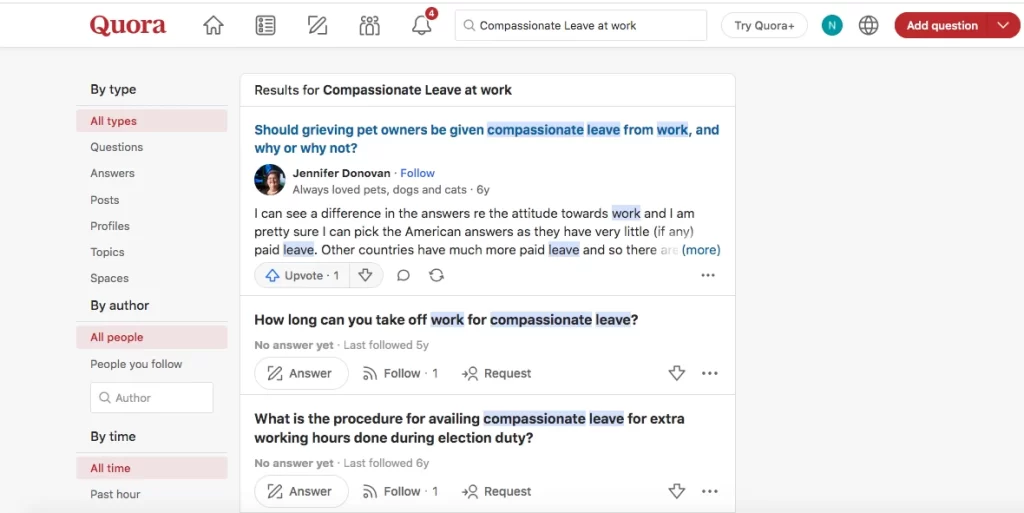
Here is a synthesis of responses from Quora users on the etiquette and practicalities of requesting bereavement or compassionate leave.
Etiquette and Communication
Dennis Manson raises a blunt but important point about straightforward communication:
“What does etiquette have to do with bereavement leave? You tell your boss…”
He emphasizes honesty and simplicity. Notify your manager immediately, state the relationship, and trust that most policies already allow a few days’ leave. If coverage is an issue, offer solutions like using holiday allowance for overlap.
“I told my work if it’s a problem take a day from my holiday allowance.”
Taurus TheBull suggests a more formal touch:
“Notify my boss immediately, in writing; cc yourself.”
Formalizing your request in an email reduces misunderstandings. He also advises requesting concurrent travel days when needed:
“If travel is involved, request additional days to run concurrent with the bereavement leave.”
Manager Empathy and Advocacy
Kathy Gydus shares a touching example of a supervisor who went beyond policy:
“My supervisor told me to take as much time as I needed. Later, I found out that she … demanded of him that I take a lot more time. I will never forget her and what she did for me.”
This story shows the profound impact of managerial advocacy. Good managers recognize that rigid limits can be insufficient.
Lisa Bushey recommends escalating firmly but respectfully if you encounter resistance:
“Don’t take no for an answer; keep going up the management chain to the owner if you must. … When I return, I am going to report that I was terminated for attending my late grandfather’s funeral to the state labor board.”
Documentation and Proof Requirements
Eileen Wood clarifies the legal right of employers to request verification:
“It’s absolutely legal. … if you refuse to provide proof, the employer can … refuse to recognize it as bereavement leave. … you can be reprimanded or fired.”
Deborah Barber voices incredulity at excessive demands:
“Excuse me, the employer doesn’t accept the death certificate? … Go to the funeral home … they should be able to provide … the information needed.”
Her suggestion to work directly with the funeral home stresses being proactive: if HR balks at one form, secure alternate verification promptly.
Unfair Denials

Diane Baum recounts two experiences of denial:
“I was fired … for taking three days off when my mother died. … my supervisor asked me, ‘When is she going to DIE?’ … it was a set up from the get go. My husband’s brother … claimed he wasn’t allowed … the funeral was … a mile away.”
Her narrative shows the risk of punitive managers and the importance of union representation.
Kevin Murphy describes an abuse of bereavement leave for non‑bereavement purposes:
“A new hire used bereavement leave to attend a wedding … she asked him … he admitted … he was fired.”
Long‑Distance and Travel Considerations
Neel Kumar shares a positive precedent for cross‑continental leave:
“Paperwork can wait. Your family cannot. … I came back 25 days later. … my boss gave me extra bereavement days because I had to travel so far.”
His story presents full travel details upfront to facilitate planning.
Susan Harrington highlights how remote work and structure can aid coping:
“Having structure or work was helpful … I stayed at her apartment until the month was out and took a few more days.”
Building a Compassionate Workplace Culture
Xena Lee bluntly calls out insensitive employers:
“That he’s a heartless jerk … unless … he couches it in … ‘if you can’t do it, I do understand.’”
Xena’s commentary shows the fine line between reasonable requests and cruelty. She suggests that employers who genuinely care will preface any request with empathy and give you an explicit out if you can’t comply.
Victoria Arlington advises consulting the handbook first:
“Make sure to check your employee handbook for the list of people that bereavement leave is allowed for.”
Philip Klossner offers a statutory update from California without replicating our legal overview, but reminding readers to cite the exact law when needed:
“AB 1949 makes it unlawful for an employer to refuse … up to five days of bereavement leave … must be taken within three months.”
Step-by-Step Request Process

This section provides a clear roadmap for notifying your employer, submitting documentation, and managing communications.
A. Immediate Emergency Response
Contact your supervisor or HR department immediately. Many companies have 24/7 emergency notification systems. Don’t worry about perfect communication during crisis moments.
Provide basic information: who died, your relationship, and expected time needed. Follow up with written notification within 24-48 hours when possible.
B. Formal Documentation Process
Submit written requests as soon as you’re able. Use company forms if available. Email may be acceptable for urgent situations.
Include essential details: dates needed, relationship to deceased, and contact information. Your supervisor may need to approve the request formally.
C. Supporting Documentation Checklist
Gather death certificates or obituaries as soon as available. Provide relationship verification if requested. Include funeral home contact information.
For extended travel, include itinerary details. Medical documentation supports illness-related leave. Legal documents may be needed for estate responsibilities.
D. Communication and Update Protocols
Estimate your initial absence duration honestly. Arrange work coverage and delegation. Notify clients or customers as appropriate.
Update your employer if circumstances change. Maintain regular communication during extended absences. Give advance notice of your return date.
E. Special Circumstances Procedures
International travel requires additional planning and documentation. Multiple leave requests need careful coordination. Request confidentiality if family situations are sensitive.
Some grief responses may need workplace accommodations. Discuss these needs openly with HR or your supervisor.
Comprehensive Sample Letters and Templates

This section offers fill‑in‑the‑blank letter templates for different compassionate leave scenarios.
A. Immediate Family Death Notification
Template 1 – Spouse Death:
Subject: Emergency Bereavement Leave Request – [Your Name]
Dear [Supervisor/HR Manager],
I am writing to inform you of the sudden death of my spouse, [Name], on [Date]. I need to request bereavement leave beginning [Date] to handle funeral arrangements and family matters.
I expect to need [Number] days as provided in company policy. I will provide a death certificate and funeral information as soon as available. [Colleague Name] has agreed to handle my urgent responsibilities during my absence.
I will contact you by [Date] with updates on my return schedule. Thank you for your understanding during this difficult time.
Sincerely,
[Your Name]
[Contact Information]
Template 2 – Parent Death:
Subject: Bereavement Leave Request – Family Emergency
Dear [Supervisor Name],
My [mother/father], [Name], passed away yesterday after a brief illness. I am requesting bereavement leave starting immediately to travel to [Location] for funeral arrangements.
The funeral is scheduled for [Date], and I expect to return to work on [Date]. This represents [Number] days as outlined in our employee handbook. I have briefed [Colleague Name] on my current projects and urgent deadlines.
I will provide official documentation within 48 hours. Please contact me at [Phone Number] if you need any additional information.
Thank you for your support,
[Your Name]
B. Extended Family Member Death
Template 3 – Grandparent Death with Travel:
Subject: Bereavement Leave Request – Grandmother’s Passing
Dear [HR Manager],
I received word that my grandmother passed away unexpectedly on [Date]. She lived in [Location], requiring travel for funeral services and family gathering.
I am requesting [Number] days of bereavement leave beginning [Date]. The funeral is scheduled for [Date], and travel time requires additional days. I understand this may exceed standard policy for extended family and am willing to use personal time if needed.
[Colleague Name] will cover my responsibilities, and I have postponed non-essential meetings. I will provide documentation and return to work on [Date].
Respectfully,
[Your Name]
C. Critical Illness and Caregiving Leave
Template 4 – Terminal Illness Care:
Subject: Emergency Family Leave Request – Critical Illness
Dear [Supervisor],
My [family member], [Name], has been diagnosed with terminal cancer and needs immediate family support. I am requesting compassionate leave to provide care and coordinate medical treatment.
Initially, I need [Number] days beginning [Date]. The situation may require intermittent leave over the coming weeks. I will coordinate with [Colleague] to ensure coverage and will update you regularly on my availability.
Medical documentation from [Hospital/Doctor] is attached. Thank you for your flexibility during this challenging time.
Best regards,
[Your Name]
D. Template Customization Guidelines
Personalize templates for your specific situation and company culture. Include relevant policy references from your employee handbook. Adjust tone based on your relationship with supervisors.
Be honest about time needs while remaining professional. Offer solutions for work coverage when possible. Follow up promptly with required documentation.
Employer Policies and Industry Variations

This section examines how company size, sector, and geographic location affect bereavement and caregiving policies.
A. Company Size and Policy Differences
Large corporations typically offer comprehensive bereavement policies. Small businesses may have limited formal policies but often show personal flexibility. Startups might lack formal policies but offer creative solutions.
Fortune 500 companies increasingly exceed legal minimums. Non-profit organizations often prioritize employee wellbeing despite budget constraints. Government employees have standardized federal guidelines.
B. Industry-Specific Considerations
Healthcare workers face staffing challenges during emergencies. Education employees must consider classroom coverage and timing. Retail workers may have limited flexibility during peak seasons.
Technology companies often lead with progressive policies. Manufacturing workers may have union-negotiated benefits that exceed company standards.
C. Paid vs. Unpaid Leave Analysis
Salary continuation varies widely between employers. Some provide full pay for standard bereavement periods. Others offer partial pay or require use of accrued time off.
State-mandated paid leave is increasing. Integration with disability benefits may provide additional support. PTO coordination can extend paid time off.
D. Progressive Policy Examples
Leading companies offer unlimited bereavement leave for immediate family. Some provide grief counseling and mental health support. Flexible return-to-work arrangements are becoming common.
Pet loss recognition is emerging in animal-friendly companies. Global companies may offer additional time for international family obligations.
Rights, Protections, and Advocacy

This section details your legal protections, how to respond if leave is denied, and where to find support.
A. Legal Rights and Protections
You have protection against discrimination based on grief or bereavement needs. FMLA provides job protection when applicable. State laws may offer additional protections.
Religious accommodations may apply to funeral and mourning practices. Disability accommodations can help if grief affects your health.
B. When Employers Deny Requests
Document any denial and request written reasons. Use internal appeal processes first. Union representatives can provide support and advocacy.
State labor departments investigate policy violations. Consider legal consultation for potential discrimination issues.
C. Discrimination and Retaliation Prevention
Recognize illegal responses like termination or harassment. Document all interactions related to your leave request. File complaints promptly with appropriate agencies.
EEOC handles federal discrimination complaints. State civil rights agencies provide additional resources. Keep detailed records of dates, conversations, and decisions.
D. Advocacy Resources and Support
Employee assistance programs offer confidential support. Professional counseling helps during difficult times. Legal aid organizations provide free consultation for eligible individuals.
Union representatives advocate for member rights. Community support groups offer emotional assistance during grief.
Returning to Work and Ongoing Support

This section covers strategies for a smooth return, workplace accommodations, and long‑term grief resources.
A. Return-to-Work Transition Planning
Consider gradual re-entry with reduced hours initially. Request workload adjustments if needed. Communicate your needs clearly with supervisors.
Performance expectations may need temporary modification. Some accommodations help manage ongoing grief responses.
B. Workplace Support Systems
Employee assistance programs continue beyond initial leave. Supervisor training helps create supportive environments. Peer support groups provide understanding colleagues.
Flexible schedules accommodate ongoing needs. Memorial acknowledgments show workplace compassion.
C. Long-term Grief Management
Anniversary dates may trigger renewed grief. Ongoing therapy and counseling provide professional support. Work performance protection helps during difficult periods.
Additional leave may be needed for grief-related health issues. Career development should continue despite temporary challenges.
Emergency Preparedness and Planning

This section offers tips for proactive personal and employer planning before a crisis occurs.
A. Personal Preparedness Strategies
Maintain updated emergency contact lists. Organize important family documents in accessible locations. Develop communication plans with family members.
Prepare financially for potential unpaid leave. Arrange preliminary work coverage plans with trusted colleagues.
B. Employer Preparedness Recommendations
Cross-train employees for critical positions. Develop emergency coverage protocols. Compile grief support resources for distribution.
Train managers on compassionate response techniques. Ensure policy communication reaches all employees.
Conclusion
Compassionate leave provides crucial support during life’s most difficult moments. Understanding your rights and options helps you navigate family crises while protecting your employment.
Proactive planning makes emergencies more manageable. Know your company policies before you need them. Keep important documents organized and accessible.
Workplace compassion benefits everyone. Advocate for better policies in your organization. Support colleagues facing family difficulties.
Remember that grief affects people differently and over varying timelines. Be patient with yourself and communicate your needs. Professional support and workplace flexibility can help you through challenging times while maintaining your career stability.
Frequently Asked Questions
This section answers the most common questions about compassionate leave procedures and requirements.
How much advance notice is required for compassionate leave?
Provide notice as soon as possible, typically within 24-48 hours. Verbal notification is usually acceptable initially, with written documentation following within 2-3 business days.
Can my employer legally deny compassionate leave?
Employers generally cannot deny reasonable leave for immediate family deaths, but requirements vary by state and company policy. Denial must be based on legitimate business needs, not discrimination.
What if I need more time than company policy allows?
Request additional unpaid leave, utilize accrued PTO, or explore FMLA eligibility. Document your request formally and explain specific circumstances requiring extended time.
How does paid vs. unpaid compassionate leave work?
Payment varies by employer and state law. Many provide 3-5 paid days for immediate family, with unpaid options beyond that. Some states now mandate paid bereavement leave.
What documentation is required for compassionate leave?
Typically required: death certificate, obituary, or funeral program. Relationship verification may include marriage certificates, birth certificates, or adoption papers.
Can I take compassionate leave for a pet’s death?
Pet bereavement leave is increasingly recognized but not legally mandated. Progressive companies may include pet death in policies or allow personal day usage.
How does compassionate leave interact with FMLA?
FMLA may apply for caring for seriously ill family members, but typically not for bereavement. However, if grief affects your health, the FMLA might apply to your own condition.
What if I need international travel for a funeral?
International travel may require extended leave due to travel time and visa requirements. Provide additional documentation, including travel itineraries and cultural ceremony requirements.
Are there special considerations for military families?
Military families have additional protections under federal laws. Active duty members have emergency leave provisions, and families may have special accommodation rights.
How do I handle multiple family deaths or ongoing crises?
Document each situation separately and communicate regularly with your employer. Consider the FMLA for ongoing situations and explore extended unpaid leave options for extraordinary circumstances.
Hire the best candidates
with Wetest.
Create pre-employment assessments in minutes to screen candidates, save time, and hire the best talent.
Try for free