
How Bell Curve Percentages Help in Grading, Hiring, and Performance Reviews
Hiring
Bonica
July 15, 2025
Ever wondered why some companies always seem to label 10% of employees as “top performers” no matter how good everyone is? Or why does your professor insist on grading “on a curve” instead of giving everyone who scores above 90% an A?
Welcome to the world of bell curve distributions – the statistical powerhouse behind how organizations evaluate everything from student grades to employee performance.
In this guide, I’ll show you exactly how these percentage-based systems work, when they’re incredibly useful, and when they might actually hurt more than help. Whether you’re a manager struggling with performance reviews or a student trying to understand your grading system, you’re about to become dangerously well-informed.
Let’s dive in.
Table of Contents
Understanding the Bell Curve Distribution and Its Applications

Bell curves model how most outcomes cluster around an average, providing a clear framework for interpreting variations in performance.
What Is a Bell Curve and Why Does It Matter?
A bell curve (also called normal distribution) is a symmetrical graph showing how data naturally clusters around an average value, with fewer occurrences at the extremes. When plotted, it forms that distinctive bell shape we’ve all seen in statistics class.
Here’s why it matters: bell curves appear everywhere in nature and human performance. From height and weight to IQ scores and work productivity – countless measurements tend to follow this pattern naturally.
When you understand that most performance metrics follow this distribution, you gain a powerful framework for:
– Setting realistic expectations about performance
– Identifying truly exceptional (or problematic) outliers
– Creating standardized evaluation systems that account for natural variation
The bell curve isn’t just a statistical concept – it’s a lens through which organizations make critical decisions about people.
The Statistical Power Behind Normal Distribution Patterns
The bell curve’s real power comes from what statisticians call “standard deviations” – essentially measuring how far data points fall from the average.
In a perfect bell curve:
– 68% of all values fall within one standard deviation of the mean
– 95% fall within two standard deviations
– 99.7% fall within three standard deviations
This predictability gives decision-makers confidence when sorting people into performance categories. If you know that naturally only about 2.5% of performers are truly exceptional (beyond two standard deviations above average), you can design systems that identify and reward these rare talents appropriately.
Organizations leverage this statistical backbone to create assessment frameworks that aren’t just arbitrary – they’re grounded in mathematical principles about how performance naturally distributes.
5 Key Percentages That Define Most Bell Curves
When implementing bell curve systems, these five critical percentages serve as the foundation for most evaluation frameworks:
1. Top 10% – Often labeled as “exceptional performers” or “A+” students. These individuals significantly outperform peers and set the standard for excellence.
2. Upper 25% – The “above average” group that consistently delivers strong results without reaching the very top tier.
3. Middle 30-50% – The core “meets expectations” group representing average performance.
4. Lower 25% – The “below average” performers who meet basic requirements but lag behind peers.
5. Bottom 10% – The “needs improvement” group that requires intervention, additional training, or potentially exit planning.
These percentages aren’t arbitrary – they reflect natural breaking points in normal distributions while providing meaningful differentiation between performance levels.
Bell Curve Grading: Benefits and Implementation Strategies

Curved grading ensures that student results remain comparable and meaningful even when test difficulties or cohort abilities fluctuate.
How Educational Institutions Use Curved Grading Systems
Universities and competitive academic programs frequently employ bell curve grading to maintain consistent standards regardless of test difficulty or instructor variations.
Harvard Business School famously uses a “forced curve” where:
– The top 15-20% receive a grade of “Excellent”
– The middle 70-75% receive a “Satisfactory”
– The bottom 5-10% receive a “Low Pass”
This approach offers several advantages:
– It prevents grade inflation where everyone receives high marks
– It differentiates performance even when absolute scores are clustered together
– It creates a standardized evaluation framework across multiple course sections
Stanford and many other elite institutions use similar systems to ensure their grading maintains its value and meaning over time.
When to Apply Bell Curve Percentages in Academic Assessment
Bell curve grading works best in these specific scenarios:
1. Large class sizes (30+ students) where you have enough data points for meaningful distribution
2. Highly competitive programs where distinguishing between levels of excellence matters
3. Standardized assessments across multiple sections or instructors
4. Graduate-level education where maintaining rigorous standards is critical
However, it’s less effective with:
– Small class sizes where statistical validity breaks down
– Skills-based assessments where absolute competency matters more than relative ranking
– Introductory courses where encouraging learning is more important than rigorous sorting
Smart educators apply curve grading selectively rather than as a universal approach.
Balancing Fairness and Competition in Student Evaluation
The most effective bell curve grading systems balance statistical rigor with fairness considerations:
– Transparent criteria: Students know exactly how the curve works and what percentile ranges correspond to which grades
– Multiple assessment types: Combining curved and absolute grading across different assignment types
– Performance feedback: Providing percentile rankings alongside absolute scores helps students understand their relative standing
– Adjustment mechanisms: Building in protections against extreme outcomes where an entire class performs exceptionally well
The University of California system provides a good model, where professors can adjust curves when class performance significantly exceeds or falls below historical patterns.
Leveraging Bell Curves in the Hiring Process

Applying statistical distributions to candidate assessments streamlines recruitment by highlighting those most likely to succeed.
Using Performance Percentiles to Filter Top Candidates
Modern hiring processes generate enormous applicant pools, making bell curve distribution essential for efficient filtering:
1. Initial screening: Using assessment scores to focus only on candidates in the top quartile
2. Comparative evaluation: Ranking interview performance on standardized rubrics
3. Reference calibration: Distinguishing between universally positive references by looking for specific indicators of top-tier performance
Companies like Google famously apply this approach, using structured assessments to identify which candidates fall into the highest percentiles before investing in extensive interviewing.
The key benefit? Dramatically improved efficiency by focusing resources on candidates with the highest statistical likelihood of excellence.
7 Ways Bell Curves Enhance Recruitment Decision-Making
1. Standardized comparison – Evaluates candidates against the same distribution regardless of who conducts the interview
2. Reduced recency bias – Prevents overvaluing the last few candidates you’ve seen by maintaining consistent standards
3. Data-driven diversity – Identifies when certain groups are being systematically underscored and helps correct for bias
4. Improved prediction – Links hiring percentiles to eventual performance ratings for continuous improvement
5. Resource optimization – Focuses the most attention on borderline candidates where decisions are hardest
6. Consistent messaging – Helps hiring teams align on what “excellent” truly means with statistical backing
7. Calibration across roles – Allows adjusting expectations based on applicant pool quality for different positions
When properly implemented, these approaches create hiring systems that are both more efficient and more likely to identify genuine talent.
Creating Standardized Assessment Metrics for New Talent
To implement bell curve thinking in recruitment, leading organizations develop standardized metrics that:
– Quantify both technical and soft skills on numerical scales
– Compare candidates to existing employees at various performance levels
– Create composite scores that weight different factors based on job relevance
– Track performance percentiles across hiring cohorts over time
McKinsey & Company exemplifies this approach with their Problem-Solving Test, which places candidates on a statistical distribution and helps identify those with exceptional analytical capabilities – a strong predictor of consulting success.
The most sophisticated systems don’t just measure current skills but predict growth trajectory by identifying candidates whose performance patterns mirror those of previous successful hires.
Performance Reviews: The Bell Curve Approach

Forced ranking enforces honest differentiation, ensuring limited rewards and development resources target the right employees.
Why Companies Distribute Employee Ratings Along Curves
Major corporations including Microsoft (historically), General Electric (under Jack Welch), and Amazon have all implemented bell curve performance review systems for compelling reasons:
– Resource allocation – Limited promotion slots and bonus pools require prioritization
– Honest differentiation – Prevents managers from rating everyone as “above average”
– Excellence recognition – Identifies and rewards truly exceptional contributors
– Development focus – Creates urgency for performance improvement among lower performers
– Succession planning – Builds clear talent pipelines by identifying high-potential employees
When implemented properly, curve-based reviews create transparency about organizational expectations and help focus development resources where they’ll have the greatest impact.
Identifying High Performers vs. Development Opportunities
Effective bell curve systems don’t just separate employees into winners and losers – they create nuanced categories that drive specific actions:
For top performers (top 10-20%):
– Accelerated advancement opportunities
– Increased compensation and recognition
– Stretch assignments and visibility
– Retention strategies to prevent poaching
For core performers (middle 60-70%):
– Targeted development in 1-2 key areas
– Opportunities to leverage existing strengths
– Clear paths to advancement
– Recognition for consistent contribution
For struggling performers (bottom 10-20%):
– Performance improvement plans with clear metrics
– Additional training and resources
– Potential role adjustment if skills misaligned
– Transition planning if improvement doesn’t occur
This differentiated approach ensures organizations invest appropriately in each segment of their workforce.
Performance Curve Best Practices in Modern Organizations
Today’s most effective organizations implement bell curve reviews with these refinements:
1. Segmented curves – Creating separate distributions for different departments, levels, or job families
2. Expanded top tiers – Sometimes widening the top performance band to 15-20% to reduce unhealthy competition
3. Multiple rating dimensions – Evaluating performance across several categories rather than assigning a single rating
4. Calibration sessions – Having managers defend their ratings to peers to ensure consistency
5. Transparent communication – Clearly explaining the distribution goals and rationale
6. Regular adjustment – Revisiting percentage targets based on business performance and talent market conditions
Companies like Netflix have evolved beyond rigid curves while still maintaining performance differentiation through rigorous “keeper tests” – regularly asking if managers would fight to keep each team member.
Common Criticisms and Ethical Considerations

While powerful, strict distribution requirements can backfire, creating unfair outcomes and undermining collaboration.
When Does Bell Curve Assessment Become Problematic?
Even the strongest bell curve advocates recognize situations where strict distribution requirements can create more harm than good:
– Small teams (under 30 people) lack statistical validity for true normal distribution
– Highly selective groups already representing the top performers may not naturally spread across a full curve
– Collaborative environments where forced rankings create unhealthy competition
– Innovation contexts where risk-taking should be encouraged but may be punished by curve-based systems
– Rapidly changing organizations where historical performance may poorly predict future contribution
Microsoft famously abandoned its strict curve approach in 2013 after finding it damaged collaboration and encouraged political behavior over productivity.
Addressing Bias Concerns in Percentage-Based Evaluations
Bell curve systems can unintentionally amplify existing biases if not carefully designed:
1. Representation issues – When underrepresented groups are disproportionately placed in lower performance tiers
2. Similarity bias – Managers rating employees who resemble themselves more favorably
3. Structural disadvantages – Some roles or departments having systematically less access to resources or opportunities
4. Language and cultural barriers – Performance descriptions favoring certain communication styles
Organizations committed to equity implement these safeguards:
– Diversity analytics tracking rating distributions across demographic groups
– Blind calibration processes that remove identifying information
– Multiple evaluator inputs to balance individual biases
– Regular audit processes to identify and correct patterns of inequity
Balancing Statistical Methods with Individual Recognition
The most sustainable bell curve systems balance mathematical rigor with human considerations:
– Recognition beyond ratings – Creating multiple ways to acknowledge contribution outside the formal curve
– Growth mindset – Ensuring current ratings don’t become permanent labels limiting future opportunity
– Transparency about constraints – Openly discussing the organization’s resource limitations that necessitate distribution
– Appeals processes – Allowing employees to challenge ratings with additional evidence
Google exemplifies this balanced approach with their calibration committees, which apply distribution guidelines while still allowing meaningful exceptions with sufficient justification.
Alternatives to Traditional Bell Curve Percentages

Innovative systems blend relative and absolute metrics to maintain differentiation without the downsides of rigid curves.
Modern Approaches to Performance Distribution Analysis
Forward-thinking organizations have evolved beyond rigid curves toward more flexible systems:
1. Dynamic distributions – Adjusting expected percentages based on overall team performance
2. Threshold systems – Setting clear performance standards and letting the distribution fall naturally
3. Multiple curves – Creating separate distributions for different performance dimensions
4. Expanded middle tiers – Using more gradations within the “meets expectations” category
5. Contribution-focused models – Evaluating impact rather than abstract “performance”
Companies like Adobe abandoned annual curves entirely in favor of ongoing feedback focused on growth and contribution, while still maintaining performance differentiation through compensation decisions.
Hybrid Evaluation Systems That Outperform Pure Curves
The most effective modern systems combine elements of curves with other approaches:
– Skills matrices + percentage distributions – Evaluating specific capabilities against both absolute standards and relative performance
– OKR achievement + calibration sessions – Setting objective success metrics while moderating ratings across managers
– 360-degree feedback + performance bands – Gathering diverse inputs while still creating meaningful differentiation
Facebook (Meta) uses a hybrid approach where manager ratings are calibrated across teams, but specific feedback focuses on individual growth opportunities rather than relative standing.
Creating Your Own Customized Assessment Framework
When developing your organization’s approach to performance evaluation, consider these principles:
1. Start with clear purpose definition – Determine if your primary goal is development, compensation allocation, promotion decisions, or some combination
2. Choose appropriate measurement dimensions – Select 3-5 key areas truly critical to success in your specific context
3. Establish thoughtful rating scales – Create clear, behavioral descriptions for each performance level
4. Design a sensible distribution approach – Decide how strictly to apply percentage targets and at what organizational level
5. Implement robust calibration processes – Create mechanisms to ensure consistency and fairness
6. Build in continuous improvement – Regularly evaluate whether your system is delivering desired outcomes
The most successful systems balance statistical validity with practical applicability and cultural fit.
Implementing Bell Curve Metrics in Your Organization

A successful rollout hinges on clear design, leader buy-in, and transparent communications at every step.
6 Steps to Introduce Percentage-Based Evaluation Systems
1. Analyze your current state – Map how ratings currently distribute and identify problematic patterns
2. Build leadership alignment – Ensure executives understand and support the rationale for distribution guidelines
3. Design your framework – Create clear documentation of performance levels, expected percentages, and processes
4. Train your evaluators – Develop manager capability to assess performance accurately and have difficult conversations
5. Pilot the approach – Test with select departments before full implementation
6. Communicate transparently – Share the “why” behind the system along with how it will work in practice
Organizations like Deloitte have found that implementation quality dramatically impacts acceptance and effectiveness of curve-based systems.
Measuring Success: How to Know If Your Curve Works
Evaluate your bell curve implementation against these key metrics:
– Retention correlation – Are your highest-rated employees staying while lowest-rated ones either improve or exit?
– Performance trends – Do you see overall improvement in key business metrics following implementation?
– Manager confidence – Can leaders clearly articulate performance differences between team members?
– Employee understanding – Do people across the organization grasp the system’s purpose and mechanics?
– Demographic analysis – Are ratings distributed equitably across different employee groups?
– Legal compliance – Does the system hold up under scrutiny for fairness and non-discrimination?
The most effective systems show improvement across these dimensions over time.
Training Leaders to Use Statistical Distributions Effectively
For bell curve approaches to succeed, managers need specific skills:
1. Statistical literacy – Understanding basic concepts of normal distribution and percentiles
2. Evidence collection – Gathering concrete examples that justify ratings
3. Calibration participation – Effectively defending and discussing employee performance
4. Feedback delivery – Communicating ratings constructively, especially to lower performers
5. Development planning – Creating targeted improvement plans aligned with rating patterns
Companies like GE invested heavily in management training during their “rank and yank” era, recognizing that even the best-designed system fails without skilled implementation.
The most successful organizations view their curve-based systems as leadership development tools as much as evaluation frameworks.
A Quora Rundown
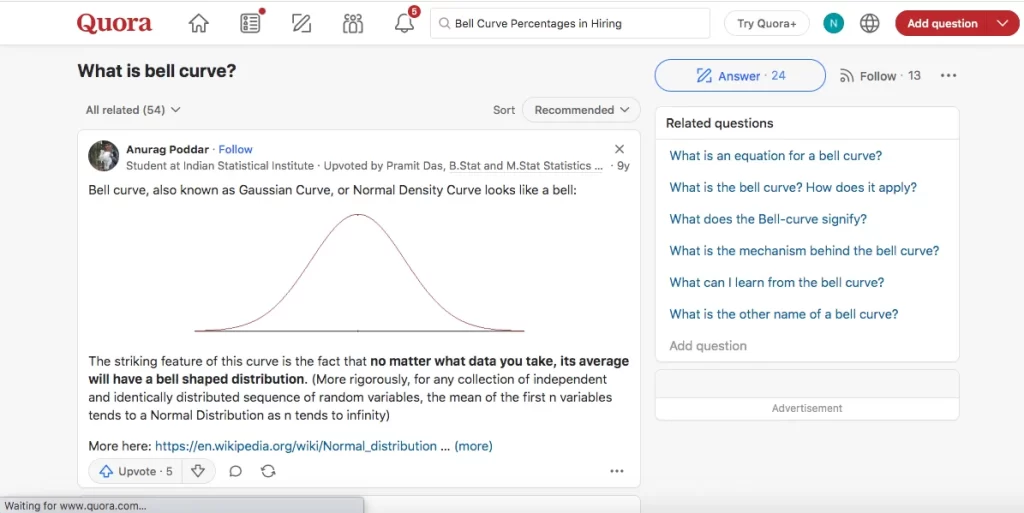
Drawing on real user insights from Quora, this section brings fresh caveats around applying bell curves in performance management.
Skewed Distributions vs. Ideal Curves
Leanne Markus (Business Psychologist) warns that workplace ratings seldom mirror the perfect bell,
“In the workplace you would expect a more skewed (lopsided) distribution… most people are rated at or above average and there are fewer outliers than there are with a bell curve.”
She emphasizes that real-world samples are far smaller than the thousands required for statistical validity.
Tom Tomasovic reminds us that deviations from normality signal flaws in assessment design,
“If scores on a particular assessment do not fit a normal distribution, we can infer that there is a flaw in the design of the assessment.”
Relative Ranking and Its Organizational Impact
Adith Srinivas explains the motivational mechanics behind top and bottom “N%” cut-offs,
“According to any organisational standards, top N% are the rare gems… once these guys know they are doing really good, they know that they have a very high demand in market.”
He also notes that bottom performers typically receive targeted mentoring with clear timelines,
“These guys are usually put into a mentor program… If they don’t they usually get fired.”
Bias, Fairness, and the Limits of Rank and Yank
Joshua Gross (Associate Professor, CSUMB) criticizes the “Rank and Yank” mindset,
“There are few objective measures… how do you measure midfielders?”
He points out that statistical rigor in academia contrasts starkly with business’ profit simplicity.
“In business, there is no rigor, only profit.”
Practical Considerations and Modern Evolutions

Gowri Menon (Ph.D. in Performance Management) discusses why large organizations lean on bell curves for normalization,
“Through the preparation of the bell curve, the organization wishes to identify where it must focus… top 20%… bottom 10%.”
By filtering 70% of “average” performers out of major decision-making, HR concentrates promotions, training, and succession planning on those segments most strategically important.
Automation, Evolution, and Future Directions
Sarath S (Marketing Executive) describes the historical evolution of performance management to modern and automated systems,
“Modern day performance management includes various areas of analysis that are deep, effective, accurate and legit… this is also automated through software.”
Nehal Joshi (HR Manager) succinctly captures the core rationale behind moderation,
“Everyone can’t be performer and everyone can’t be non-performer. So if rating comes that all are at excellent level HR have to moderate the ratings.”
Conclusion
Bell curve percentages provide powerful frameworks for evaluating performance across educational and corporate settings. When thoughtfully implemented, they balance statistical rigor with practical needs for differentiation and resource allocation.
The key lies not in blindly applying normal distributions, but in creating systems that identify genuine excellence, encourage improvement, and align with your organization’s specific culture and objectives.
What performance distribution approach works best in your context?
Hire the best candidates
with Wetest.
Create pre-employment assessments in minutes to screen candidates, save time, and hire the best talent.
Try for free