
Bonica
December 19, 2025
Companies need employees more than ever who can look at data to objectively figure out what’s going on and come up with solid answers.
Analytical thinking is a structured process where you break down complex problems to find patterns and judge the evidence to pick the most logical thing to do. It becomes a powerful tool that makes every decision better and more reliable when you use it consistently at work.
What makes analytical thinking so valuable is that it brings clarity to ambiguity. Modern workplaces are full of competing priorities and unpredictable stuff.
Professionals who think analytically tackle these problems with a disciplined mindset. They gather the right info and question their own assumptions to look at things from multiple angles and search for causation.
Analytical thinking makes teamwork way better. Teams benefit hugely when people can explain why they think what they think and evaluate options together.
Leaders need analytical skills to wisely allocate resources and justify their choices with actual evidence instead of just personal opinions.
Understanding what analytical thinking means improves your ability to solve problems and makes you more adaptable. Let’s learn how you can develop it at work so you can make better decisions.
Table of Contents
Why Analytical Thinking Matters for Workplace Decisions
Analytical thinking is the foundation for making great decisions at work because it takes raw information and turns it into clear insights.
Employees gain the ability to deal with uncertainty and pick perfect solutions when they get why analytical thinking improves decision-making.
One of the best things about analytical thinking is how it cuts down on bias. Humans naturally let their emotions and past experiences cloud their judgment. Analytical thinkers fight this by making sure their decisions are grounded in evidence.
They collect data, check facts, question assumptions, and look at problems from every angle. This way of thinking leads to results that are way more rational and easier to defend.
Analytical thinking also makes the decision process faster. I know that sounds weird because analysis seems like it takes more time, but the clarity you get from it cuts right through all the confusion.
Teams focus on patterns and measurable effects rather than everyone arguing about opinions. The solutions are easier to spot, and the risks are clearer to see coming.
Another reason analytical thinking is a big deal is its ability to show the long-term consequences. A lot of workplace decisions fail because nobody bothered to look ahead.
Analytical thinkers are awesome at seeing those ripple effects and analyzing if the resources will run out.
Analytical thinking improves collaboration and communication. Discussions are way more productive when your ideas are backed up by structured logic. Your coworkers understand the why behind your suggestion, and teams reach agreements with way less fighting.
Main Analytical Skills
You should develop a few core skills that let you interpret information well and solve problems accurately to build strong analytical thinking muscles at work.
Data Analysis
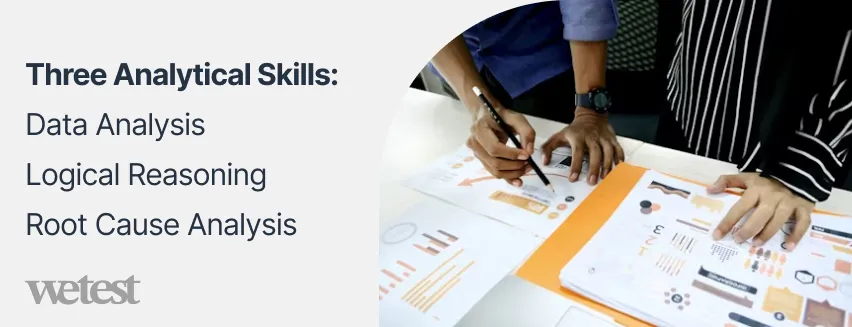
It is all about interpreting and drawing conclusions from numbers or descriptive information.
This could mean looking at performance metrics, checking customer feedback, reviewing financial reports, or spotting operational trends at work.
Having strong data analysis skills lets you identify patterns and predict what will happen next. You can base your decisions on evidence instead of just guessing.
Logical Reasoning
This lets people connect different ideas and figure out if the conclusion they reached makes sense based on the information they have.
This means recognizing when things don’t line up and questioning assumptions to compare different alternatives and make deductions based on facts.
Logical reasoning makes your recommendations way clearer and ensures that your decisions are coherent.
Root Cause Analysis
RCA focuses on finding the true underlying source of a problem instead of just fixing the symptom you can see right away.
This skill requires you to ask targeted questions, map out the process, and systematically eliminate possibilities until you spot the real issue.
Mastering root cause analysis stops problems from happening again and supports those continuous improvement initiatives across the whole company. These analytical skills give professionals the power to handle complexity.
Analytical Thinking Process
Analytical thinking follows a repeatable flow that anyone can learn and use. The whole thing starts with defining the problem as clearly as you can.
You end up with bad conclusions if the issue is too vague. The goal here is to clarify the main question and figure out who the stakeholders are to outline what you want the result to be.
The next step is to gather relevant information. Include data, observations, past records, expert opinions, and anything that influences the situation.
The process moves into examination and breakdown. This is where analytical thinkers categorize the information and spot patterns to look for connections between different variables.
They figure out what’s a fact versus what’s just an inference, and they pay close attention to anything that contradicts itself or anomalies that need a deeper look.
The next step is interpreting the findings. This means evaluating causation and comparing potential outcomes to weigh the good and bad parts of possible options.
The step after that is generating solutions or recommendations. Analytical thinkers look at multiple alternatives instead of just settling for the first idea that pops into their head. They check the feasibility and the risks involved, as well as the resources needed.
The decision should be implemented with a clear action plan. This means assigning responsibilities and setting deadlines.
The final step is review and reflection. Good decision-makers evaluate the results and compare the outcomes with what they expected to write down the lessons they learned.
Examples of Analytical Thinking in the Workplace
Seeing how analytical thinking works in real-life settings makes it clear just how valuable it is.
Customer Service

A classic example happens in customer service when you start seeing a sudden spike in complaints that seems to signal some kind of process issue.
An analyst categorizes the complaints and figures out the recurring themes to connect them with any recent policy changes or workflow tweaks rather than reacting on instinct.
Most of the complaints are caused by one specific new step they added to the customer verification process. The team can quickly revise that step. This immediately cuts down the complaints and makes customers happier.
Marketing
Analytical thinking shines when they evaluate how a campaign performed in a marketing department.
An analytical marketer reviews the performance by different customer groups and different social media channels to check the timing and the different creative versions they used, rather than just assuming the whole campaign was bad because of one weak part
The team avoids an unnecessary and expensive redesign by finding out that engagement only dropped within a single specific demographic and only on one platform. They reallocate money to the channels that were already working well.
Operations
Operations teams use analytical thinking all the time for inventory and logistics problems.
The manager looks into the ordering patterns and past demand spikes when a warehouse is constantly running out of one specific product that everyone wants.
The manager can negotiate new supplier terms or adjust the order timing after discovering that delays only happen when their orders go over a particular volume threshold.
Leadership
Leadership decisions rely on analytical thinking when they’re assessing the health of a department.
Imagine a team is seeing high turnover! An analytical leader reviews exit interviews, engagement surveys, workload data, and how the supervisors are managing things.
The leader knows to intervene with targeted coaching or restructuring. This stops them from making broad policy changes and focuses the effort on the true root cause.
How to Develop Analytical Thinking Skills
Analytical thinking isn’t some talent only a few people are born with. It’s a skill you can systematically improve with training and the consistent use of the right tools.
The very first step is to grow your curiosity and make a habit of questioning everything. Analytical thinkers always dig deeper! Why is this happening? What evidence backs this up? What other choices could we make? Just adopting that mindset alone changes how you solve everyday problems.
Regularly practicing with data also sharpens your analytical muscle. Even simple things! Check performance metrics, compare trends, and interpret what a dashboard is showing. Train your brain to spot patterns and draw logical conclusions.
Some professionals improve these skills with online learning platforms like Coursera. It has easy courses on data analysis and critical thinking. These structured programs expose you to real situations.
Another effective method is getting into problem-solving routines. Techniques like root cause analysis help you build a systematic way of thinking. Using these frameworks creates the discipline to dissect the issue instead of immediately rushing to a solution.
Keeping a journal of your assumptions and your conclusions can also help reduce personal bias.
Tools and technology are also a big deal here. Spreadsheet programs, data-visualization platforms, and project-management software give you structured places where you can evaluate information much better. They improve your ability to think with numbers.
Feedback accelerates growth. Talking about your conclusions with coworkers exposes you to blind spots and forces you to think more rigorously. This cycle of questioning and refining builds an analytical mindset.
Conclusion
We looked at what analytical thinking means and how it makes your judgment stronger and improves the quality of your decisions.
Its main value is the structure it brings to uncertainty. You can make decisions that are easy to defend by breaking problems down and drawing logical conclusions.
Analytical thinking involves having information and doing something with it. It enables everyone to see obstacles coming and clearly explain why their assumptions are recommending something.
This mindset also makes teamwork better. Groups talk about their reasoning openly and work toward solutions instead of just sticking to old habits.
Developing these skills is an ongoing thing. Every process you question makes your ability to think critically and act strategically sharper.
A Quora Rundown
Here are Quora users’ perspectives on how analytical thinking helps people make better decisions.
Breaking Out of Invisible Ruts
Greg Streib discusses how we trap ourselves in choices simply because we never look for alternatives.
“An example is how we tend to drive the same routes all the time… You can easily extrapolate that example to all walks of life. Again and again, we find ourselves making sub-optimal choices, and the error is clear: we should have examined a broader range of possibilities… We often consider zero alternate possibilities. And our original idea was the best essentially because we thought of it. There we sit in a universe of possibilities, repeatedly doing the same things, surrounded by better options.”
Decision-Making is Mostly Emotional!
Phil draws on Jonathan Haidt’s rider-and-elephant metaphor to explain why pure analysis loses.
“Humans make decisions based on emotions. Rational thought is used primarily for post-hoc justification rather than real decision making… There’s only so much the rider (rational thought) can do when the elephant (emotions) decide on a course of action… It actually works pretty well most of the time! It’s fast, and it’s been tuned by evolution to be correct more often than not.”
Your Future Self is the Ultimate Stakeholder
Sean Kernan uses two haunting stories to show why long-term analytical thinking matters.
“Everything we do is linked hand in hand with our future selves… I’ve tried to think through each decision with my future self standing next to me. And just as bad decisions are bad investments, the opposite is true. You can reverse them and have your future self high-fiving you rather than cursing you out.”
He shares the example of King George VI dying at 56 from illness and a former rock-and-roll roadie now living with incurable COPD as proof that analytical thinking is about not sentencing your 65-year-old self to a slow death!
Build Your Thinking on Rock, Not Air!
Jordan warns against the trap of analyzing floating opinions instead of grounded structures.
“A lot of people build their ideas in the middle of the air by acting on feelings rather than foundational unwavering truth… Even very successful business owners make this radically silly mistake of ‘Trusting the gut’… If there is no solid ground for your logic to stand on all of the analysis in the world can’t fix it.”
Logic, Truth, Context, and Alternatives
Hafiz Suboor breaks critical and analytical thinking into four pillars that rarely get airtime in articles.
“Critical thinking is based on four key elements… LOGIC, discerning direct relationships between causes and effects; TRUTH, unbiased data; CONTEXT, historical impacts and external pressures; ALTERNATIVES, looking at potential solutions not currently being used.”
He argues that most people skip at least two of these pillars in everyday decisions.
Active Reading as Brain Training
Naela Blosh offers a simple daily habit for sharpening analytical muscle.
“One way to start is to read more books… try to look at both sides of the story. For example, if you are reading a novel, try to see the plot from the perspective of the hero, the villain and other supporting characters. This causes your brain to think in new ways, and increase your stimulation.”
Emotion Belongs in the Equation
Hali Aquino pushes back against the cold logic only.
“Not underestimate the power of emotion… We are biological, not silicon characters… No critical analysis, worth our time, is useful without this skill… We relate to analyses that are ultimately human, because that is who we are.”
She argues that the most persuasive analytical outcomes acknowledge human feeling.
Daily Micro Practice List That Works
CK Dwarakanath gives the longest daily checklist seen on Quora!
“Practice the following… ask relevant questions, raise objections, seek data for validations, pose contrary views, see through alternatives, gather & organise crucial data, identify parts and their interrelationships, find root causes, learn associations between disparate inputs and see patterns (cricket leagues, elections, anything).”
He insists analytical skill is a set of micro-behaviors you repeat until they become automatic.
The Fastest Path
Brian White offers the most academically backed route.
“The best way to improve rigorous thinking is to study a STEM major in a no-nonsense university… The very practice of studying advanced courses will convey a general improvement in ways of thinking and testing hypotheses. The thing that really matters is the ability to think inductively. That is the essence of science.”
FAQs
What does analytical thinking mean in the workplace?
Analytical thinking in the workplace refers to the ability to collect and interpret data or information, break down complex issues into manageable parts, identify patterns or relationships, and draw logical conclusions.
How does analytical thinking improve decision-making at work?
People can systematically weigh evidence, consider multiple variables, evaluate risks and benefits, and anticipate possible outcomes. This leads to more rational and defensible decisions.
What are some examples of analytical thinking in the workplace?
Analyzing sales data to identify trends, breaking down a project’s workload to optimize resource allocation, and diagnosing a drop in performance by tracing root causes.
How is analytical thinking different from critical thinking?
Analytical thinking focuses more on breaking down information into components and identifying patterns and relationships. Critical thinking emphasizes evaluating arguments and logic.
Can analytical thinking skills be developed?
Yes, it can be trained and improved over time. Methods include practice on real tasks, using frameworks, asking deeper questions, and reflecting on past decisions.
What should I do when I have incomplete data but still need to decide?
Analytical thinking means accepting the uncertainty, exploring multiple plausible hypotheses, and evaluating potential options based on the available evidence.
Hire the best candidates
with Wetest.
Create pre-employment assessments in minutes to screen candidates, save time, and hire the best talent.
Try for free