According to LinkedIn’s Future of Recruiting research, more than 75% of recruiters say AI will play a significant role in hiring decisions in the coming years. That shift is already reshaping how companies attract, evaluate, and hire talent in 2026.
Hiring today looks very different from just a few years ago. Talent shortages remain persistent, remote and hybrid work have become standard, and competition for skilled candidates is now global. At the same time, hiring teams face growing pressure to move faster, reduce costs, and make high-quality decisions with less room for error.
AI is now a necessity in recruitment, moving beyond basic screening to analyze data, predict outcomes, reduce bias, and personalize the hiring process. It has become essential for consistent success.
But with so many AI hiring tools available, each specializing in different areas, choosing the wrong one can be costly, risky, and harm your reputation.
This post explores the best AI recruiting tools for 2026, evaluated through real-world use cases, AI depth, scalability, and measurable hiring impact. Hiring looks different at every stage. Let’s find the tools that work for where you are right now.
Table of Contents
How We Ranked the Best AI Recruiting Tools
The AI recruiting market is crowded, and many tools market themselves as “AI-powered” without delivering meaningful intelligence or measurable hiring impact.
To avoid superficial rankings and marketing-driven claims, each platform in this guide was evaluated using a consistent, criteria-based framework focused on real-world hiring performance.
Our goal was not to rank tools based on popularity alone, but to identify AI recruiting software that genuinely improves hiring outcomes in 2026.
Evaluation Criteria
- AI capabilities (NLP, ML, predictive analytics): Depth of intelligence beyond basic automation, including learning accuracy and predictive hiring insights.
- Bias reduction and compliance: Built-in safeguards for fair hiring, explainable AI, and alignment with hiring and data regulations.
- Integration with ATS and HRIS: Ease of connecting with existing recruitment and HR systems without workflow disruption.
- Candidate experience: Application, communication, and interview flows that feel efficient, transparent, and human.
- Pricing transparency and scalability: Clear cost structures that scale predictably from small teams to enterprise hiring.
- Real-world adoption and reviews: Evidence of proven use through customer feedback, case studies, and sustained adoption.
Best AI Recruiting Tools in 2026 (In-Depth Reviews)
AI recruiting tools in 2026 are no longer one-size-fits-all. The strongest platforms specialize in different stages of the hiring lifecycle, from talent intelligence and sourcing to interviews, assessments, and high-volume automation. Below are the leading tools, grouped by category, starting with the most influential platforms in each segment.
Talent Intelligence & End-to-End AI Platforms
These platforms use advanced machine learning to map skills, predict success, and support large-scale hiring and workforce planning.
Eightfold AI
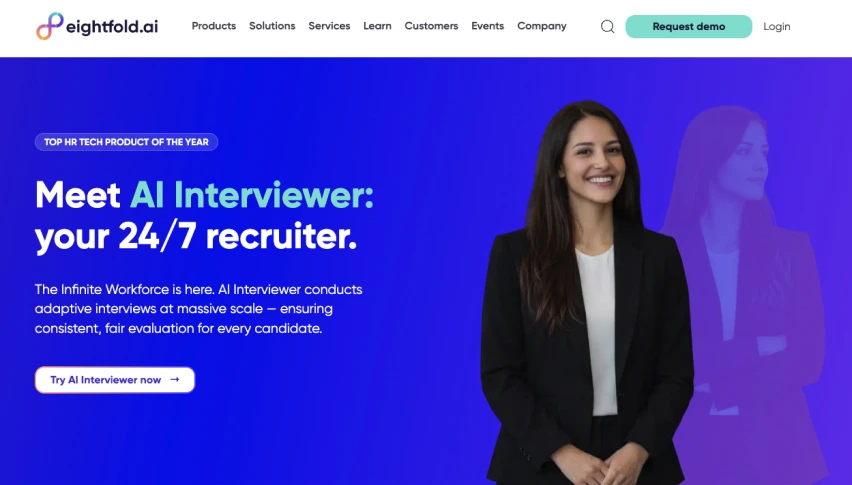
Eightfold AI is widely regarded as one of the most advanced talent intelligence platforms in the AI recruiting landscape, particularly in 2026 where skill-based hiring has become the dominant model.
Rather than relying on resumes or keyword matching alone, Eightfold uses deep machine learning models trained on billions of career data points to understand skills, potential, and career trajectories across both external candidates and internal employees.
At its core, Eightfold excels at skills inference and predictive matching. The platform analyzes resumes, profiles, and historical career paths to identify transferable skills and predict how well a candidate may perform and grow in a role over time.
This makes it especially valuable for organizations shifting away from rigid job requirements toward capability-based hiring and internal mobility.
Key features:
- Advanced skill taxonomy and skills inference engine
- AI-driven candidate ranking and matching based on potential, not just experience
- Internal mobility and talent redeployment tools
- Diversity and bias-mitigation analytics
- Workforce planning and talent forecasting dashboards
- Enterprise-grade compliance and explainable AI controls
Pros:
- Exceptional depth in AI and machine learning maturity
- Strong support for diversity, equity, and fair hiring initiatives
- Powerful internal mobility and reskilling capabilities
- Proven scalability for global enterprise hiring
Cons:
- Designed primarily for large enterprises, not SMBs
- Implementation and change management can be complex
- Pricing is premium and typically not transparent upfront
- Overkill for teams focused on simple, high-volume hiring
Best for:
Eightfold AI is best suited for large organizations and enterprises with complex hiring needs, high internal talent movement, and long-term workforce planning goals. It is particularly effective in industries undergoing rapid skill transformation, such as technology, finance, healthcare, and consulting.
Eightfold AI is a full-scale talent intelligence system. For companies ready to invest in AI-driven hiring at scale, it offers unmatched insight into skills, potential, and workforce evolution.
Beamery
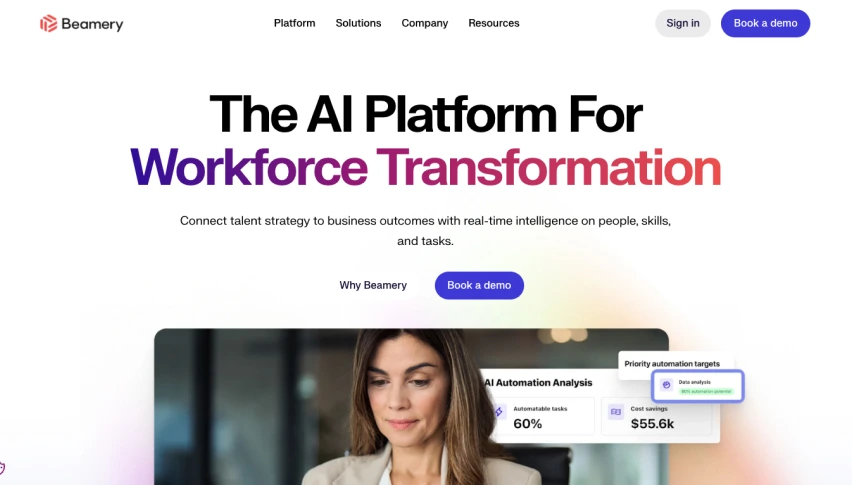
Beamery is a leading talent lifecycle management platform that focuses on building long-term relationships with candidates rather than transactional, role-by-role hiring. In 2026, it is widely used by enterprise hiring teams that want deeper visibility into talent pipelines, future workforce needs, and candidate engagement over time.
At its core, Beamery combines AI-driven talent CRM, workforce planning, and engagement automation. The platform uses machine learning to help recruiters understand candidate intent, recommend next-best actions, and identify high-potential talent earlier in the hiring funnel.
Unlike traditional ATS systems, Beamery is designed to support proactive hiring strategies, including talent pooling, pipelining, and internal redeployment.
Key features:
- AI-powered talent CRM and candidate relationship management
- Skills-based talent segmentation and pipeline analytics
- Predictive workforce planning and demand forecasting
- Personalized candidate engagement and communication journeys
- Native integrations with major ATS and HRIS platforms
- Compliance and data governance controls for enterprise hiring
Pros:
- Excellent for long-term talent nurturing and pipeline building
- Strong visibility into future hiring needs and skill gaps
- Improves recruiter productivity through AI-recommended actions
- Well-suited for global and complex hiring organizations
Cons:
- Less effective for urgent, high-volume transactional hiring
- Requires mature recruiting operations to unlock full value
- Implementation and onboarding can be resource-intensive
- Premium pricing compared to basic recruiting tools
Best for:
Beamery is best suited for mid-to-large enterprises that prioritize strategic workforce planning, employer branding, and sustained candidate relationships. It is particularly valuable for organizations hiring at scale across multiple regions or planning for future skill transformation.
Beamery excels where traditional ATS platforms fall short: long-term talent intelligence and engagement. For organizations focused on building future-ready talent pipelines rather than just filling open roles, Beamery offers a powerful, AI-driven advantage.
Phenom
Phenom is a leading talent experience platform built around AI-driven personalization for candidates, recruiters, and employees.
In 2026, it is best known for transforming career sites and application journeys into intelligent, conversion-focused experiences that adapt to user behavior in real time.
At the heart of Phenom’s platform is its AI-powered personalization engine, which analyzes candidate intent, skills, and engagement patterns to recommend relevant jobs, content, and next steps.
Rather than focusing solely on recruiters, Phenom optimizes the entire talent experience, from first visit to career site through application, hiring, and internal mobility.
Key features:
- AI-powered career site personalization and job recommendations
- Conversational AI chatbots for candidate engagement and screening
- Skills-based matching and talent insights
- Recruiter and hiring manager productivity tools
- Internal mobility and employee experience modules
- Enterprise-grade integrations with ATS and HRIS platforms
Pros:
- Significantly improves candidate engagement and application conversion
- Strong employer branding and personalization capabilities
- Scales well for global, high-traffic career sites
- Unified experience across candidate, recruiter, and employee journeys
Cons:
- Enterprise-focused, with pricing and complexity to match
- Requires strong content and employer branding strategy to maximize value
- Implementation can be time-intensive
- Less emphasis on deep candidate assessment compared to testing platforms
Best for:
Phenom is best suited for large enterprises that receive high volumes of applicants and want to improve candidate experience, employer brand perception, and conversion rates across digital hiring touchpoints.
Phenom excels at making hiring experiences smarter, faster, and more personalized. For organizations where candidate experience is a strategic priority, it delivers measurable gains in engagement and hiring efficiency at scale.
iCIMS
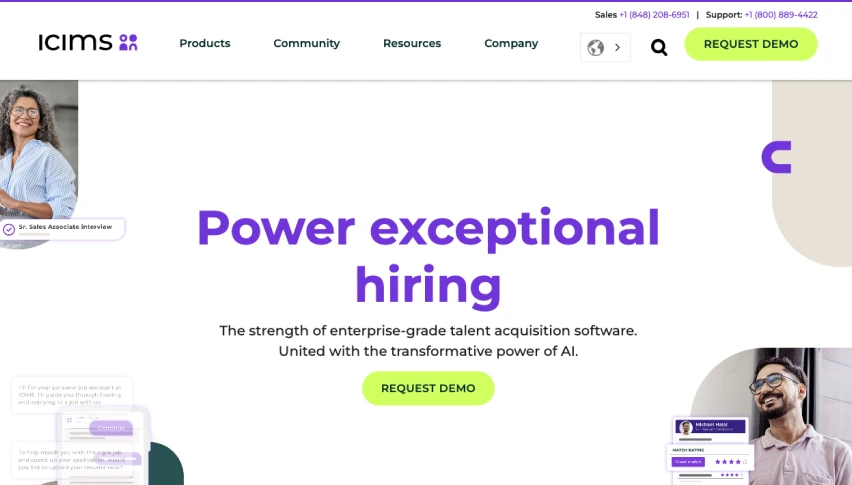
iCIMS is one of the most established players in the recruiting software market and remains a dominant enterprise-grade applicant tracking system (ATS) in 2026.
While historically known for workflow management rather than advanced AI, iCIMS has steadily expanded its AI capabilities across sourcing, matching, and candidate engagement.
The platform’s strength lies in its stability, scalability, and ecosystem depth. iCIMS integrates with hundreds of HR and recruiting tools, making it a central hub for complex hiring operations.
Its AI features focus on improving efficiency through resume parsing, candidate matching, and automated communication, rather than replacing recruiter judgment.
Key features:
- Enterprise ATS with configurable hiring workflows
- AI-assisted resume parsing and candidate matching
- Talent pools and basic predictive recommendations
- Automated candidate communication and scheduling
- Extensive marketplace integrations and APIs
- Compliance, reporting, and global hiring support
Pros:
- Highly reliable and scalable for large hiring organizations
- Strong integration ecosystem and partner marketplace
- Flexible workflows that support complex hiring processes
- Trusted by global enterprises across industries
Cons:
- AI capabilities are more incremental than transformative
- User experience can feel dated compared to newer platforms
- Customization often requires administrative effort
- Less advanced in skills inference and predictive hiring
Best for:
iCIMS is best suited for large organizations and enterprises that need a robust, configurable ATS with strong compliance and integration capabilities, especially when AI is used to enhance rather than drive hiring decisions.
iCIMS remains a foundational recruiting platform rather than a pure AI-first solution. For enterprises seeking operational reliability, ecosystem flexibility, and gradual AI adoption, it continues to be a safe and proven choice.
AI Sourcing & Talent Discovery Tools
These tools focus on finding and engaging both active and passive candidates using AI-driven search and data enrichment.
SeekOut
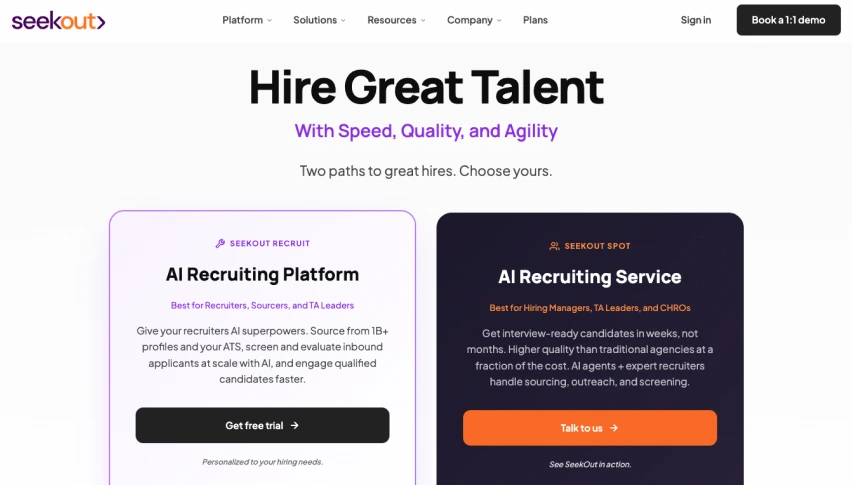
SeekOut is an AI-powered talent sourcing and analytics platform designed to help recruiters identify and engage both active and passive candidates across multiple public and professional data sources.
In 2026, it is widely used by organizations competing for scarce skills, especially in technology, data, and engineering roles.
The platform’s core strength lies in its advanced search intelligence. SeekOut uses machine learning to analyze skills, career trajectories, and experience patterns, allowing recruiters to build highly targeted talent pipelines.
In addition to sourcing, it provides market insights that help hiring teams understand talent availability, competition, and diversity trends.
Key features:
- AI-driven candidate sourcing and search
- Advanced filtering by skills, experience, and career signals
- Diversity-focused sourcing and reporting tools
- Talent pool and labor market analytics
- ATS and CRM integrations
Pros:
- Excellent for discovering passive candidates
- Strong support for diversity and inclusive hiring initiatives
- Powerful and intuitive search capabilities
- Useful market intelligence for strategic hiring
Cons:
- Primarily focused on sourcing rather than full-cycle recruiting
- Dependent on the quality of external data sources
- Limited assessment and interview functionality
Best for:
SeekOut is best suited for mid-sized and large organizations that rely heavily on proactive sourcing, particularly for technical, data, and hard-to-fill roles.
SeekOut functions best as a sourcing intelligence layer within a broader recruiting stack, complementing an ATS rather than replacing it.
HireEZ
HireEZ is an AI-driven recruiting platform focused on outbound sourcing and candidate engagement, designed to help recruiters identify and reach qualified talent more efficiently.
In 2026, it is commonly used by teams that rely on proactive outreach rather than inbound applications to fill roles quickly.
The platform combines AI-powered candidate search with contact discovery and automated engagement tools. HireEZ analyzes profiles across multiple data sources to surface relevant candidates, enriches contact information, and supports multi-channel outreach. Its value is centered on increasing recruiter productivity at the top of the hiring funnel.
Key features:
- AI-powered candidate sourcing and search
- Contact enrichment and email discovery
- Automated outreach and engagement workflows
- Talent pool analytics and reporting
- Integrations with major ATS platforms
Pros:
- Significantly reduces manual sourcing effort
- Strong outbound recruiting capabilities
- Easy to deploy and use
- Effective for fast-paced hiring teams
Cons:
- Limited support for inbound or applicant-driven hiring
- Minimal assessment and interview features
- Effectiveness depends on outreach quality and messaging
Best for:
HireEZ is best suited for recruiting teams that depend on outbound sourcing and want to scale candidate outreach without increasing recruiter headcount.
HireEZ works best as a sourcing and engagement engine, complementing an ATS rather than acting as a full end-to-end hiring platform.
AmazingHiring
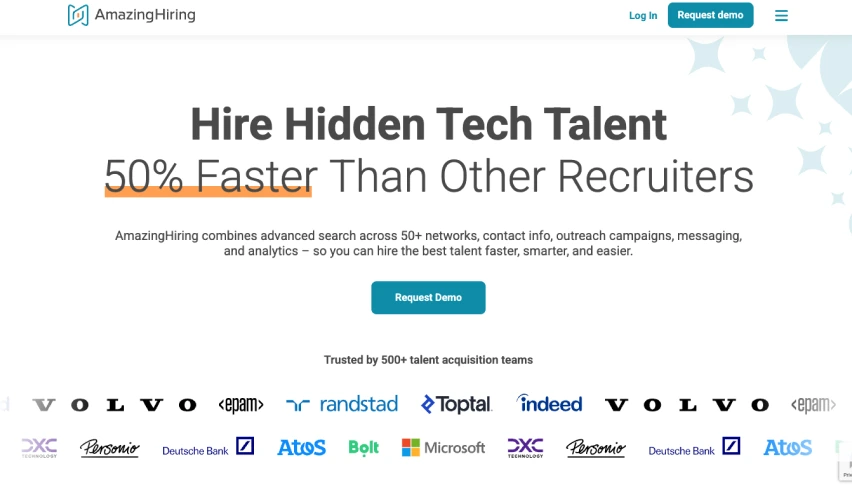
AmazingHiring is a specialized AI-powered sourcing platform built specifically for technical recruiting. In 2026, it is primarily used by companies that need to hire software engineers and technical specialists at scale, where traditional sourcing methods often fall short.
The platform aggregates developer data from multiple public sources and applies AI-driven search to identify candidates based on technologies, skills, and experience patterns.
Its strength lies in precision and speed, helping recruiters quickly surface relevant engineering talent without manually searching across multiple platforms.
Key features:
- AI-powered developer sourcing
- Multi-source candidate aggregation
- Skill and technology-based filtering
- Candidate profile enrichment
- ATS integrations
Pros:
- Highly effective for engineering and technical roles
- Strong skill-based search accuracy
- Saves significant time in developer sourcing
Cons:
- Limited usefulness outside technical hiring
- Smaller ecosystem compared to general-purpose platforms
- Less focus on candidate engagement and nurturing
Best for:
AmazingHiring is best suited for organizations with consistent demand for software engineers, developers, and technical specialists.
AmazingHiring is a focused sourcing tool that delivers strong results within its niche but is not designed to manage the full recruiting lifecycle.
Fetcher
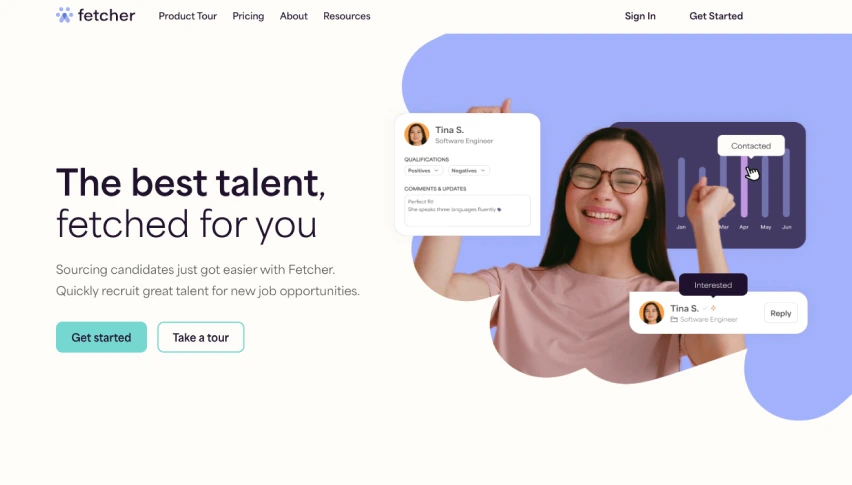
Fetcher is an automated sourcing platform designed to remove repetitive top-of-funnel recruiting work by combining AI-driven candidate discovery with managed sourcing services.
In 2026, it is commonly used by lean recruiting teams that want quick access to qualified candidates without building large in-house sourcing operations.
The platform uses AI to identify relevant candidates based on role requirements, then delivers curated candidate lists directly to recruiters.
Fetcher emphasizes speed and simplicity, allowing teams to focus more on interviewing and decision-making rather than manual sourcing.
Key features:
- Automated candidate sourcing
- Managed sourcing and outreach services
- Curated candidate list delivery
- Basic analytics and performance reporting
- ATS integrations
Pros:
- Minimal setup and recruiter involvement
- Fast access to pre-qualified candidates
- Well-suited for small and growing teams
Cons:
- Limited control over sourcing criteria
- Less transparency into sourcing methodology
- Not ideal for highly specialized or senior roles
Best for:
Fetcher is best suited for startups and small to mid-sized companies that want fast sourcing results without investing heavily in sourcing infrastructure.
Fetcher prioritizes efficiency and ease of use, making it a practical solution for teams that value speed over deep customization.
AI Interview, Assessment & Screening Platforms
These tools specialize in evaluating candidates through interviews, assessments, and predictive scoring.
Wetest
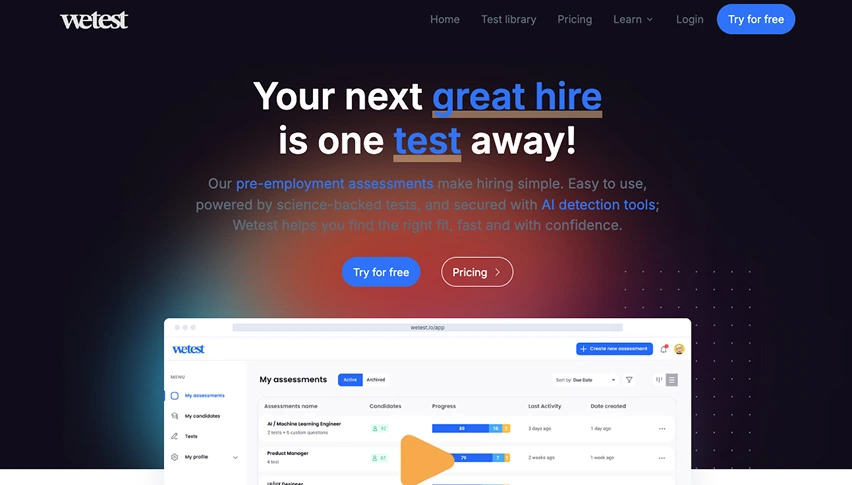
Wetest is a pre-employment assessment platform designed to make hiring simple, fast, and data-driven, with a strong emphasis on affordability and test integrity.
In 2026, it positions itself as a practical alternative to complex and expensive assessment tools, targeting growing companies that want reliable hiring signals without enterprise-level overhead.
The platform’s core strength lies in its science-backed test library combined with AI integrity detection. Wetest focuses on ranking candidates based on validated test scores rather than gut feeling, while actively addressing modern hiring risks such as AI-generated or plagiarized answers.
Its straightforward pricing and ease of use make it accessible to teams without dedicated HR tech specialists.
Key features:
- 60+ research-backed pre-employment tests
- AI detection tools to identify AI-assisted and plagiarized answers
- Choice between AI-friendly or standalone assessment modes
- Unlimited tests per assessment
- Candidate ranking based on certified test scores
- Customizable assessments at no extra cost
- Intro and outro videos included for employer branding
- ATS integrations and API access
- Over 5,000,000 assessments taken globally
Pros:
- Strong focus on test integrity and AI misuse prevention
- Transparent and affordable pricing model
- Easy-to-use interface with minimal setup
- Unlimited tests per assessment without extra fees
- Reduces unconscious bias through standardized testing
- Well-suited for data-driven hiring decisions
Cons:
- Focused primarily on pre-employment assessments rather than end-to-end recruiting workflows
- Designed as a lightweight, standardized testing platform rather than a highly customized enterprise hiring system
Best for:
Wetest is best suited for startups, SMBs, and fast-growing companies that want reliable, fair, and cost-effective pre-employment assessments without complex contracts or hidden fees.
Wetest stands out as a practical, integrity-focused assessment platform that prioritizes fairness, usability, and pricing transparency, making it a strong choice for teams aiming to hire better candidates with confidence rather than complexity.
TestGorilla
TestGorilla is a pre-employment assessment platform built around skills-based hiring, aiming to replace resume screening with standardized online tests. In 2026, it is widely used by startups and mid-sized companies seeking a fast and structured way to evaluate candidates early in the hiring funnel.
The platform offers a broad library of ready-made assessments covering cognitive ability, role-specific skills, language proficiency, and personality traits.
Hiring teams can combine multiple tests into a single assessment and automatically rank candidates based on performance. TestGorilla prioritizes speed and accessibility over deep customization or advanced AI modeling.
Key features:
- Large library of pre-built skills, cognitive, and personality tests
- Multi-test assessments per role
- Automated candidate scoring and ranking
- Basic anti-cheating and plagiarism detection
- Custom questions and employer branding
- Integrations with common ATS platforms
Pros:
- Promotes skills-based and bias-reducing hiring practices
- Fast setup with minimal configuration
- Broad test coverage across roles and industries
- Clear and accessible pricing for SMBs
Cons:
- Limited to pre-employment testing and does not support full recruiting workflows
- AI capabilities are relatively basic compared to AI-first assessment platforms
- Anti-cheating and AI-detection tools are less advanced than integrity-focused competitors
- Customization depth is limited for complex or senior roles
- Less suitable for highly technical or role-specific evaluations
Best for:
TestGorilla is best suited for startups and small to mid-sized organizations that want to introduce standardized skills testing early in the hiring process without investing in complex recruitment technology.
TestGorilla functions as a screening layer rather than a comprehensive hiring system, making it most effective when used alongside an ATS or broader recruitment stack.
HireVue
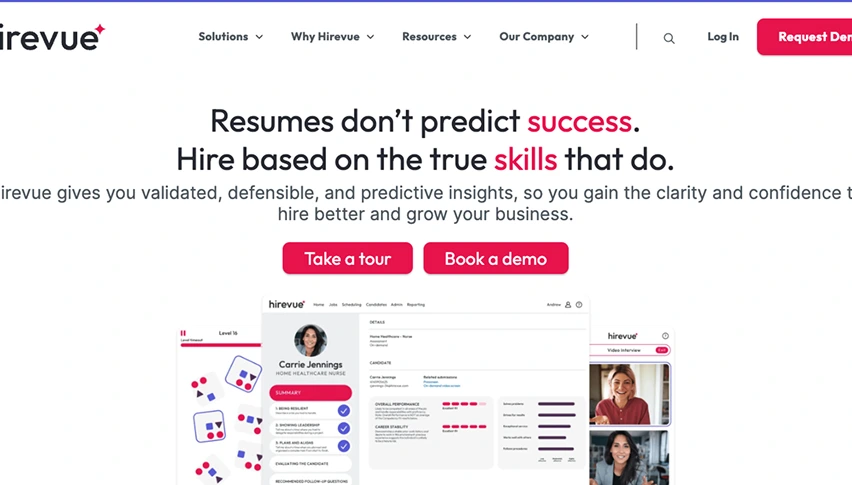
HireVue is an AI-based interview and assessment platform primarily focused on structured video interviewing and standardized candidate evaluation. In 2026, it remains one of the most widely adopted solutions among large enterprises, particularly in regulated industries and high-volume hiring environments.
The platform enables organizations to conduct on-demand and live video interviews supported by structured frameworks and automated scoring tools.
HireVue’s AI is designed to improve consistency and efficiency rather than replace human decision-making, with a strong emphasis on compliance, auditability, and governance.
Key features:
- On-demand and live video interviews
- Structured interview frameworks and standardized questions
- AI-assisted scoring and candidate comparison
- Built-in compliance, audit, and governance controls
- Integration with enterprise ATS platforms
- Support for high-volume hiring workflows
Pros:
- Strong adoption among large and global enterprises
- Emphasis on compliance and explainable hiring processes
- Improves consistency and scalability of interviews
- Reduces scheduling and coordination overhead
Cons:
- AI-driven evaluations have faced scrutiny and require careful configuration
- Candidate experience can feel impersonal compared to live interviews
- Limited sourcing and early-stage screening capabilities
- Less flexible for highly customized or role-specific assessments
- Pricing and implementation are geared toward enterprise budgets
Best for:
HireVue is best suited for large organizations managing high-volume or regulated hiring processes where standardization, auditability, and scale are critical.
HireVue functions as an interview and assessment layer within a broader recruiting stack, rather than a complete end-to-end hiring platform.
Pymetrics
Pymetrics is an AI-driven behavioral assessment platform that evaluates candidates using neuroscience-based games rather than resumes or traditional interviews.
In 2026, it is most commonly used by large organizations for early-career, graduate, and high-volume hiring where potential and cognitive traits are prioritized over prior experience.
The platform measures attributes such as attention, risk tolerance, learning speed, and emotional traits through short, game-based assessments.
AI models then match candidates to roles based on behavioral fit, with an emphasis on fairness and bias reduction. Pymetrics positions its technology as a complement to traditional hiring methods, not a replacement for role-specific skill evaluation.
Key features:
- Neuroscience-based game assessments
- Behavioral and cognitive trait modeling
- AI-driven role matching and candidate ranking
- Bias auditing and fairness monitoring tools
- Integration with enterprise ATS platforms
Pros:
- Strong focus on potential rather than credentials
- Effective for early-career and graduate hiring programs
- Designed with fairness and bias reduction in mind
- Engaging, low-pressure assessment format for candidates
Cons:
- Limited role-specific or technical skill evaluation
- Assessment results may feel abstract to hiring managers
- Less suitable for senior or highly specialized roles
- Requires explanation and change management to gain internal buy-in
Best for:
Pymetrics is best suited for large organizations hiring at scale for early-career or entry-level roles, particularly where diversity, potential, and cultural fit are strategic priorities.
Pymetrics operates as a behavioral assessment layer within the hiring process, adding insight into candidate potential but relying on other tools for skills validation and full-cycle recruitment.
Codility
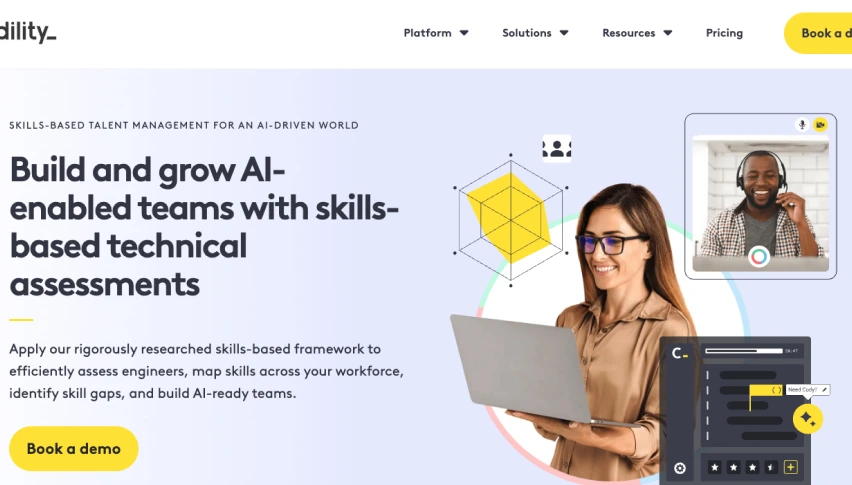
Codility is a technical assessment platform focused on evaluating software engineering skills through structured coding tests and real-world programming tasks. In 2026, it is widely used by engineering teams that want a standardized and data-backed way to assess technical competence beyond resumes and interviews.
The platform emphasizes practical problem-solving and code quality rather than puzzle-style challenges. Codility allows hiring teams to test candidates in realistic scenarios, analyze performance metrics, and compare results consistently across applicants. Its approach is designed to support later-stage screening and technical interviews rather than early sourcing.
Key features:
- Role-based coding tests and programming challenges
- Real-world tasks aligned with production scenarios
- Automated scoring and performance analytics
- Benchmarking against global developer data
- Remote technical interview support
- ATS integrations
Pros:
- Strong signal for real engineering ability
- Focus on practical, job-relevant coding tasks
- Standardized evaluation across candidates
- Widely recognized and trusted by engineering teams
Cons:
- Limited functionality outside technical hiring
- Not designed for early-stage candidate sourcing
- Candidate experience can feel demanding under timed conditions
- Customization is more constrained compared to bespoke assessment tools
Best for:
Codility is best suited for organizations hiring software engineers and technical specialists who need consistent, objective technical assessments during mid to late hiring stages.
Codility functions as a technical evaluation layer within the hiring process, complementing ATS and interview workflows rather than replacing them.
HackerRank
HackerRank is a developer assessment and technical interviewing platform built around coding challenges, skill benchmarking, and remote technical interviews. In 2026, it remains one of the most widely recognized platforms for evaluating engineering talent at scale, supported by a large global developer community.
The platform enables hiring teams to assess candidates through standardized coding tests, role-based challenges, and live technical interviews. HackerRank emphasizes consistency and comparability across candidates, using performance data and benchmarks to inform hiring decisions. Its breadth makes it suitable for high-volume technical hiring, though depth can vary by role and customization level.
Key features:
- Coding challenges and role-based assessments
- Remote technical interviews with collaborative coding environments
- Skill benchmarking against global developer data
- Automated scoring and candidate ranking
- Libraries of questions across languages and frameworks
- ATS integrations
Pros:
- Strong brand recognition among developers
- Scales well for high-volume engineering hiring
- Broad coverage of programming languages and roles
- Standardized assessments enable fair comparison
Cons:
- Risk of candidate familiarity with common challenges
- Signal quality can drop for senior or highly specialized roles
- Timed tests may disadvantage strong but slower problem-solvers
- Customization depth is limited compared to fully bespoke assessments
Best for:
HackerRank is best suited for organizations running large-scale engineering hiring programs that require standardized, repeatable technical screening.
HackerRank operates as a technical assessment and interview layer within the hiring stack, offering scale and consistency rather than deep role-specific customization.
Conversational AI & Hiring Automation
The following platforms improve speed and candidate experience through chatbots and workflow automation.
Paradox
Paradox is a conversational AI platform designed to automate high-volume hiring tasks through chat-based interactions. In 2026, it is most commonly used by large organizations and employers with frontline, hourly, or high-turnover roles where speed, responsiveness, and candidate experience are critical.
The platform’s AI assistant handles tasks such as candidate screening, interview scheduling, and ongoing communication across multiple channels. Paradox focuses on reducing time-to-hire and administrative burden by automating repetitive interactions, while routing more complex decisions back to human recruiters.
Key features:
- Conversational AI chatbot for candidate engagement
- Automated screening and qualification questions
- Interview scheduling and reminders
- Multi-channel communication support
- Integrations with major ATS platforms
Pros:
- Significantly reduces time-to-hire in high-volume roles
- Improves candidate response rates and engagement
- Minimizes recruiter administrative workload
- Scales effectively for large hiring volumes
Cons:
- Limited depth in candidate assessment and evaluation
- Not well suited for complex or senior roles
- Heavy reliance on scripted workflows
- Less flexibility for highly customized hiring processes
Best for:
Paradox is best suited for organizations hiring at scale for hourly, frontline, or operational roles where speed and efficiency are the primary priorities.
Paradox functions as an automation and communication layer within the recruiting stack, complementing ATS and assessment tools rather than replacing them.
Humanly
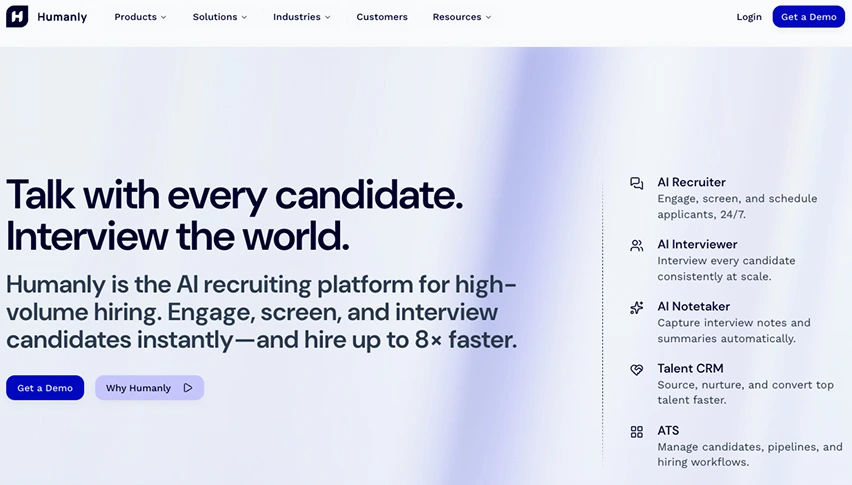
Humanly is a conversational AI recruiting platform focused on automating early-stage candidate screening while emphasizing fairness and structured decision-making.
It is primarily used by organizations managing high applicant volumes and seeking more consistent, bias-aware screening processes.
The platform conducts structured, chat-based screening conversations that collect standardized candidate responses before passing qualified applicants to recruiters.
Humanly’s AI is designed to support equitable hiring by applying the same criteria to all candidates and documenting decisions, rather than making opaque judgments.
Key features:
- Conversational AI for structured candidate screening
- Standardized qualification questions
- Bias-aware screening and decision support
- Interview scheduling automation
- Integrations with ATS platforms
Pros:
- Improves consistency and fairness in early-stage screening
- Reduces recruiter workload during high-volume hiring
- Creates a more structured and transparent candidate intake process
- Easy to integrate into existing hiring workflows
Cons:
- Limited functionality beyond early-stage screening
- Less effective for complex role evaluation
- Conversational flow may feel rigid to some candidates
- Not designed for deep assessment or interviewing
Best for:
Humanly is best suited for organizations conducting high-volume hiring where structured and fair early screening is a priority.
Humanly operates as an early-stage screening layer, adding consistency and scalability to the hiring process without replacing deeper assessment or interview tools.
Resume Screening & Matching AI
These tools focus on parsing resumes, matching skills, and ranking candidates efficiently.
Textio
Textio is an AI-powered writing and language optimization platform focused on improving job descriptions and employer messaging. It is widely used by HR and talent teams aiming to attract higher-quality and more diverse applicants through better-written, more inclusive job content.
The platform analyzes language patterns in job postings and career communications, using predictive models to suggest wording that performs better with different candidate groups.
Rather than screening or assessing candidates, Textio operates at the very top of the hiring funnel, influencing who applies in the first place and how roles are perceived.
Key features:
- AI-driven job description optimization
- Inclusive language and bias detection
- Performance predictions based on language choices
- Real-time writing suggestions and scoring
- Employer branding and tone consistency tools
- Integrations with ATS and content platforms
Pros:
- Improves applicant quality through clearer job descriptions
- Supports inclusive and bias-aware hiring practices
- Easy to use with immediate feedback
- Strong impact at the top of the hiring funnel
Cons:
- Does not support candidate screening or assessment
- Limited value without sufficient job posting volume
- Effectiveness depends on adoption by hiring managers
- Not a standalone recruiting solution
Best for:
Textio is best suited for organizations that post a high volume of job openings and want to improve candidate attraction, diversity, and employer branding through better language.
Textio functions as a content and optimization layer in the hiring stack, shaping candidate pools before any assessment or interview takes place.
HiredScore
HiredScore is an AI-driven talent matching and resume screening platform focused on helping large organizations make consistent, compliant, and data-backed hiring decisions.
It is primarily adopted by enterprises operating in regulated environments where transparency and auditability are critical.
The platform applies machine learning to analyze resumes and internal talent data, ranking candidates based on skills, experience, and role fit.
A key differentiator is HiredScore’s emphasis on explainable AI, allowing hiring teams to understand and audit how recommendations are generated rather than relying on black-box scoring.
Key features:
- AI-powered resume screening and candidate ranking
- Explainable AI decision models
- Internal talent mobility and redeployment tools
- Bias monitoring and compliance support
- Integration with enterprise ATS platforms
Pros:
- Strong focus on transparency and regulatory compliance
- Reduces manual resume screening workload
- Supports internal mobility and talent redeployment
- Well-suited for complex enterprise hiring environments
Cons:
- Primarily targeted at large enterprises
- Implementation can be resource-intensive
- Limited functionality outside screening and matching
- Less flexible for highly customized or niche roles
Best for:
HiredScore is best suited for large organizations and regulated industries that require explainable, auditable AI in their hiring processes.
HiredScore functions as a screening and matching intelligence layer, augmenting existing ATS systems rather than replacing full recruiting workflows.
Zoho Recruit
Zoho Recruit is an applicant tracking system with built-in automation and AI-assisted features, designed to support end-to-end recruiting workflows for small and mid-sized businesses.
It is commonly used by teams looking for an affordable, all-in-one hiring solution that integrates tightly with the broader Zoho ecosystem.
The platform covers the full recruitment lifecycle, including job posting, resume management, candidate tracking, and communication.
Its AI capabilities are focused on practical automation such as resume parsing, candidate matching, and workflow optimization, rather than advanced predictive hiring analytics.
Key features:
- End-to-end ATS and recruitment CRM
- AI-assisted resume parsing and candidate matching
- Automated workflows and candidate communication
- Job posting and career site management
- Reporting and hiring analytics
- Integrations with Zoho apps and third-party tools
Pros:
- Cost-effective solution for SMBs
- Covers the entire recruiting workflow in one platform
- Easy to configure and use
- Strong integration within the Zoho ecosystem
Cons:
- AI functionality is relatively basic compared to AI-first platforms
- Limited advanced analytics and predictive insights
- Less suitable for large-scale or highly complex hiring operations
- User interface and customization options can feel constrained
Best for:
Zoho Recruit is best suited for small and mid-sized organizations that want a straightforward, affordable ATS with essential automation and AI assistance.
Zoho Recruit serves as a practical all-in-one recruiting platform, prioritizing accessibility and operational efficiency over advanced AI-driven hiring intelligence.
How to Choose the Right AI Recruiting Tool in 2026
Choosing the right AI recruiting tool in 2026 requires a clear understanding of your hiring goals, data maturity, and operational constraints. Start by asking vendors how their AI models are trained, how decisions can be explained or audited, and how the tool integrates with your existing ATS and HR systems.
Watch for red flags such as vague “AI-powered” claims, lack of transparency around bias and data usage, hidden pricing structures, or tools that promise full automation without human oversight. Before implementation, confirm basics such as data security, compliance support, workflow compatibility, and internal ownership for rollout and change management.
To measure ROI, focus on practical outcomes like reduced time-to-hire, lower cost per hire, improved candidate quality, and recruiter productivity, rather than relying solely on headline AI features or vendor benchmarks.
Final Thoughts
AI recruiting tools are no longer experimental add-ons; they are core components of modern recruitment strategies.
The market has matured into a diverse ecosystem where different platforms solve very different problems, from sourcing and assessments to interviews, automation, and candidate experience.
There is no single “best” tool for every organization, and success depends less on AI hype and more on alignment with real hiring needs, data readiness, and team capabilities.
Companies that approach AI recruiting thoughtfully, prioritizing transparency, measurable impact, and human oversight, are far more likely to see sustainable improvements in hiring quality, efficiency, and fairness over time.
Frequently Asked Questions (FAQs)
What is the best use of AI in recruitment?
To support and enhance human decision-making by reducing manual work and helping recruiters focus more effectively on high-potential candidates.
Which AI tool is best for recruitment?
There is no single best tool; the right choice depends on hiring volume, role complexity, and company size. For example, platforms like Wetest are well suited for organizations that prioritize structured, data-driven pre-employment assessments.
What are the AI recruitment trends in 2026?
AI recruitment trends focus on skills-based hiring, greater use of explainable AI, and stronger AI integrity detection to address misuse and fairness concerns. Conversational automation continues to streamline candidate communication, while tighter regulations increasingly shape how data is used and governed in hiring processes.
Which AI tool is best for HR?
HR teams benefit most from tools that combine automation with analytics, such as AI-enabled ATS platforms and talent intelligence systems that support workforce planning, for example Eightfold AI, which is widely used for skills-based workforce insights and internal mobility.
Are AI hiring tools biased?
AI tools can reflect bias if poorly designed or trained, but when properly governed, audited, and used with human oversight, they can reduce bias compared to manual hiring.
Hire the best candidates
with Wetest.
Create pre-employment assessments in minutes to screen candidates, save time, and hire the best talent.
Try for free