
Understanding Paid Leave Meaning with Types and Examples: A Comprehensive Guide
Human resources
Bonica
July 22, 2025
Ever thought about getting paid while you’re just kicking back and not working? That’s what paid leave lets you do, whether you’re on vacation, feeling cruddy, or handling family stuff.
Most private sector workers in the US (like, 79%!) get some, but it’s a total maze figuring out the details.
Companies and countries have wildly different rules, so knowing your rights is key for a sane work-life balance.
Seriously, good paid leave can mean thousands more in your bank account each year.
Table of Contents
What Is Paid Leave and Why It Matters

When you truly get paid leave, you see how stepping away from work helps both your bank account and your inner peace.
Defining Paid Leave in Employment Terms
Paid leave is pretty simple: it’s time off, but you still get your normal paycheck. Unlike when you take time off without pay, your bank account doesn’t take a hit when you need a break.
Usually, there are specific types of paid leave, each with its own rules about who qualifies and for how long.
You’ll probably find all the details in your employee handbook, or maybe in your actual job contract or union agreement.
The main idea is awesome: you’re getting paid while not working, which means you can deal with life stuff without freaking out about money.
The Financial Impact of Paid vs. Unpaid Time Off
The money side of paid versus unpaid leave is just night and day.
Think about it: if someone making $50,000 a year takes off two weeks without pay, they’re straight up losing almost two grand from their paycheck. And it gets even worse when unexpected stuff like a medical emergency pops up.
If you don’t have paid sick leave, you’re one and a half times more likely to drag yourself to work sick, which just makes you sicker and takes longer to get better.
For new parents? The contrast is huge. In places with paid parental leave, moms are 40% more likely to go back to work after having a baby.
How Paid Leave Benefits Both Employers and Employees
Paid leave is seriously a win-win for everyone involved. Employees get that financial safety net when life happens, and it helps them avoid burnout; in fact, a big 64% say their mental health is way better after taking paid time off.
And for the bosses? It’s just as good: we’re talking an 87% drop in staff leaving if the paid leave is generous, a 22% bump in how much gets done after vacations, and a 29% cut in people just not showing up thanks to proper sick leave plans.
Companies like Microsoft even said they save $2 for every $1 they put into paid leave programs because people stick around, and they don’t have to hire as much. It makes total sense why smart companies are adding more paid leave, not less.
7 Common Types of Paid Leave Policies Explained

Explore the seven core leave categories so you know exactly which benefits apply to your situation.
Annual Leave: Vacation Time You’ve Earned
Annual leave, or vacation time, is probably what everyone looks forward to the most when it comes to paid time off.
In the US, after you’ve been at a job for a year, most folks get about 10 paid vacation days, but if you look at Europe, they’re usually getting way more, like 20 to 30 days.
This time usually builds up the longer you’ve been with the company, and a lot of places follow a pattern like: 10 days after one year, 15 days after five years, and 20 days after ten years.
Some forward-thinking employers have even moved to ‘unlimited PTO,’ though it’s funny because studies show people with those policies only take around 13 days a year, which can be even less than what people get with regular accrual.
The main thing is knowing how your vacation time adds up, when you’re allowed to use it, and if there are any times you just can’t take off because the business needs you.
Sick Leave: Protection During Health Challenges
Sick leave is your financial safety net when you’re too unwell to work. Most companies in the US give out about 7-9 sick days a year, but get this: nearly a third of private sector workers (32%!) still don’t even have paid sick leave.
Unlike vacation, you can usually use sick leave right away when you get sick, no need to plan. A lot of places now only ask for a doctor’s note if you’re out for more than three days in a row.
Some companies have just thrown sick and vacation days into one big ‘personal time off’ (PTO) pot. That sounds flexible, but it can make people come to work sick just so they don’t use up their vacation time, and 68% of employees admit they’ve done exactly that.
Maternity and Paternity Leave Benefits Explained

When you look at parental leave around the world, it’s a wild mix of policies. The weird thing is, the US is still the only developed country without a federal law for paid parental leave, though some states have stepped up with their own rules.
Typically, maternity leave gives moms about 6-8 weeks to recover physically (often through short-term disability) plus extra time to bond with the baby. Paternity leave is getting bigger too, with companies like Netflix even giving all new parents up to 52 weeks of paid leave.
Studies show dads who take at least two weeks of paternity leave stay way more involved in childcare later on. More and more, smart companies are just offering ‘gender-neutral parental leave’ instead of ‘maternity’ or ‘paternity’ to be inclusive of all sorts of families.
Bereavement Leave: Support During Personal Loss
Bereavement leave provides time to grieve and handle arrangements following the death of a family member. Standard policies typically offer:
– 3-5 days for immediate family (parents, spouse, children)
– 1-2 days for extended family (grandparents, in-laws)
Companies like Facebook have expanded this to 20 days for immediate family loss, recognizing that grief doesn’t follow a convenient schedule. While not legally required in most jurisdictions, 88% of employers offer some form of paid bereavement leave.
The definition of “family” is increasingly broadening in modern policies to include non-traditional relationships and chosen family members.
Public Holiday Leave: Understanding Your Entitlements

Public holiday leave covers nationally or regionally recognized holidays when businesses typically close. In the US, most companies observe 6-10 federal holidays, while many European countries recognize 10-14 public holidays annually.
For employees required to work on holidays, companies typically provide either:
– Premium pay (often 1.5-2x regular wages)
– Compensatory time off (a “floating holiday” to use later)
While most salaried employees receive holiday pay automatically, hourly workers should verify eligibility, as some companies require you to work the day before and after a holiday to receive holiday pay.
Personal/Casual Leave: Flexibility for Life Events
Personal leave (sometimes called casual leave) covers life events that don’t fit neatly into other categories – from attending a child’s school event to handling home repairs or government appointments.
Typically ranging from 2-5 days annually, this leave type acknowledges that life happens during business hours. Some progressive companies have adopted “no questions asked” policies for personal days, recognizing privacy in personal matters.
The key distinction from sick leave is that personal leave is usually scheduled in advance rather than being used for sudden emergencies.
Compensatory Time Off: Balancing Overtime Work
Compensatory time (“comp time”) provides paid time off in lieu of overtime pay. For every hour of overtime worked, you receive 1.5 hours of paid time off to use later.
Important notes about comp time:
– In the US, it’s generally only legal for public sector employees
– Private companies must follow strict Fair Labor Standards Act requirements
– Many countries outside the US have more flexible comp time regulations
When implemented correctly, comp time can provide valuable flexibility, with 73% of employees who have access to it reporting higher job satisfaction.
Legal Requirements for Paid Leave Around the World

See how laws differ globally and what minimum entitlements you can expect in each region.
Federal and State Paid Leave Laws in America
The US lacks comprehensive federal paid leave laws, with the Family and Medical Leave Act (FMLA) only guaranteeing unpaid job protection for up to 12 weeks for qualifying reasons.
However, state laws are changing the landscape:
– California, New Jersey, Rhode Island, New York, Washington, Massachusetts, Connecticut, Oregon, and Colorado have implemented paid family leave programs
– 16 states plus Washington DC have enacted paid sick leave requirements
The recent federal government employee benefit providing 12 weeks of paid parental leave may signal future changes for the private sector, though comprehensive federal paid leave remains politically contentious.
European Paid Leave Standards and Practices
When it comes to paid leave benefits, European countries are setting the bar high globally. The EU even says you have to get at least 20 paid vacation days, plus all the public holidays too.
Some standout policies include: Sweden with a massive 480 days of paid parental leave per child, France gives you 30 paid vacation days and 11 public holidays, Germany has a minimum of 24 paid vacation days but people usually get closer to 30, and Finland even has a ‘Daddy’s Month’ just for paternity leave.
And get this, these super generous policies aren’t just for show, research backs them up, showing European workers get more done per hour than American workers, even though they work fewer hours in a whole year.
How Asian Countries Approach Mandatory Paid Leave
Asian approaches to paid leave reflect diverse cultural and economic priorities:
– Japan: 10 paid vacation days initially, increasing to 20 days after 6.5 years
– Singapore: 7-14 days of paid vacation plus 16 weeks of paid maternity leave
– South Korea: 15-25 paid vacation days plus one of the world’s most generous parental leave systems (52 weeks)
– China: 5-15 paid vacation days based on length of service
A notable trend is the growing recognition of mental health leave, with Japan and South Korea implementing specific provisions to address burnout and work-related stress.
Global Best Practices in Paid Leave Policies
Looking at global best practices reveals several emerging trends:
1. Paid leave banks that don’t distinguish between sick time and vacation
2. Sabbatical programs offering extended paid leave after service milestones
3. Bereavement policies that recognize non-traditional relationships
4. Floating holidays allowing employees to observe culturally significant days
5. Mental health days explicitly designated for psychological wellbeing
Companies with global workforces increasingly adopt “highest common denominator” approaches, offering all employees benefits matching the most generous jurisdictions where they operate.
A Quora Rundown
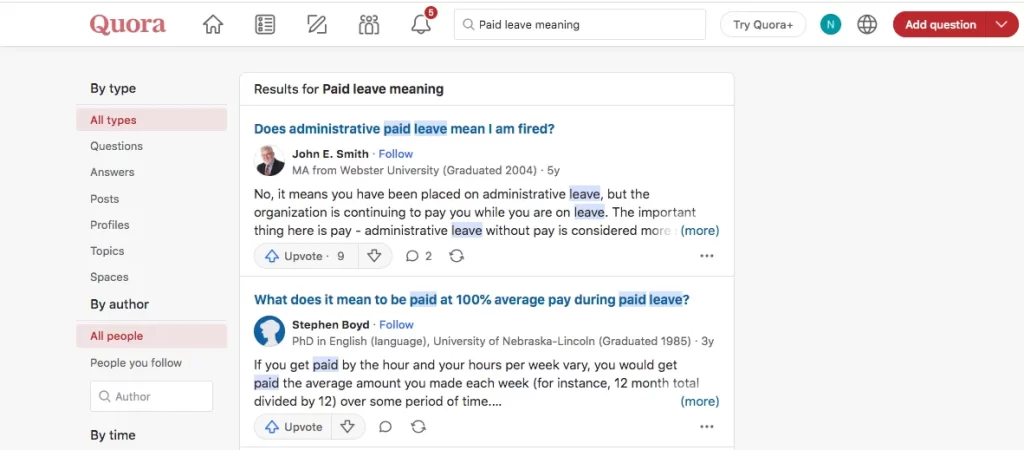
Beyond policies and legal frameworks, everyday conversations about paid leave reveal the real-life perceptions and debates surrounding this benefit. We explored Quora discussions to uncover how people define paid leave.
The Simplicity Behind the Term
At its core, paid leave should be simple, but Douglas Hartman’s post shows that even the basics need clarification.
Hartman writes:
“Two words—‘PAID’ and ‘LEAVE’—which one’s giving you a problem? … PAID LEAVE means the company treats you as if you’re at work and pays you while you’re not.”
Many users echoed this plain definition, cutting through HR jargon to emphasize its essence: time off that doesn’t impact your paycheck.
Country Realities and Legal Baselines
Some Quora users emphasized the real-world implementation in their countries.
Sumitra Mukerji noted:
“Indian employment law mandates a minimum of 15 days paid annual leave… The leave is accrued monthly for employees in service for less than one year.”
Others pointed out that paid leave is shaped more by company policy than government mandates.
Suresh Menon stated:
“As per the law of land, an employee is entitled for leave, after a certain period of work… which are to be paid by the employer.”
Cultural Variations in Attitudes Toward Leave

Some users pointed out cultural nuances often left out of corporate handbooks. For example, Sherry Tarbutton, a former HR VP, noted:
“You may receive paid time away for sick leave or vacation… during the year you may have days away from work… that you are paid.”
Sachin Manchanda tied this to public holidays, explaining:
“Leave given on days like Republic Day, Diwali etc. are paid leaves.”
In countries like India, religious and national holidays are often interwoven into paid leave systems.
Paid Leave as a Perk That Pays You Back
A fresh angle not previously covered in your article is how accumulated leave can have monetary value later at retirement.
Mani Shankar, an HR specialist, explained:
“At the time of retirement, whatever paid leave is accumulated, the company will also pay money equivalent to leftover paid leaves. This is like a perk.”
Similarly, Venkateshh Chitteti shared a practical observation:
“In my MNC, they encash automatically if paid leaves are more than 30.”
This idea of leave as deferred compensation is often overlooked in company presentations.
PTO’s Evolution Through History
A particularly rich post came from Philip Klossner, who explored the roots of paid leave in labor history:
“Vacations and PTO in general were rare before WWII. After that… union membership was at a peak. Employers offered benefits to keep the unions out.”
He continued:
“We’re slowly going the other way… wage and hour violations have been increasing… employees having vacation time on the books but not being allowed to take any of it.”
Klossner’s post acts as a reminder that paid leave is the result of decades of labor negotiations, and its existence isn’t guaranteed.
Employer Costs and the “No Free Lunch” Argument
Not everyone sees paid leave through a purely positive lens. Andy Christian offered a business critique:
“Every benefit you get has to be paid by you… If paid family leave is funded by government, that means massive increases in taxes. If funded by the company, it means lower wages.”
He framed paid leave as a zero-sum equation:
“If I’m paying \$30,000 for an employee, and benefits go up in cost for paid family leave… then I pay you \$28,000.”
Paid Leave = Trust
Quora users hinted at a deeper meaning behind paid leave: trust between employer and employee.
Laura Wilson shared:
“Just what it says. You get paid your regular hourly rate for taking time off… Most professionals start with about 80 hours PTO per year and then more gets added with each year.”
How to Calculate Your Paid Leave Entitlements

Learn the simple formulas and best practices to track and verify every hour or day you’ve earned.
Understanding Accrual Rates and Methods
Most paid leave accrues through one of three methods:
1. **Lump sum allocation**: Receiving your full annual entitlement on January 1st or your work anniversary
2. **Per-pay-period accrual**: Earning small increments each pay period (e.g., 3.33 hours bi-weekly for 10 days annually)
3. **Monthly accrual**: Receiving a set amount monthly (e.g., 0.83 days monthly for 10 days annually)
To calculate your current balance, use this formula:
(Accrual rate × Time worked) – Leave already taken = Current balance
Most modern payroll systems display this calculation on your pay stub, though it’s worth verifying the math occasionally.
Pro-Rating Leave for Part-Time Employees
Part-time employees typically receive proportional paid leave based on their schedule compared to full-time equivalents.
For example, if you work 20 hours weekly (half of standard full-time):
– Full-time entitlement: 10 days (80 hours)
– Your pro-rated entitlement: 5 days (40 hours)
Some companies calculate based on percentage of full-time (50% = 5 days) while others use hours worked (1,000 hours annually might equal 5 days of leave).
Always clarify whether your leave is calculated in days or hours, as this significantly impacts part-time benefits.
What Happens to Unused Paid Leave?
When it comes to vacation time you don’t use, the rules are all over the place. Some places do Rollover, letting you save days for next year, but usually not too many. Others do a Cash-out, where they just pay you for those days, often at the end of the year.
The not-so-nice one is Use-it-or-lose-it, meaning if you don’t take your time by a certain date, it’s just gone. And then there are Hybrid approaches, which are a mix, maybe letting you save some and getting paid for others.
Roughly 56% of companies in the US let you save a few days, but usually only like 5 to 10. And if they pay you for unused time, it’s usually just vacation, not sick days.
Just a heads up, states like California and Montana actually say companies can’t do “use-it-or-lose-it” because they see that vacation time as money you’ve earned, and you can’t just lose money.
Calculating Paid Leave During Notice Periods
When resigning, your final paycheck typically includes payment for accrued, unused vacation time. In most states, this payment is legally required, though policies for sick leave vary widely.
During your notice period (typically two weeks), you may have restrictions on using paid leave. Many companies prohibit taking vacation during notice periods unless previously approved.
For calculation purposes:
– Accrued vacation days × daily rate = Vacation payout
– Some states require inclusion of the cash value of unused sick time
Always check your employee handbook and state regulations before assuming how much paid leave will be included in your final compensation.
5 Real-World Examples of Effective Paid Leave Programs

Discover how leading organizations structure leave to boost satisfaction, retention, and productivity.
Case Study: Tech Industry’s Unlimited PTO Approach
Companies like LinkedIn, HubSpot, and Netflix pioneered the “unlimited PTO” model, which eliminates accrual tracking in favor of flexible time off with manager approval.
Key implementation factors include:
– Minimum usage requirements (LinkedIn encourages at least 10 days annually)
– Manager training to approve requests fairly
– Executive modeling of taking substantial vacation time
Netflix reports 94% employee satisfaction with their unlimited policy, compared to 65% average satisfaction with traditional accrual systems. However, successful implementation requires strong cultural support to prevent the “unlimited means zero” paradox where employees take less time off due to unclear expectations.
Government Sector Leave Benefits Analysis
Historically, government employment offered generous leave benefits to offset typically lower salaries compared to private sector roles.
Federal government employees receive: 13 days of sick leave annually (no expiration), vacation starting at 13 days (increasing to 20 days after 3 years and 26 days after 15 years), 12 weeks paid parental leave (implemented in 2020), and 11 paid federal holidays.
This structured approach provides clear expectations and rewards longevity, with federal employees taking an average of 17.5 days of leave annually, significantly higher than the private sector average of 9.5 days.
Small Business Models for Sustainable Paid Leave
Small businesses often struggle to match corporate leave benefits, but innovative approaches show it’s possible:
Portland-based Basecamp (58 employees) offers:
– 4-day summer workweeks without reducing pay
– 3-week annual paid sabbatical after 3 years
– 16 weeks paid parental leave
Their approach focuses on quality over quantity, with founder Jason Fried noting: “We’d rather have 40 great hours than 60 mediocre ones.”
Small businesses can implement graduated benefits that grow with the company, starting with core offerings like sick time and gradually expanding as finances allow.
How Fortune 500 Companies Structure Leave Policies
Large corporations typically offer comprehensive, tiered leave programs:
American Express provides:
– 20-30 vacation days based on tenure
– 6 months paid parental leave for all parents
– 5 “personal days” separate from vacation time
– Sabbatical program offering 3-6 months partially paid leave after 10 years
Microsoft recently revised their parental leave to 20 weeks for birth mothers and 12 weeks for all other parents, reflecting a trend toward more generous and inclusive policies among top employers.
These companies use sophisticated data analysis showing each dollar invested in paid leave returns $2.50-$3.00 in reduced turnover, higher productivity, and decreased healthcare costs.
International Examples of Progressive Leave Programs
Some of the most innovative approaches originate from international companies.
Sweden’s Spotify offers: 6 months paid parental leave with flexible scheduling over 3 years, global implementation regardless of local requirements, and a “Welcome Back” program easing transition after extended leave.
Australia’s Deloitte provides: 18 weeks paid parental leave for all parents, a career break program allowing 4-12 weeks unpaid leave annually, and cultural and religious leave specifically for observing non-standard holidays.
These companies demonstrate that generous leave policies can work across industries and cultures when supported by intentional implementation and clear values.
Common Questions About Paid Leave Rights

Find clear answers to the most frequent employee concerns and policy exceptions.
Can Employers Deny Your Paid Leave Request?
Yes, employers can legally deny paid leave requests for legitimate business reasons, but not arbitrarily or discriminatorily.
Valid reasons for denial typically include:
– Critical business periods (tax season for accountants)
– Multiple simultaneous requests creating staffing shortages
– Insufficient notice for non-emergency absences
– Patterns of abuse (consistently requesting Mondays/Fridays)
If your request is denied, ask for specific reasoning and consider proposing alternatives like partial days or shifted dates. Document all communications in case you need to escalate to HR or legal authorities.
Most companies use “first-come, first-served” policies for vacation requests, so planning ahead significantly improves approval chances.
How to Request Paid Leave Professionally
Effective leave requests adhere to key best practices: providing appropriate advance notice (minimum 2 weeks for planned absences), submitting requests in writing (even if initially discussed verbally), suggesting coverage plans for your responsibilities, timing requests thoughtfully (avoiding known busy periods), and being flexible with dates when possible.
A professional request might read: “I’d like to request vacation time from July 10-14. I’ve already discussed coverage with Sarah, who has agreed to handle any urgent matters. My key projects will be completed before departure, and I’ll prepare detailed handover notes.” This approach proactively addresses concerns and demonstrates professional consideration.
Dealing with Paid Leave Disputes at Work
If you encounter resistance or denial of legally entitled leave:
1. Review your employee handbook and employment contract
2. Document all communications regarding your request
3. Consult HR for clarification of policies
4. Consider involving your union representative if applicable
5. Research applicable laws in your jurisdiction
For serious disputes, contact your state labor department or the U.S. Department of Labor’s Wage and Hour Division. In cases involving family/medical leave, the EEOC may have jurisdiction.
Remember that retaliation for legally protected leave requests is prohibited, though proving retaliation can be challenging without clear documentation.
Planning Your Finances During Extended Leave
Extended leave often entails reduced income.
Prepare financially by: building a dedicated leave fund covering 1-3 months of expenses, understanding the exact percentage of your salary that continues during leave, researching supplemental benefits like short-term disability, planning for continued health insurance premium payments, and adjusting tax withholding to account for income changes.
For parental leave, investigate state-specific benefits (e.g., California’s Paid Family Leave provides 60-70% of wages for up to eight weeks). Create a leave budget, distinguishing between essential and discretionary expenses.
Navigating Special Circumstances in Paid Leave

Get guidance on handling probationary periods, restructurings, emergencies, and other unique scenarios.
Paid Leave During Probationary Periods
Most companies restrict paid leave during probationary periods (typically 30-90 days), though policies vary widely:
– Some offer immediate access to sick leave but delay vacation eligibility
– Others accrue benefits during probation but prohibit usage until completion
– A minority provide no paid leave benefits until probation concludes
For urgent needs during probation, your options typically include:
– Unpaid time off with manager approval
– Schedule adjustments rather than formal leave
– Using legally mandated sick time where applicable
Always clarify leave eligibility during the hiring process to avoid surprises during your initial employment period.
Managing Leave During Company Restructuring
Company changes like mergers, acquisitions, or downsizing create unique leave challenges:
– Accrued leave typically transfers to acquiring companies
– Policy harmonization may change future accrual rates
– Planned leaves may require reapproval under new management
Best practices include:
1. Documenting all approved leave in writing before restructuring announcements
2. Requesting written confirmation that previously approved leave remains valid
3. Understanding how leave policies will change post-transition
If restructuring includes layoffs, verify whether your state requires payout of all accrued leave or only vacation time.
Emergency Leave Provisions You Should Know
Emergency leave is for sudden, unplanned times you need to be away: family health crises, disasters at your house, or personal safety problems.
Most places don’t have a law for it, but many companies have their own rules, separate from sick days.
They usually ask you to: tell them ASAP. Show papers when you get back. And your boss decides if it’s okay. The pandemic made many places add or expand this, so now 64% have official rules for big unexpected issues.
Paid Leave Options During Global Crises
The COVID-19 pandemic revolutionized crisis-related leave policies. Future-focused companies now maintain:
1. Pandemic/public health emergency leave
2. Natural disaster provisions
3. Civil unrest considerations
4. Extended caregiving options during community emergencies
These policies typically activate based on official declarations from authorities and provide flexibility beyond standard leave programs.
During such periods, documentation requirements are often relaxed, and remote work options may be prioritized over formal leave when feasible.
Conclusion
Understanding your paid leave benefits is essential for protecting your wellbeing and financial health. Take time to thoroughly review your company’s policies, ask clarifying questions, and plan your leave usage strategically.
The landscape of paid leave continues evolving, with more companies recognizing that generous, flexible policies attract and retain top talent while boosting productivity and engagement. As an employee, staying informed about your rights and options empowers you to make the most of available benefits.
Remember that paid leave isn’t just a perk—it’s a crucial component of sustainable work that prevents burnout, supports life transitions, and ultimately contributes to both personal and organizational success.
FAQs About Paid Leave Entitlements and Usage
What’s the difference between PTO and vacation time?
PTO (Paid Time Off) typically combines vacation, sick time, and personal days into one bank. Vacation time is specifically for planned leisure absences. PTO offers more flexibility but may incentivize working while sick to preserve time for vacations.
Can my employer force me to use paid leave?
Yes, in most circumstances. Employers can mandate vacation during company shutdowns or slow periods. However, some state laws restrict how and when employers can force leave usage.
Will I lose my unused vacation days at year-end?
It depends on your company policy and state laws. Some states like California prohibit “use-it-or-lose-it” policies, while others permit them. Check your employee handbook and state regulations for specifics.
How much notice should I give for vacation requests?
Most companies require 2-4 weeks’ notice for vacation time, though longer periods may be needed for extended absences. Emergency or sick leave typically requires notification as soon as reasonably possible.
Can paid leave be revoked after approval?
Yes, though it’s generally considered poor practice. Employers can legally rescind approval for business necessity, though some companies provide compensation if pre-approved leave is canceled, particularly if you’ve made non-refundable travel arrangements.
Is paid leave required by federal law?
No federal law requires private employers to provide paid vacation, sick time, or holidays. Requirements come from state laws, employment contracts, or company policies. The only federal requirement is unpaid leave through the Family and Medical Leave Act (FMLA).
How does paid leave work for remote employees?
Remote employees typically receive the same paid leave benefits as in-office staff. The main difference is often in how time off is requested and tracked, with some companies implementing special systems for remote workers to ensure coverage and availability.
Hire the best candidates
with Wetest.
Create pre-employment assessments in minutes to screen candidates, save time, and hire the best talent.
Try for free