
Professional Ways to Give Feedback to Your Manager
Employee relations
Bonica
April 22, 2025
Offering constructive feedback to your manager is a strategic tool. It drives leadership development and improves overall team performance.
Using professional ways to give feedback to your manager allows employees to contribute to their company’s growth.
You help break down communication barriers that block progress. Feedback shows the importance of communication in the workplace. Mutual respect creates an environment where the manager and team members feel understood.
Giving feedback brings collaborative problem-solving and performance improvement. You should approach these conversations with actionable language. This needs an understanding of proven feedback techniques.
Providing effective feedback is not without its challenges. Many employees struggle with the fear of retribution or the possibility of their feedback being misinterpreted.
These common challenges show the need for strategies and tips that help discuss in a supportive manner.
Feedback changes everyday interactions into powerful opportunities for development.
Key Takeaways
- Constructive feedback strengthens managerial relationships by improving communication and mutual trust.
- Framing feedback with professionalism and empathy ensures that your message is received.
- Providing specific examples makes feedback more actionable.
- Selecting the right moment and setting allows for discussion and avoids reactive responses.
- Creating a culture of continuous feedback allows employees to contribute to development.
Table of Contents
Feedback in Leadership Development

Managers prefer to receive constructive feedback. They understand how to refine their strategies and improve team dynamics.
Feedback as a Catalyst
Managers need good ideas from their teams delivered with clarity and respect. This offers managers a mirror that reflects both strengths and areas for growth.
Techniques like the SBI feedback model or the 360-degree review process allow managers to receive necessary data.
This allows managers to address concerns and improve positive behaviors in their teams. They become better equipped to figure out how to communicate at work.
Evolving Expectations of Leadership
Globalization and technological advancements have shifted employee expectations. Leadership demands have expanded beyond traditional boundaries.
Modern managers are now expected to bring empathy and innovation as components of their leadership style.
This shift has created a fertile ground for professional ways to give feedback to your manager.
Feedback brings constructive criticism along with recognition and encouragement. Using digital platforms and feedback tools simplifies gathering insights.
Managers are encouraged to start feedback conversations and to view these interactions as components of leadership development. They should actively seek out and use employee feedback.
Your Manager’s Perspective

You need to learn about the managerial roles and expectations to give effective feedback. This enriches your communication and fits your ideas with your company’s goals.
Managerial Roles and Expectations
Managers’ roles demand a balance between daily operations and team leadership. Professional ways to give feedback to your manager is a transformative process when you accept that managers are responsible for performance improvement.
They manage numerous tasks. Managers meet deadlines and manage budgets as well as coordinate team efforts. Recognizing these varied responsibilities is the first step.
The pressures managers face are substantial. Resource limits and constant shifts in market dynamics mean that managers work under significant stress.
Your feedback with specific examples shows areas for improvement and validates the hard work your manager is already putting in. Using clear language changes a challenging discussion into a collaborative opportunity.
Managers appreciate feedback that focuses on solutions. You should discuss actionable suggestions and align them with measurable outcomes.
Organizational Goals
Every action must help the overall mission. Show your grasp of the bigger picture and improve the relevance of your feedback.
Start by finding the key performance indicators your manager is tasked with. They can be improving team productivity or customer satisfaction as well as innovative projects.
Your feedback should speak to these objectives to become a tool for change. Using specific metrics or industry benchmarks makes abstract feedback more actionable.
Feedback must be tied to strategic priorities to become more than a personal opinion. This alignment creates a dialogue that is planning for the future and taking action now.
Preparing for the Conversation

Self-assessment is the first step. Reflect on your own experiences and motivations. Set the stage for a constructive dialogue.
Begin by taking stock of your own performance. Analyze both successes and challenges in everyday work scenarios.
This helps you identify instances where communication played a role in improving growth or blocking progress.
Examples make feedback methods more practical and realistic.
Consider the impact of different situations on team performance. Ask yourself! What specific behaviors influenced project outcomes? Answering such questions helps you speak your thoughts with precision.
Define actionable outcomes for your feedback session.
It’s not enough to merely point out areas for improvement. Your conversation should aim to achieve real change. Look for measurable goals that you and your manager can work on together.
Applying feedback conversation tips creates a roadmap for future improvement that benefits the entire team.
Researching Best Practices
Research proven frameworks like SBI and use them. They ensure that your observations are structured.
The SBI model is widely recognized for its capacity to convert subjective opinions into objective ideas.
Start by describing the situation. Outline the specific behavior observed and then detail the impact that behavior had. This approach minimizes ambiguity.
Staying current on feedback trends makes your approach better. Look for articles and case studies as well as industry benchmarks that discuss conversation strategies.
These resources provide examples of how feedback methods have led to measurable improvement. They back up your arguments with data.
This dual focus positions you as a contributor to the team’s success who is knowledgeable about current research.
Creating the Right Environment for Feedback

Strategic timing makes the difference between a constructive discussion and a missed opportunity.
Think about the workflow and recent events that could impact your manager’s mindset. Giving feedback during a high-stress period or after a challenging project is not appropriate. Choose a time when your manager is more relaxed and open to dialogue.
Effective feedback methods discuss the importance of context. Give feedback when it makes sense for the company.
Performance reviews and one-on-ones are good times to give feedback. Timing also relates to the frequency of feedback. Avoid overwhelming your manager with constant input.
Public Praise and Private Coaching
The environment you choose to give feedback to your manager should improve the message and the relationship.
Private feedback sessions are ideal for sensitive issues. These settings provide a safe space for open dialogue. Your feedback is delivered with empathy and without the risk of public embarrassment.
There are instances where public recognition increases the positive impact of your feedback. Praising your manager in team meetings or company meetings helps them become a better leader. Public recognition should be reserved for celebrating successes.
Balancing private feedback with public commendations creates a comprehensive feedback ecosystem.
Communication Strategies for Effective Feedback

Effective communication is essential for giving professional feedback to your manager. If you’re looking to improve your ability to express ideas clearly, consider taking a communication skills test offered by WeTest. This can help you assess and refine your approach, ensuring that your feedback is constructive and well-received. Strong communication fosters better workplace relationships, encourages open dialogue, and leads to meaningful improvements in leadership and team dynamics.
Constructive Criticism vs. Personal Attacks
Constructive feedback is objective and meant to improve performance. Personal attacks ruin conversations and hurt workplace communication.
Begin by clearly outlining the situation and specifying the behavior observed. Detail its impact.
Choose language that is neutral and fact-based. Use phrases like “I noticed” to present your feedback without judgment.
Avoid language that feels like a personal attack. Offer actionable suggestions. You want to contribute to a culture where feedback is seen as a catalyst for change rather than a source of conflict.
Emotional Control and Professionalism

Staying calm and professional under pressure is key to ensuring that your feedback is received in a positive light.
One of the main strategies is to prepare mentally before the conversation.
Engage in stress management techniques such as deep breathing and mindfulness. A brief walk can clear your head.
These methods help you enter the discussion with a balanced mindset.
Emotions sometimes run high in challenging work environments. Anticipate triggers by thinking about previous experiences and identifying moments when emotions influence your tone.
Techniques such as pausing before responding and paraphrasing your manager’s points help maintain a calm atmosphere.
Use phrases like “I understand your perspective” to validate your manager’s feelings when a sensitive topic brings defensiveness.
Neutrality and clarity help reduce the emotional charge of the conversation.
Integrating Technology and Feedback Tools

Digital tools like 360-degree feedback and anonymous surveys provide a structured way to give your manager feedback.
360-degree feedback systems collect performance insights from peers and subordinates as well as supervisors.
This offers managers a well-rounded understanding of their strengths and areas for development.
Platforms like Deel and Mitratech Trakstar are renowned for their 360-degree feedback capabilities.
Anonymous surveys are useful tools. They provide a safe space for employees to share honest ideas without fear.
They uncover issues that otherwise remain unspoken. Survey platforms such as SurveySparrow offer customizable anonymous surveys.
A Quora Rundown
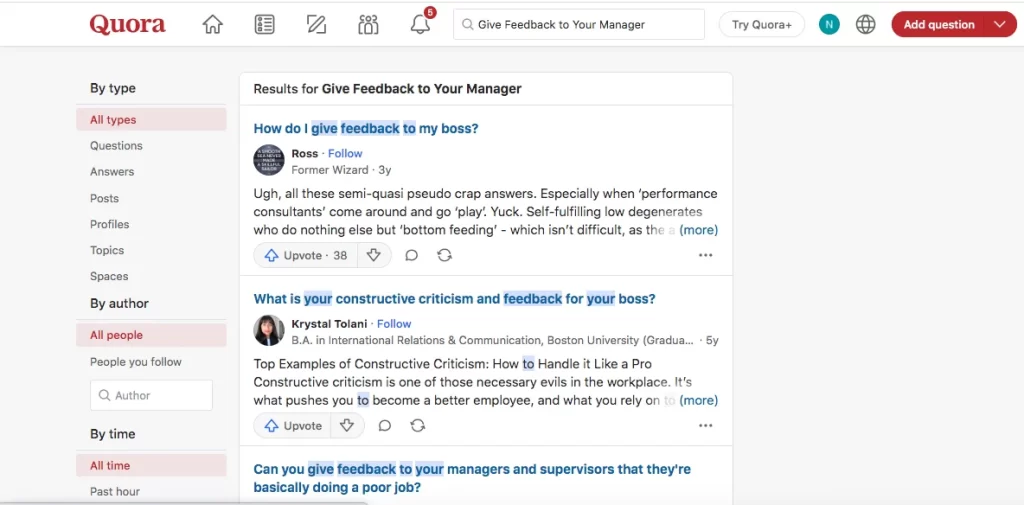
Reading ideas from professionals on Quora offers strategies to approach this challenge effectively.
Establishing Equality
Shekar Rangarajan is a professional coach and business mentor.
He emphasizes the importance of perceiving the relationship between employee and manager as one of equals. He notes: “For effective feedback, both parties should feel and act as equals, like buddies. There has to be equality and status parity. This is a precondition.”
A sense of mutual respect and eliminating hierarchical barriers improves feedback quality.
Focusing Feedback on Specific Issues
Rangarajan also discusses that feedback should be centered on specific issues rather than personal emotions.
He advises, “An effective feedback is issue-driven; not personality or emotion-driven.”
This approach ensures that the feedback remains objective.
Building Rapport
You should build a rapport with your manager before giving feedback.
Rangarajan compares this to administering painkillers before a medical procedure! “When a doctor performs an operation, pain is inevitable. So some painkillers are administered beforehand. Likewise, rapport building and preparatory work are essential.”
Focusing on Strengths

Emphasizing a manager’s strengths is a more effective strategy than focusing on weaknesses. Rangarajan suggests drawing attention to positive attributes.
You should help managers feel more confident and motivated to improve their performance, “A constructive feedback in positive psychology will draw upon fortifying the strengths instead of eliminating the weaknesses.”
Using Facts and Polite Communication
Gary Pennington is a former textile manager. He discusses basing feedback on factual evidence and delivering it politely, “Use facts and do it politely. If they choose to take it personally, that is totally their choice.”
Concrete examples and a respectful tone help give feedback without offending anyone.
Identifying Issues and Offering Solutions
William McLemore is a former systems analyst and trainer. He advises that feedback should not only point out problems, “Any problem expressed must be followed up with a proposed solution.”
This shows you are serious about improvement and teamwork.
Open Dialogue Through Questions

Jerry Pitts is a retired professional. He recommends starting feedback by asking questions that encourage discussion, “It is OK to ask if anyone has thought of doing it a different way… I would like to run it by you to see what you think!”
Face-to-Face Interactions
CellarDoor Production discusses in-person communication, “Face-to-face interactions help to improve morale, and they allow you to dole out constructive criticism in a gentle yet effective way.”
Direct interactions reduce misunderstandings.
Professional Boundaries

Molly Shannon is a former government lawyer. She advises caution when considering giving feedback to a superior, “It is not up to anyone to lecture their boss, and likely will be seen as lack of respect.”
Understanding the appropriate context makes the feedback respectful.
Conclusion
Constructive feedback is a tool for improving managerial relationships and improving a culture of development.
Engaging in open dialogue allows managers and employees to facilitate the company’s success.
Understanding a manager’s perspective and the challenges they face enables more empathetic communication. This awareness ensures that feedback is considerate of the manager’s position.
Engaging in self-assessment and setting clear objectives presents the feedback constructively.
Creating the right environment influences the effectiveness of feedback. Good timing makes people more receptive.
These techniques ensure that the message is understood as intended and reduce the potential for misunderstandings.
Good feedback helps people grow and do their best. Using it well changes how managers and employees work together and helps everyone succeed.
Hire the best candidates
with Wetest.
Create pre-employment assessments in minutes to screen candidates, save time, and hire the best talent.
Try for free