Improving Your Decision-Making Skills: Tips for Better Choices in Life and Work
Leadership
Bonica
January 21, 2025
The ability to make awesome decisions affects our success. It is critical in bringing productivity and innovation to the workplace.
Leaders who make informed choices inspire confidence and lead their company toward growth.
Making good decisions is the key to moving forward and not feeling stuck. It helps you use your time and energy wisely.
Making good choices is about creating chances for yourself and building a future you’re proud of.
Decision-making is sometimes surprisingly difficult! One of the biggest hurdles is information overload.
We are bombarded with endless options and data. This overload leads to analysis paralysis. Having too many choices makes it hard to decide because you’re worried about making a mistake.
Another common obstacle is cognitive bias! We tend to rely on mental shortcuts that cloud judgment. Confirmation bias makes us more likely to believe information that agrees with what we already think.
Emotions make the process more complicated. Stress or fear distort our perspective as well. They make objective evaluation of options difficult.
Knowing what makes it difficult is the first step to making better decisions. We can learn to handle complex situations and avoid biases.
Table of Contents
The Decision-Making Process
Making decisions is like taking steps to go from not knowing what to do to figuring it out and fixing the problem.
The first stage is problem identification. You define the issue that requires a decision. A clear problem statement is the basis for effective action because it helps you focus on the underlying cause instead of just the symptoms.
Next comes gathering information and generating options. You collect relevant data and brainstorm possible solutions. It’s essential to remain open and look for diverse perspectives. These uncover innovative approaches you might not initially consider.

The third stage is evaluating alternatives. You weigh the pros and cons of each option! You should consider factors like feasibility and potential outcomes. Tools like decision matrices and cost-benefit analyses help bring structure to this step.
The fourth stage is making the decision. This step requires confidence and commitment. Balance logic and data with trusting your instincts.
The process concludes with taking action and reviewing outcomes. It’s crucial to have a plan for putting your decision into action. You should think about the results afterward to make better decisions next time.
Strategies to Improve Your Skills
Irrational choices come from unchecked emotions. You should have the ability to recognize your emotions. Are you feeling frustrated or excited? Identifying the precise emotion helps you understand its influence on your thinking.
Studies show that people who label their emotions are better equipped to separate feelings from facts. This reduces the risk of emotional bias.
Realizing that stress is making you think risks are bigger than they are helps you see the situation more clearly. Regularly thinking about your feelings helps you get better at understanding your emotions.
Managing emotions is the next step.

Techniques such as deep breathing and mindfulness exercises help you remain calm under pressure. This allows you to approach decisions with a clearer mind. Pausing for a few moments to focus on your breath stabilizes your emotional state.
Turning negative feelings into positive motivators completely changes how you make decisions. Instead of seeing fear as something that stops you, see it as a reason to get prepared.
Critical Thinking
Thinking logically means looking at situations carefully. You should find patterns and make good conclusions. You need to value evidence and clarity.
Start by breaking complex problems into smaller components. Listing the main factors and possible results as well as contributing factors of a major decision helps you get a clearer picture of the situation.
Using structured thinking methods like deductive reasoning (going from general ideas to specific conclusions) and inductive reasoning (making general conclusions based on specific observations) helps you think more analytically.

Engaging in activities like debates or strategy games also enhances logical reasoning. They challenge you to think critically and anticipate outcomes.
Questioning assumptions is crucial as well. Regularly ask yourself, “Why do I believe this? Is there evidence to support it?”
Using Data and Evidence in Decision-Making
This minimizes guesswork. Begin by finding the information most relevant to your decision.
Be wary of biases or the tendency to prioritize recent information. Focus on comprehensive and balanced evidence. Tools like spreadsheets and statistical software help you visualize data and spot patterns.
It’s also important to seek reliable sources. Verified reports and peer-reviewed studies give you a solid basis for making decisions. Don’t rely too much on personal stories or isolated examples.
Mindfulness and Awareness
It is the practice of fully engaging with the present moment without distraction. This approach is useful when stress or overthinking makes it difficult to make good choices.
Mindfulness improves focus and reduces mental clutter. One effective mindfulness practice is single-tasking. It involves giving your full attention to one task at a time. You should set aside distractions like email or social media to avoid overlooking critical details.
Another technique is mindful observation. You take a step back to assess your thoughts and emotions objectively. You pause and ask, “What’s influencing my thinking right now? Am I being swayed by assumptions?” This moment creates space for rational decision-making.

Meditation and deep breathing are great for dealing with the mental stress that comes with making decisions. Regular meditation improves cognitive flexibility.
Techniques like diaphragmatic breathing activate the body’s relaxation response and reduce tension.
Studies also show that meditation leads to lasting changes in the parts of the brain that control attention.
Diverse Perspectives
Relying solely on your viewpoint leads to blind spots that prevent you from making the best choices. You should expand your understanding of the situation and find solutions you may ignore.
Consulting team members from different departments offer fresh angles.
Seeking advice from friends and mentors is also invaluable. People with diverse experiences often see risks and opportunities that may escape your notice.
Decision-Making Frameworks and Tools
Decision trees are a structured framework that simplifies complex decisions by visualizing options and possible outcomes. They are used in project management and personal planning.
Decision trees help break down choices into manageable steps. They make it easier to evaluate the potential consequences of each option.
A decision tree starts with a central question or decision point. It branches out into different paths that represent possible actions. Each branch includes a corresponding outcome or consequence.

A decision tree outlines scenarios for success and moderate performance as well as failure along with factors like cost and resource allocation.
You can use tools like diagram software or even a simple pen-and-paper approach. They help you create decision trees to bring clarity and structure to your decision-making process.
The Role of Intuition
Intuition provides us with a quick understanding of a situation based on past experiences. While gut feelings guide us toward sound decisions in some cases, they should be balanced with rational analysis.
It is useful when decisions need to be made quickly or when there is limited information.
Relying solely on intuition sometimes leads to errors. There are times when trusting your intuition is both effective and efficient.

Use it for decisions that are repetitive or where you have considerable expertise.
Professionals in fields like medicine or finance may rely on their intuition. Their experience provides them with an internal database of patterns.
Doing research and carefully thinking through the situation makes sure your decision is based on facts and not just a quick feeling.
The Influence of the Hive Mind Mentality
The hive-mind mentality describes how groups tend to prioritize what everyone agrees on over individual thinking when making decisions.
The desire for cohesion and conformity in teams or companies prevents people from thinking objectively.
Collective decision-making mimics the behavior of a “hive,” where individual members are expected to contribute to the overall good but may simply follow the group’s lead instead of expressing their own views.

This brings harmonious outcomes but people don’t speak up if they disagree and everyone just goes along with the majority.
Members feel pressured to align with the majority opinion. Leaders may push forward a strategy due to peer pressure! It’s not necessarily because they have made the best decision.
The Prisoner’s Dilemma
This is a famous example from game theory. It shows the conflict between working together and looking out for yourself.
It involves two people who can choose to work together or go against each other, and what happens depends on what both of them decide.

When both people cooperate, they both benefit. If one person betrays the other, the betrayer benefits more, while the other person suffers. If both betray, they both end up with negative consequences. This situation shows that cooperation often leads to the best result for everyone involved. People can always be tempted to act selfishly in the short run.
The Prisoner’s Dilemma is relevant when cooperation is at play. Both parties may gain more by collaborating, but one may feel tempted to act in their interest and it potentially leads to a less favorable outcome for both.
A Quora Rundown
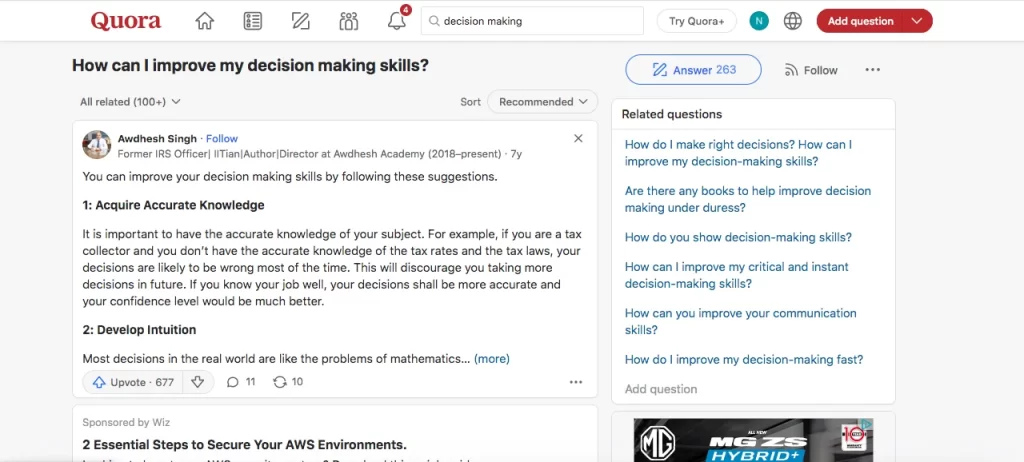
Users on Quora have shared some real-life advice on how to make better decisions. Their comments show how important it is to use your intuition and take risks sometimes.
Knowledge and Experience
Awdhesh Singh is a former IRS officer and author. He thinks that having a good understanding of the situation makes you more confident and helps you make better choices.
Singh values intuition in decision-making. He explains that decisions do not have immediate outcomes.
“Experience is a necessary but not a sufficient condition for good decision-making. Without experience, you can never make good quality decisions.”
He believes that failure and criticism are inevitable in decision-making. In his words, “No risk, no gain.”
Controlling Emotions in Decision Making
Srinath Nalluri draws on a lesson from the Ramayana to show the consequences of emotional decision-making.

He recounts the story of Sita and the golden deer. It symbolizes fleeting desires that lead us to make impulsive decisions. Sita’s desire for the golden deer made her make a bad decision, and that caused her to be separated from Ram.
Nalluri advises regulating emotions in decision-making and not solely relying on feelings. “Control your feelings using your thoughts,” he advises.
Deliberate Decision Making
Brendon Lemon is a business development manager. He brings a structured approach to decision-making called DDM. This method is inspired by Ray Dalio’s principles. You write down the question at the top of a page and then categorize your feelings and relevant data.
Lemon suggests listing your decision principles, such as prioritizing learning and personal growth or only stepping out of your comfort zone.
He believes that the analysis section is where the real power of this method lies. It forces you to compare your instinctual reactions with your deeper decision-making values.
Learning from Failures
Abhishek Kshirsagar shares a powerful lesson about decision-making through the contrasting lives of two individuals. There is a girl who made popular and seemingly “right” decisions against a boy who took what many considered wrong decisions but followed his passion.

Kshirsagar’s story shows how life is not always about making the “right” decision but rather about staying true to oneself and learning from mistakes.
He concludes, “Life is not about making the right decisions, it’s about learning from the wrong ones.”
Conclusion
We’ve explored different strategies to improve decision-making skills. Continuous learning and gaining experience improve your decision-making abilities.
Avoiding quick decisions based on how you feel at the moment and managing your emotions will help you make better choices.
Getting information before making a decision and carefully looking at all the choices makes sure your decisions are based on facts and sound reasoning.
Accept the mistakes as learning opportunities finally lead to growth and fulfillment. Improving your skills needs practice and patience. It’s important to implement these strategies consistently.
Hire the best candidates
with Wetest.
Create pre-employment assessments in minutes to screen candidates, save time, and hire the best talent.
Try for free