
Fixed Salary Means: What It Is and How It Works
Salary guides
Bonica
July 11, 2025
Have you ever asked yourself why some jobs are steady with the money, and then others are just, boom, up and down?
The answer is really about understanding fixed salary structures – and, honestly, it’s one of the most common ways people get paid, but nobody really seems to get it in today’s work world.
So, in this guide, you’re going to find out exactly what fixed salaries even mean, how they’re different from other pay setups, and if this whole compensation thing fits what you want to do with your career.
I’m just going to break down everything, from how they do the math to negotiation stuff, and no complicated jargon, I promise.
If you’re looking at a job offer, maybe thinking about a new career, or just want to understand your current pay package better, this practical guide will give you the knowledge to make smarter moves for your money down the line.
Table of Contents
Introduction to Fixed Salary Structures

How you get your paycheck, that just changes everything. From your daily spending to your big money plans for the future. And with 59% of folks in America just living paycheck to paycheck (that’s from a 2022 LendingClub report), really getting how your compensation works is more important than ever.
In today’s job market, pay comes in all these different forms – hourly, commissions, bonuses, and, yeah, fixed salaries, of course. Each way has different good things, risks, and opportunities that directly mess with your money stability and where your career is going.
So, throughout this whole article, we’re going to check out what makes fixed salaries unique, when they’re a good deal, what their problems might be, and how they’re even calculated. By the end, you’ll totally understand if a fixed salary setup fits your career and money goals.
What Exactly Is a Fixed Salary?

Understanding the components that make up a fixed salary is the first step toward evaluating any job offer.
Definition and Key Components of Fixed Salary
A fixed salary is a predetermined amount of money paid to an employee regularly (typically monthly or bi-weekly) regardless of hours worked or performance metrics. Unlike variable compensation, this amount remains constant throughout the agreed payment period.
The standard fixed salary package typically includes:
– Base salary (the core guaranteed amount)
– Predetermined allowances (housing, transport, etc.)
– Standard benefits (health insurance, retirement contributions)
– Paid time off allocation
For example, if you accept a job with a $60,000 annual fixed salary, you’ll receive approximately $5,000 monthly (or $2,500 bi-weekly) before taxes and deductions, regardless of whether you worked extra hours or met specific performance targets.
How Fixed Salary Differs from Variable Compensation
The key distinction between fixed and variable compensation lies in predictability and performance connection:
Fixed salary provides:
– Consistent payment regardless of hours worked
– Guaranteed income independent of company performance
– Stable earnings unaffected by seasonal fluctuations
Variable compensation offers:
– Earnings tied directly to performance metrics
– Potential for higher income during successful periods
– Greater income volatility based on results
As Brian, a former sales representative who switched to a fixed-salary marketing role, explains: “When I was on commission, I could make double my current salary in a good month, but then barely cover rent in slow seasons. Now with a fixed salary, I can actually plan my life more than two weeks ahead.”
Common Industries That Typically Offer Fixed Salaries
While many industries use mixed compensation models, fixed salaries dominate in:
– Government and public sector roles
– Education and academia
– Healthcare administration
– Corporate middle management
– IT and software development
– Administrative positions
– Non-profit organizations
Industries that typically lean toward variable or mixed compensation include:
– Real estate
– Sales
– Investment banking
– Insurance brokerage
– Entrepreneurial ventures
The Core Benefits of Fixed Salary Arrangements

Knowing these key advantages will help you decide when predictability and stability outweigh variable upside.
Financial Stability: Predictable Income for Planning
The most significant advantage of fixed salaries is the financial predictability they provide. Knowing exactly how much you’ll earn each month allows for:
– Reliable budget planning
– Consistent bill payment scheduling
– Easier qualification for loans and mortgages
– Long-term financial planning with greater confidence
This predictability creates a financial foundation that supports both everyday decisions and major life plans like buying a home or planning for retirement.
Simplified Budgeting for Both Employers and Employees
Fixed salaries streamline financial management for all parties involved:
For employees:
– Clear understanding of monthly income
– Easier tax planning and estimation
– Simplified personal budgeting
For employers:
– Predictable labor costs
– Straightforward payroll processing
– More accurate cash flow forecasting
– Simplified departmental budget management
This mutual simplicity reduces administrative overhead and financial uncertainty for both sides.
Reduced Stress from Income Fluctuations
Perhaps the most underrated benefit of fixed salaries is the psychological relief they provide. A 2021 American Psychological Association survey found that money remains the top source of stress for 72% of Americans.
Fixed salaries help reduce financial anxiety.
They effectively eliminate the “feast or famine” cycle often seen in commission-based roles. This consistent income provides crucial stability during personal challenges such as illness.
It also reduces the pressure to constantly perform solely for basic income needs. Furthermore, fixed salaries contribute to creating clearer work-life boundaries.
This stability allows employees to focus on their work quality rather than constantly worrying about meeting basic financial obligations.
Potential Drawbacks of Fixed Salary Models

It’s equally important to recognize the limitations of a guaranteed paycheck so you can plan around them.
Limited Earning Potential Compared to Commission-Based Roles
The security of fixed salaries comes with a significant trade-off: capped earning potential. While commission-based roles offer theoretically unlimited earnings based on performance, fixed salaries establish a definite ceiling regardless of your contribution level.
This limitation becomes particularly evident in high-growth scenarios:
– A fixed-salary marketing manager watches sales soar from their campaign but receives the same paycheck
– A salaried software developer creates a feature that generates millions but earns no additional compensation
– High performers receive the same compensation as average performers with similar experience
For ambitious professionals in high-performance environments, this ceiling can become both a financial and motivational challenge.
How Inflation Can Impact Fixed Salary Value
Fixed salaries face a silent but powerful enemy: inflation. While your numerical salary remains constant, its purchasing power can decline significantly over time without appropriate adjustments.
Consider these real-world implications:
– With 3% annual inflation, a $50,000 salary effectively becomes worth $43,219 after just five years
– Fixed transportation or meal allowances buy less as costs rise
– Housing costs may increase faster than salary adjustments
This erosion of purchasing power means that without regular cost-of-living adjustments, a fixed salary that initially seemed generous can gradually become insufficient.
Lack of Performance-Based Financial Incentives
Human motivation research consistently shows that direct financial rewards for performance can drive productivity. Fixed salaries remove this immediate connection between exceptional work and financial benefit.
This disconnect can lead to:
– Reduced motivation for going “above and beyond”
– Difficulty retaining top performers without other incentives
– The “coasting” phenomenon where employees do just enough to maintain their position
– Cultural challenges in high-achievement environments
Organizations with strictly fixed salaries often need to create alternative recognition and advancement systems to maintain motivation levels.
How Fixed Salary Calculation Actually Works

Breaking down each element of your pay package reveals the true value of what you’re being offered.
Standard Components in Fixed Salary Packages
A fixed salary typically contains several distinct components that together form your total compensation package:
When you look at your pay, it’s not just one big number; it’s made up of different parts. There’s your Base salary, which is the guaranteed chunk of money you get.
Then you have Allowances, which are extra fixed payments for things like rent, travel, or food. Don’t forget Statutory benefits, those are the things the law says your employer has to pay for, like health insurance or pension stuff.
And of course, your paid time off (vacation, sick days, personal days) all count towards your yearly compensation.
Knowing all these bits is super important when you’re comparing job offers, because two jobs that seem to pay the same “salary” might actually be very different when you add everything up.
The Role of Position Level in Salary Determination
Organizations typically establish salary bands or ranges for different position levels, with several factors determining where in that range a specific employee falls:
– Entry-level positions often have narrow salary bands with limited negotiation room
– Mid-level positions feature wider ranges based on experience and credentials
– Senior positions may have the widest bands, reflecting the varying impact different leaders can have
For example, a marketing coordinator (entry-level) might have a salary band of $40,000-$50,000, while a marketing director (senior level) could see a range of $90,000-$150,000 for the same company in the same location.
How Industry Standards Influence Fixed Salaries
No salary exists in a vacuum – market forces play a crucial role in establishing what’s considered fair compensation for any position. Key industry influencers include:
– Industry profitability (tech typically pays more than education for similar roles)
– Regional cost of living (identical positions pay differently in San Francisco versus Omaha)
– Skill scarcity (specialized roles command premium compensation)
– Current market demand (growing fields offer higher compensation to attract talent)
Companies typically use industry salary surveys, competitor analysis, and market research to establish their salary structures, ensuring they remain competitive enough to attract talent while managing costs.
A Quora Rundown
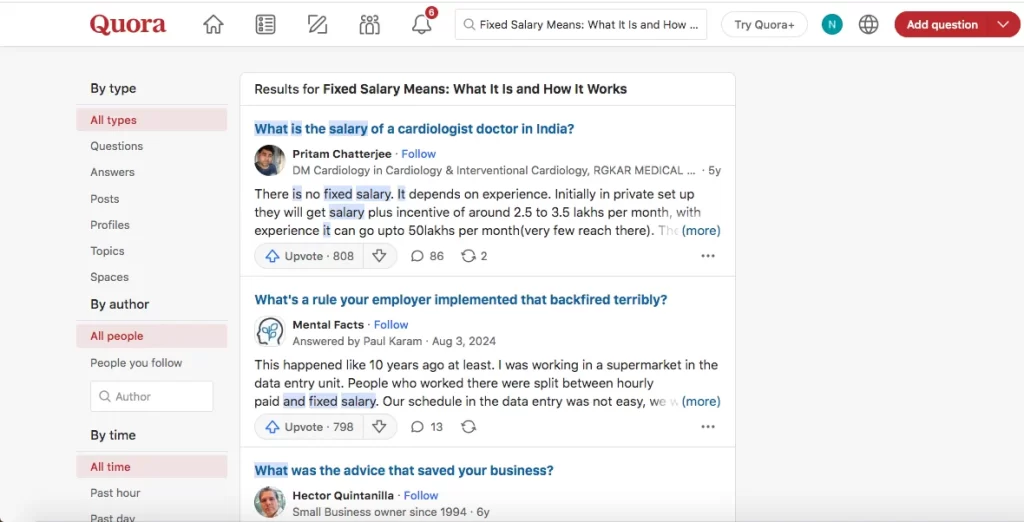
I’ve gathered real insights from Quora users on how fixed and variable pay operate in practice.
Pay Component Breakdown
Divesh Singh offers a granular look at what typically falls into each bucket,
“Fixed pays are Basic, DA, HRA, Conveyance allowance, special allowance, adhoc allowance, medical reimbursement, LTA, etc. Variables pays are DA (if linked to CPI points), incentives, OT, shift allowances, travel allowances, etc.”
Frequency and Structure of Payouts
Several users underscore how timing varies by employer,
Sam (Former PwC Senior Consultant) explains,
“In a 9 LPA package with 7.5 LPA fixed and 20% variable, your ₹62,500 monthly (pre-tax) is guaranteed. The ₹1.5 Lakh variable lands quarterly or yearly, based on performance — and not everyone earns 100% of it.”
Vivek Agarwal shows the quarter‑by‑quarter math,
“If your ₹1,000 monthly package splits as ₹700 fixed and ₹300 variable, and the company pays out 80% of variable this quarter, you receive (0.8×₹300)×3 = ₹720.”
Performance Linkages and Incentives
Many users note that variable pay ties closely to individual and organizational metrics,
Ashley Thompson summarizes the purpose behind mixed structures,
“Companies use fixed plus variable pay to reward strong performance and control costs. Variable elements include bonuses, commissions, or stock options.”
Pankil Tejani (Professor of Accounts) emphasizes performance dependency,
“Variable pay is based on your performance and makes a profit for the company. If your work drives profit, you get that extra payout; otherwise, you don’t.”
Equity and Long‑Term Rewards
Some respondents expand beyond cash components to include equity.
Karen Simon notes hybrid models that add stock incentives,
“An engineer might earn a \$150 K fixed salary plus a 5% bonus if the company performs well or you deliver a standout project.”
Aditya Gupta delves into stock options as part of CTC,
“Equity offers capital growth—high‑growth companies can multiply your vesting value. But there’s default risk: if the company falters, your options could be worthless, and vesting lock‑ins can trap you if you change jobs early.”
Stability vs. Flexibility

Several voices contrast the peace of mind from salary with the flexibility (and potential windfalls) of hourly or commission roles.
Himanshu Rajpal (Lead Business Analyst) argues for a strong fixed base,
“Negotiate high fixed pay. Even with a top performance rating, a struggling company might cut your variable. I once earned 100% rating but got zero variable due to COVID‑19 impacts.”
Andy Christian compares salary to hourly work,
“With salary, you control your schedule—take breaks or leave early if work’s done. Hourly pay locks you into shifts, but offers overtime income if you love extra hours. Managers sometimes earn less than floor staff who clock long shifts.”
Pros and Cons Beyond the Basics
Some users spotlight psychological and practical trade‑offs.
Sethuraman Ramanujam (Military Engineering Services) on fixed pay’s upsides and downsides,
“Pros: predictable planning, routine expenditure covered. Cons: inflation erodes value, static salary breeds mental fatigue, unplanned costs hurt, and watching peers climb faster can be demoralizing.”
Dennis Copeland draws a parallel to fixed‑price contracts,
“Fixed price (salary) works only if both parties share perfect expectations. Otherwise, like under‑bid contractors, employees may do minimum work or walk away when costs outstrip agreed terms. A backup agreement on handling unforeseen issues is crucial.”
Contextual Considerations
Finally, users remind us that context matters.
Mamata Matta (Content Strategist) reiterates variability across organizations,
“Fixed pay is as stated in the offer letter, paid monthly; variable pay arrives quarterly or half‑yearly, depending on company policy.”
Multiple users suggest always clarifying with HR,
Anuj Sharma: “Before joining, ask HR how variable pay is provided, because it depends on team and company performance.”
Fixed vs. Variable: Comparing Different Compensation Models

A comparison shows when you’re better off with security versus incentive‑driven pay.
When Fixed Salaries Make More Financial Sense
Fixed salaries offer distinct advantages under specific career and life circumstances. They are particularly beneficial when you’re establishing financial foundations, such as buying a home or starting a family.
They provide crucial stability during periods requiring significant financial predictability, like paying for education or managing healthcare expenses.
Fixed salaries are also well-suited for roles where individual performance is genuinely difficult to quantify objectively.
They are preferable when work quality takes precedence over quantity or speed. Finally, they appeal greatly to professionals who prioritize work-life boundaries and predictable schedules.
Sarah, a former real estate agent who switched to a corporate marketing role, shares: “I took a 30% pay cut on paper, but after accounting for the stress reduction, consistent income, and benefits package, it was financially and mentally the best decision I’ve made.”
Combining Fixed and Variable Pay: Hybrid Models
Many contemporary organizations have evolved beyond a simple fixed or variable compensation choice, opting instead for hybrid models that blend stability with performance incentives.
A popular approach is Base salary plus bonus, offering guaranteed income supplemented by performance-based additions.
Another model is Salary with commission, which provides security alongside incentives for exceptional results.
Some companies implement a Fixed salary with profit sharing, directly connecting compensation to overall company success. Additionally, Tiered salary progression creates predictable advancement pathways based on clear metrics.
These hybrid approaches attempt to capture the benefits of both systems while minimizing their respective drawbacks.
5 Questions to Consider When Choosing Pay Structures
When evaluating which compensation structure best fits your needs, ask yourself:
1. How important is predictable income to my current life situation?
2. Am I comfortable with income that fluctuates based on performance or market conditions?
3. Does my personality thrive on incentive-based motivation, or do I prefer stability?
4. What are my current financial obligations and how would irregular income affect them?
5. How does my industry typically structure compensation, and what are the implications of choosing an atypical model?
The answers to these questions will help clarify which compensation structure aligns best with both your financial needs and work style preferences.
Fixed Salary and Career Advancement Opportunities

In a fixed‑pay world, your growth often hinges on strategic reviews and well‑timed negotiations.
Negotiating Salary Increases in Fixed Pay Structures
Without built-in performance increases, negotiating raises in fixed salary environments demands strategic preparation.
You should document your achievements quantitatively whenever possible. It’s crucial to research current market rates for your position and experience level. Timing is key, so negotiate around annual reviews or upon completing major projects.
Focus your pitch on value added rather than personal needs. Finally, always be prepared with specific numbers and solid justification.
Unlike commission structures, where earnings naturally rise with performance, fixed salary environments require proactive negotiation to ensure your compensation keeps pace with your contributions and experience.
Performance Reviews and Their Impact on Fixed Salaries
In fixed salary structures, performance reviews gain heightened importance as the key mechanism for salary advancement.
These reviews typically connect directly to annual adjustment decisions. Consequently, documentation becomes crucial for effectively demonstrating your value.
Utilizing objective metrics helps to strengthen your position in salary discussions. Furthermore, the feedback received directly influences both promotion timing and movement within salary bands.
While commission-based roles see performance reflected immediately in compensation, fixed salary positions generally connect performance to compensation on an annual cycle through this review process.
Career Progression Paths with Fixed Compensation
Fixed salary environments typically structure career advancement through clearly defined ladders.
Promotions from junior to mid-level often follow predictable timelines, accompanied by standard increases. However, senior advancement usually necessitates specific position openings rather than automatic progression.
In some cases, lateral moves may be required before vertical advancement becomes possible. Additionally, specialized skills development can establish alternative advancement paths.
Understanding these progression patterns helps set realistic expectations and develop appropriate career strategies within fixed salary environments.
Legal and Tax Implications of Fixed Salaries

Knowing your rights and obligations ensures you fully benefit from and comply with salary regulations.
Tax Considerations for Employees with Fixed Income
Fixed salary earners face distinct tax planning considerations compared to those with variable income.
A key advantage is that withholding is more predictable, leading to a reduction in surprise tax bills. Consequently, tax bracket planning becomes more straightforward.
This stability also allows for retirement contribution strategies to be established with greater confidence. Furthermore, deduction planning is simplified due to known income levels.
This predictability allows for more precise financial planning but may also mean fewer opportunities for tax optimization compared to self-employed or variable compensation structures.
Employer Responsibilities in Fixed Salary Arrangements
Employers utilizing fixed salary structures carry specific legal obligations.
These include compliance with minimum salary thresholds for exempt employees and ensuring proper classification of workers as exempt or non-exempt.
They must also maintain consistent application of salary increases and adjustments. Furthermore, clear documentation of salary decisions is essential to prevent discrimination claims.
Finally, adherence to pay transparency laws in applicable jurisdictions is mandatory.
These responsibilities create a framework that protects both employers and employees in fixed salary arrangements.
How Fixed Salaries Affect Benefits and Entitlements
Your chosen salary structure has a direct impact on various benefits and entitlements. Fixed salaries typically qualify you for full benefits packages.
Retirement contribution matching is usually calculated as a percentage of your fixed salary. Disability insurance benefits are generally based on your fixed salary amounts.
Paid time off accrual is typically tied to your fixed salary level and tenure. Lastly, the unemployment benefits calculation uses your fixed salary history.
Understanding these connections helps you evaluate the true value of your compensation package beyond just the salary figure.
Is a Fixed Salary Right for Your Career?

Weighing your personal risk tolerance and financial needs will guide you to the best compensation choice.
Assessing Your Financial Needs and Risk Tolerance
Choosing the right compensation structure heavily relies on your personal financial situation and your comfort with uncertainty.
For individuals with high fixed expenses, such as a mortgage or student loans, a fixed salary may be more appropriate. Conversely, substantial emergency savings can make variable compensation a less risky option.
When facing family financial responsibilities, the value of predictable income often increases. It’s important to remember that risk tolerance varies significantly between individuals, even in identical financial situations.
Honestly evaluating your financial needs and comfort with income fluctuation provides essential context for making compensation structure decisions.
Industry-Specific Considerations for Salary Structures
Different industries have established distinct compensation norms that influence both job availability and candidate expectations.
For instance, Creative fields often blend project-based fees with retainer arrangements. Technology frequently combines moderate base salaries with equity compensation.
Healthcare typically offers strong fixed salaries with limited variable components. In contrast, Financial services commonly feature lower base salaries with significant performance bonuses.
Understanding your industry’s typical structures helps set realistic expectations and identify unusual opportunities or red flags in compensation offers.
7 Questions to Ask Before Accepting a Fixed Salary
Before committing to a fixed salary position, consider asking:
1. How frequently does the company typically review and adjust salaries?
2. What criteria are used for determining raises and promotions?
3. Does the organization offer any performance-based bonuses or incentives?
4. How has the company handled compensation during previous economic downturns?
5. What is the typical career progression timeline in this department?
6. How does this offer compare to market rates for similar positions?
7. What additional benefits complement the base salary?
The answers to these questions provide crucial context that helps evaluate whether a fixed salary aligns with your career and financial goals.
Conclusion
Fixed salaries offer predictability, stability, and simplicity that many professionals value highly, especially during certain life stages. However, they also come with limitations in earning potential and may be vulnerable to inflation over time.
The ideal compensation structure varies widely based on your industry, career stage, financial circumstances, and personal preferences. By understanding the mechanics, benefits, and limitations of fixed salary arrangements, you can make more informed decisions about which opportunities align with your unique needs.
Rather than viewing any compensation structure as inherently superior, consider how each option fits your current situation and future goals. The right structure for you provides not just financial support, but also motivation, appropriate risk levels, and alignment with your preferred work style.
Hire the best candidates
with Wetest.
Create pre-employment assessments in minutes to screen candidates, save time, and hire the best talent.
Try for free