Understanding Reimbursement Collaboration Meaning in Business and Healthcare
Business strategy
Bonica
August 12, 2025
Reimbursement collaboration is a big change in how organizations handle getting money back.
Understanding teamwork isn’t just a nice-to-have; it’s a must. Organizations that really nail collaborative reimbursement can speed up their processing times by as much as 67%, according to recent reports.
What does that mean for you? Better cash flow, lower office costs, and stronger relationships with everyone you work with.
Throughout this guide, we’ll show you how reimbursement collaboration works in both business and healthcare.
We’ll also cover the tech that’s making it all happen and give you practical steps to put these collaborative plans into action in your own organization. Let’s dive into why this new way of thinking is changing how modern organizations handle getting paid.
Table of Contents
What Is Reimbursement Collaboration: Key Definitions Explained

Reimbursement collaboration means forming a smart partnership for expense recovery. It’s a big step away from traditional, separate methods, pushing for teamwork, common goals, and connected systems.
The Core Elements of Effective Reimbursement Processes
Effective reimbursement collaboration rests on several key pillars:
1. Streamlined Data Flow: When organizations connect their data platforms, they achieve 42% faster reimbursement cycles than those with unlinked systems.
2. Accessible Guidelines: All stakeholders can easily access and understand the documented policies and procedures.
3. United Vision: All parties involved agree on their key priorities, project timelines, and individual responsibilities.
4. Seamless System Interoperability: Technology systems are designed to reduce error rates.
5. Outcome Measurement: Agreed metrics are used to evaluate overall results.
Organizations build better reimbursement systems when these pieces click together.
How Collaboration Transforms Traditional Reimbursement Models
Reimbursement has been a one-way street: you submit, they approve, they pay. That old structure often just creates tons of operational inefficiencies and big stress points.
But collaborative models completely reinvent this dynamic by pushing for: shared responsibility (where everyone involved takes ownership), open communication (setting up ways to share info proactively), inclusive design (building processes with comprehensive user input), automation with technology (using tech for routine tasks), and full transparency (making sure every step is visible).
Organizations trying these collaborative models see a 37% jump in how happy their stakeholders are and disputes getting resolved 29% faster.
5 Critical Differences Between Cooperation and Collaboration
Many organizations mistake basic cooperation for true collaboration. Here’s how they differ in the reimbursement context:
- How Deeply You Work Together: Cooperation means working alongside each other; collaboration means working as one integrated team with shared systems.
- What You’re Aiming For: Cooperation is about individual goals that just happen to line up; collaboration means setting common goals together right from the start.
- Sharing What You Have: In cooperative setups, resources stay separate; collaborative approaches mean pooling resources for everyone’s benefit.
- Who Decides What: Cooperation keeps decisions individual; collaboration means making decisions together.
- Owning the Process: With cooperation, each party owns their part; in collaborative systems, everyone shares ownership of the whole process.
Grasping these differences helps organizations move past just “working together” to build a truly game.
The Evolution of Reimbursement Systems in Business Settings

Corporate reimbursement has evolved dramatically over the past few decades:
- 1970s-1980s: Everything was on paper, and getting approvals could take weeks of manual work.
- 1990s-2000s: We started seeing early computer systems, but they mostly stayed within single departments and didn’t really talk to each other.
- 2010s: Cloud-based tools began showing up, letting us track things in real-time and see much more clearly.
- Present Day: Now, API-driven platforms make it super easy for different departments, vendors, and financial systems to connect seamlessly.
This change really mirrors how businesses are becoming less rigid and using more team-based approaches across different departments.
How Digital Transformation Has Reshaped Reimbursement Processes
Digital transformation has fundamentally altered reimbursement landscapes:
Mobile submission apps have reduced documentation time by 76% compared to paper systems. Cloud-based approval workflows now enable decisions in hours instead of days. Real-time dashboards provide visibility into reimbursement status at any point in the process.
Perhaps most importantly, digital tools have enabled true collaboration by removing information silos and creating single sources of truth for all stakeholders.
Case Studies: Successful Business Reimbursement Collaboration Models
This is where we look at actual cases of companies nailing the whole reimbursement collaboration thing.
Global Consulting Firm Implementation
A Fortune 500 consulting firm redesigned its reimbursement system to connect consultants, project managers, and finance teams through a unified platform. The result: 68% faster reimbursement cycles and 42% reduction in disputed expenses.
Manufacturing Supply Chain Example
A manufacturing company created a collaborative vendor reimbursement portal that integrated with supplier systems. This approach reduced reimbursement processing costs by 31% and strengthened vendor relationships.
These examples demonstrate how thoughtfully designed collaborative systems deliver measurable improvements over traditional approaches.
Healthcare Reimbursement Collaboration: A Specialized Approach

Healthcare reimbursement faces unique challenges that demand specialized collaborative approaches:
- Tricky Rules: Healthcare organizations have to deal with a constantly changing maze of compliance requirements.
- Lots of Players: Patients, doctors, insurance companies, and government groups are all involved in getting reimbursed.
- Detailed Paperwork: Getting paid depends on very specific and detailed medical records.
Exact Coding: Healthcare reimbursement really relies on using the right codes to describe the services given.
These factors create a complex environment where collaboration becomes not just beneficial but necessary for survival.
How Providers and Payers Navigate Collaborative Frameworks
Forward-thinking healthcare organizations are totally creating these collaborative frameworks designed to: set up pre-service verification protocols to minimize claim denials, make shared coding resources that benefit both providers and payers, implement joint technology solutions for streamlined claims processing, and develop mutual performance metrics focused on patient outcomes.
These strategies really show a crucial move from the traditionally “us vs. them” relationship between providers and payers to a more cooperative partnership model that, ultimately, helps all involved parties.
The Impact of Value-Based Care on Reimbursement Structures
Value-based care models have accelerated the need for reimbursement collaboration in healthcare:
- Shared Risk Arrangements: Providers and payers now share financial risk, creating natural incentives for collaboration.
- Quality Metrics Alignment: All parties must agree on how quality is measured and rewarded.
- Data Sharing Requirements: Effective value-based care demands transparent information exchange between stakeholders.
Organizations that excel in collaborative approaches show 23% higher performance on value-based contracts compared to those using traditional reimbursement models.
7 Benefits of Implementing Collaborative Reimbursement Models

Seven key advantages can transform healthcare finance.
Improving Cash Flow Through Streamlined Processes
It drastically cuts the average reimbursement cycle time by a remarkable 47%, which is a big deal.
This approach also lowers rejection rates due to proactive communication, meaning less back-and-forth. It helps you identify and resolve payment issues much faster.
Plus, it creates predictable payment schedules, greatly enhancing your financial planning.
Companies using these collaborative models report getting paid an average of 12 days faster compared to traditional methods.
Reducing Administrative Burden and Processing Costs
The administrative savings from collaborative reimbursement are substantial:
- Staff Time Reduction: Organizations report 35% fewer hours spent on reimbursement processing.
- Error Reduction: Collaborative systems show 61% fewer errors requiring correction.
- Automation Opportunities: Shared platforms enable automation of up to 70% of routine reimbursement tasks.
These efficiencies translate directly to bottom-line savings, with organizations reporting administrative cost reductions between 27-41%.
While modern reimbursement stacks increasingly run on cloud infrastructure, optimizing their overhead is critical evaluate leading cloud cost management software for 2025 to monitor usage, curb overspend, and channel savings into automation and compliance initiatives.
Enhancing Transparency Between Stakeholders
Transparency benefits all parties in the reimbursement process:
For submitters, transparency means knowing exactly where their reimbursement stands. For approvers, it means clearer visibility into upcoming payment obligations. For financial teams, it provides better forecasting data for cash management.
This transparency reduces friction, builds trust, and creates a foundation for ongoing process improvement.
Building Stronger Business Relationships Through Collaboration
Perhaps the most significant benefit is the strengthening of key business relationships:
• Vendor Relationships: Suppliers consistently rank reimbursement efficiency among their top factors for preferred customer status.
• Employee Satisfaction: Staff satisfaction scores improve by 29% when reimbursement processes are perceived as efficient and fair.
• Partner Trust: Organizations with collaborative reimbursement models report 37% higher trust scores from business partners.
These relationship improvements extend far beyond the reimbursement process itself, creating broader business benefits.
A Quora Rundown
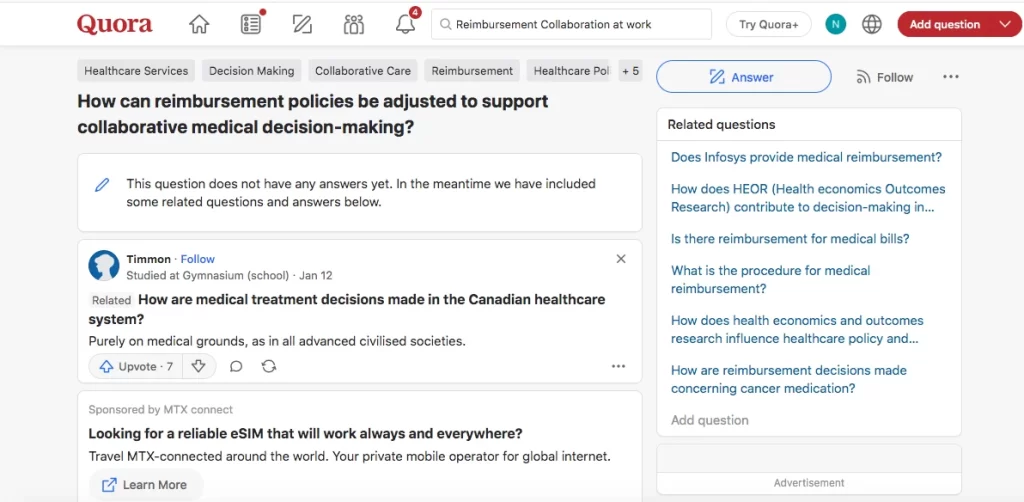
I’ve synthesized perspectives from Quora users on various facets of reimbursement in both business and healthcare contexts.
Employer-Funded Reimbursement Arrangements
Several users emphasize how employers structure reimbursements to attract and retain talent, especially in the U.S.
Tax-Exempt Medical Reimbursement (India)
Bhanita Sarmah notes that,
“Medical Reimbursement is an arrangement under which employers reimburse the portion of the health expenses incurred by the employee. The Income Tax Act allows tax exemption of up to INR 15,000 on medical reimbursements paid by the employer.”
Health Reimbursement Arrangements (U.S.)
Katherine Torres explains,
“A health reimbursement arrangement (HRA) is an employer-funded health benefit used to reimburse employees for out-of-pocket medical expenses and health insurance premiums. Some HRAs are offered as an alternative to traditional group health coverage…”
Network vs. Non-Network Dynamics
Users describe how network affiliations shape reimbursement flows and patient experiences.
Dynamic Hospital Tie-Ups
Dinesh Jain clarifies that,
“if a person is getting hospitalized and his insurance company has tied up with that hospital, then all the claims will be settled by the insurance company… This is called Cashless.” Conversely, non-network care triggers reimbursement, where “the insured has to pay the hospital bill at the time of discharge and then… submit the bills… on the basis of which… the insurance company pay it back.”
Prior Authorization for Non-Network Care
Prakash S adds that “after prior approval of the insurer… the insured is permitted to undergo treatment in the said hospital, the insurer arranges for the reimbursement of the bills.”
This shows how collaborative pre-service protocols can mitigate unexpected out-of-pocket expenses.
Complexity in Provider Reimbursement Processes

Healthcare providers face a journey to payment, far beyond simple expense repayment.
Five-Step Claim Lifecycle
Bhanita Sarmah lays out a detailed five-step process for providers.
1. “Document the details necessary for payment…”
2. “Assign medical codes…”
3. “Submit the claim electronically…”
4. “Interpret the payer’s response…”
5. “Prepare for post-payment audits.”
International and Industry-Specific Variations
Reimbursement isn’t a one-size-fits-all concept; geography and industry nuances matter.
No Reimbursement in Single-Payer Systems
Ronald J Brown points out that “No one in Canada is ‘reimbursed’ for medical expenses. Canadian citizens… do not pay anything when they receive medical care…”
His observation reminds us that reimbursement frameworks must adapt to public healthcare systems.
Medical Device Reimbursement in the U.S.
Kelvin Ning dives into device-specific reimbursement,
“For an in-patient procedure, the hospital is only allowed a single DRG to cover what they do… The remaining 40%… is supposed to cover any associated Medical Devices used in the procedure.”
This shows how device manufacturers, hospital finance teams, and payers negotiate cost allocations.
Simplifying the Patient Experience
End-users often struggle with the administrative burden of reimbursement.
Mitzi Friedland Kotler observes that “you pay for the service… and after you send the receipts… you will be repaid… In some cases you will only receive a predetermined amount, not necessarily the entire cost.”
This shows patient frustration with unpredictable coverage limits and the importance of transparent communication from insurers to subscribers.
Common Challenges in Reimbursement Collaboration Implementation

A big hurdle in reimbursement collaboration is often getting data to work together.
Overcoming Data Integration and Sharing Obstacles
Data integration represents the most frequently cited challenge in implementing collaborative reimbursement:
• Legacy System Limitations: Many organizations struggle to connect older systems with modern collaborative platforms.
• Data Standardization Issues: Different stakeholders often use incompatible data formats and definitions.
• Security Concerns: Sharing financial data raises legitimate security and privacy questions.
Successful organizations overcome these challenges by:
1. Implementing API-first integration strategies
2. Establishing clear data governance frameworks
3. Creating phased approaches that tackle high-value integration points first
4. Leveraging middleware solutions to connect disparate systems
Addressing Compliance Concerns in Collaborative Models
Compliance requirements often seem at odds with collaborative approaches:
• Documentation Requirements: Regulatory standards may dictate specific documentation processes.
• Approval Hierarchies: Compliance may require certain approval sequences that seem to conflict with streamlined workflows.
• Audit Trails: Maintaining proper records across integrated systems presents challenges.
Leading organizations address these concerns by designing compliance requirements into collaborative processes from the beginning rather than treating them as afterthoughts.
How to Navigate Competing Priorities Between Partners
Different stakeholders naturally bring different priorities to reimbursement processes:
Finance teams prioritize accuracy and cost control. Operations teams value speed and simplicity. External partners focus on predictability and communication.
Successful collaborative frameworks explicitly acknowledge these differing priorities and create systems that balance competing needs rather than allowing any single perspective to dominate.
Technology’s Role in Advancing Reimbursement Collaboration

Digital tools empower today’s reimbursement systems.
Essential Digital Tools for Modern Reimbursement Systems
Several technology categories have become essential for effective reimbursement collaboration:
Chief among these are Mobile Submission Applications. They enable users to capture expense data flexibly with built-in policy guidance.
Equally important are Workflow Automation Platforms, which direct approvals using intelligent rules rather than being limited by strict organizational charts.
To ensure seamless data exchange, Integration Middleware bridges the gap between disparate systems without requiring full replacements.
For a clear understanding of operations, Analytics Dashboards provide real-time tips into process performance and potential holdups.
Communication Tools are crucial for enabling discussions related to specific reimbursements directly within the process flow.
Organizations with these capabilities in place report 53% higher satisfaction with their reimbursement processes.
How AI and Automation Transform Collaborative Processes
AI and automation are revolutionizing reimbursement collaboration:
This includes Intelligent Document Processing, where AI can extract data from receipts and invoices with an impressive 99% accuracy.
Beyond that, Anomaly Detection uses machine learning to identify any odd patterns that might suggest errors or fraud.
Predictive Analytics allows AI to forecast future reimbursement volumes and timing, which helps in allocating resources more effectively.
And to assist users, Virtual Assistants (chatbots) are on hand to answer common questions and guide them through the submission processes.
These technologies reduce manual intervention requirements by up to 73% while improving accuracy and compliance.
Blockchain Applications in Secure Reimbursement Collaboration
Despite still being new, blockchain technologies are bringing some very promising uses to how we work together on reimbursements.
They offer Immutable Audit Trails, meaning every transaction and approval gets a record that simply can’t be changed.
They also let us use Smart Contracts, which automatically make a payment when specific things happen.
And a big part of it is Decentralized Verification, allowing for secure checks without needing one central group to approve everything.
Early adopters report significant improvements in trust between parties and dramatic reductions in disputed reimbursements.
Best Practices for Establishing Effective Collaboration Frameworks

Building strong collaboration involves developing clear reimbursement policies.
Developing Clear Reimbursement Policies and Guidelines
Successful collaboration starts with crystal-clear policies:
1. Use simple language that all stakeholders can understand
2. Provide concrete examples that illustrate proper application
3. Make policies easily accessible through multiple channels
4. Create decision trees for common scenarios
5. Establish regular review cycles to keep policies current
Organizations with clearly documented policies report 43% fewer disputed reimbursements and 27% faster processing times.
Building Cross-Functional Teams for Better Outcomes
The makeup of reimbursement teams has a big impact on how well they work together.
You need to have people from all the different groups involved in how things are planned and put into action. Getting support from leaders in multiple departments is also really important.
Creating roles that connect different parts of the organization can help a lot.
Holding regular meetings where different teams review things together keeps everyone on the same page. And, it’s key to notice and reward people when they work well with others.
Teams structured this way deliver 39% better adherence to reimbursement timelines compared to siloed approaches.
Creating Metrics to Measure Collaboration Success
Effective measurement drives continuous improvement:
Process Metrics:
• Cycle time from submission to payment
• First-pass approval rates
• Exception handling time
• System availability and performance
Outcome Metrics:
• Stakeholder satisfaction scores
• Administrative cost per transaction
• Error rates and correction costs
• Compliance audit results
Leading organizations review these metrics in cross-functional settings to identify improvement opportunities and celebrate successes.
The Future of Reimbursement Collaboration: Emerging Trends

A major part of the future of reimbursement collaboration involves understanding how AI will transform reimbursement models.
How Will AI Transform Reimbursement Models?
AI is going to completely change how we work together on reimbursements in a few big ways.
Systems are going to become Hyper-Personalized, meaning they’ll adjust workflows based on what each user has done before and their habits. This will lead to Autonomous Processing, where regular reimbursements just go through with almost no one needing to touch them.
AI will also be able to perform Predictive Issue Resolution, spotting problems before they even happen. And instead of filling out forms, we’ll have Natural Language Interfaces that let us talk to the system.
Organizations should prepare for these changes by building flexible architectures that can incorporate AI capabilities as they mature.
Predictions for Cross-Industry Collaboration Growth
The next frontier involves collaboration that spans traditional industry boundaries:
• Healthcare-Employer Integration: Direct connections between healthcare providers and employer reimbursement systems.
• Financial Institution Embedding: Banks becoming active participants in reimbursement workflows rather than just payment processors.
• Government-Private Sector Platforms: Shared systems that streamline interactions between businesses and regulatory agencies.
These cross-industry models will create entirely new efficiency opportunities while challenging traditional organizational boundaries.
Preparing Your Organization for Coming Changes
To ensure future success, organizations must proactively engage in several key actions.
They should begin by evaluating their current reimbursement process maturity against leading collaboration best practices.
Next, it’s essential to identify the most beneficial collaboration opportunities with key stakeholders.
A vital step is to assess technology platforms for their adaptability and integration potential. Furthermore, organizations need to nurture talent that possesses both detailed process knowledge and a collaborative spirit.
They must develop governance structures capable of evolving alongside their maturing collaboration models.
Those who prepare now will be positioned to capture significant competitive advantages as reimbursement collaboration continues to evolve.
Conclusion
Effective reimbursement collaboration isn’t just about technology or process—it’s about fundamentally rethinking how different stakeholders work together to achieve shared goals. Organizations that master this approach gain significant advantages in efficiency, relationships, and financial performance.
Start by identifying one high-impact area where collaboration could improve your current reimbursement processes. Bring together representatives from all stakeholder groups, establish clear success metrics, and implement changes with a commitment to continuous improvement.
Remember: the most successful reimbursement collaboration strategies balance structure with flexibility, technology with human relationships, and efficiency with proper controls. By applying the principles outlined in this guide, you’ll be well-positioned to transform reimbursement from a necessary business function into a strategic advantage.
Hire the best candidates
with Wetest.
Create pre-employment assessments in minutes to screen candidates, save time, and hire the best talent.
Try for free